An AI model that performs well during a pilot may face a very different set of challenges in production. As more employees and applications begin using it, demand for computing resources increases, response times become more critical, and infrastructure needs grow.
Now consider an enterprise running several AI applications simultaneously. A customer-facing assistant needs fast, consistent responses. A retrieval-augmented generation (RAG) application must access enterprise information before answering questions. Analytics teams need to process large datasets, while deep learning teams require sustained computing power to train and fine-tune models.
Each workload places different demands on the underlying infrastructure. When they operate within the same environment, simply adding GPUs may not address every performance challenge.
This is where enterprise AI servers become central to an AI factory. Rather than treating each application as a separate infrastructure project, enterprises need a coordinated foundation of compute, memory, storage, networking and workload management that can support AI applications as they move into production.
Why AI Factory Infrastructure Needs More Than GPU Capacity
Moving from AI experimentation to production changes how infrastructure must perform. A server that handles a single model successfully may not deliver the same experience when applications face growing user demand or compete for resources.
Understanding the requirements of each workload is therefore the first step towards designing the right AI infrastructure.
LLM inference: delivering consistent performance at scale
During development, running a large language model successfully is an important milestone. In production, the bigger challenge is serving requests consistently as the number of users increases.
An enterprise AI assistant, for example, may need to respond to hundreds of requests while maintaining acceptable response times.
Performance depends on several factors, including model size, available GPU memory, context length, request concurrency and the efficiency of the inference software.
Infrastructure teams must therefore look beyond whether a model fits into GPU memory. They need to assess how quickly the system responds, how many requests it can process simultaneously and whether performance remains acceptable during peak demand.
RAG: connecting model performance with enterprise data
Retrieval-augmented generation allows AI applications to use information retrieved from enterprise data sources when generating responses.
Consider an employee asking an AI assistant about an internal policy. Before responding, the application searches relevant information sources, retrieves suitable content and passes that context to the language model.
Depending on the implementation, the process may also involve creating query embeddings and reranking retrieved information for relevance.
Each stage adds requirements beyond LLM inference. Retrieval systems need efficient access to indexed data, while the model must process the additional context before generating a response.
A powerful GPU cannot compensate for every bottleneck in this process. Slow retrieval, inefficient data access or excessive context processing can still affect the user experience. Equally, accurate responses depend on the quality of the retrieved information, not just infrastructure performance.
For enterprise RAG, the entire retrieval and generation pipeline must be considered when planning infrastructure.
Analytics and deep learning: managing different compute demands
Enterprise AI is not limited to conversational applications.
Analytics workloads may process large datasets to identify patterns, support forecasting or generate operational insights. Depending on the application, these tasks can place significant demands on CPUs, system memory, storage throughput or GPUs.
Deep learning training and fine-tuning introduce a different challenge. These workloads can require sustained GPU compute, large amounts of accelerator memory and efficient communication between GPUs.
When long-running training jobs share infrastructure with latency-sensitive inference applications, resource contention can affect performance.
This makes workload scheduling, capacity planning and resource isolation important. Enterprises need to determine which applications can share resources efficiently and which require dedicated capacity.
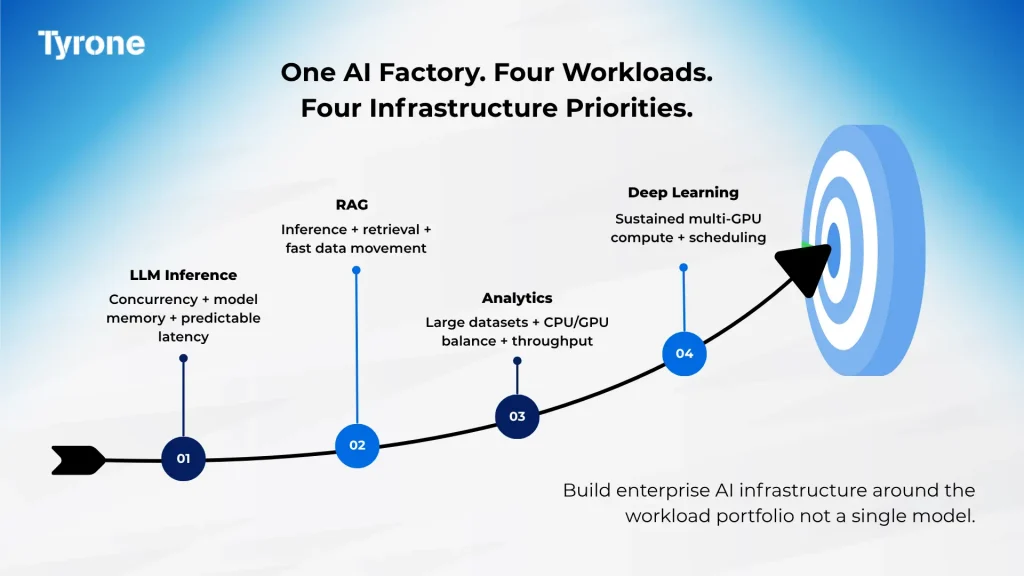
The following table summarises the main infrastructure priorities across these workloads.
| Workload | Primary Infrastructure Pressure | AI Factory Design Priority |
| LLM inference | Latency, concurrency, model memory | GPU capacity, memory, predictable serving |
| RAG | Inference + retrieval + data movement | Fast storage/networking and integrated data path |
| Enterprise analytics | High-volume data processing | CPU/GPU balance, memory and storage throughput |
| Deep learning | Long-running parallel compute | Multi-GPU density, memory, scheduling and power |
| Mixed AI services | Competing workload classes | Resource isolation, orchestration and scale-out planning |
Designing Enterprise AI Infrastructure for Production
Once workload requirements are understood, the next decision is how to translate them into server architecture.
The objective is not necessarily to deploy the highest possible GPU count. It is to create an infrastructure environment in which compute, memory, storage and networking work together to meet application requirements.
Choose GPU capacity based on actual workload needs
Different AI applications require different levels of acceleration.
An inference application serving a smaller model may perform effectively with a modest GPU allocation. Larger models, greater concurrency or demanding training workloads may require multiple accelerators.
However, adding more GPUs does not automatically improve performance. The available GPU memory, communication bandwidth between accelerators, software configuration and workload characteristics all influence how effectively additional compute can be used.
Infrastructure planning should begin with measurable requirements such as expected user concurrency, model size, response-time targets and training frequency.
This helps enterprises determine whether to use higher-density servers, expand capacity across multiple nodes or combine both approaches.
Balance GPU performance with memory, storage and networking
GPU capacity is only one part of the infrastructure equation.
System memory supports data preparation and other CPU-side operations. High-performance NVMe storage can help reduce delays when loading datasets, model files and training checkpoints.
Networking becomes particularly important when applications need to access external storage, retrieval systems or other compute nodes.
For example, a RAG application may have sufficient GPU resources for language model inference but still experience delays if its retrieval layer cannot deliver the required information efficiently.
Similarly, distributed deep learning workloads may be constrained by communication between accelerators or servers.
A balanced architecture ensures that investment in GPU compute is supported by the resources required to use it effectively.
Build the server layer into a wider AI factory architecture
As AI adoption expands, infrastructure teams must manage more than hardware performance.
Multiple teams may need access to shared GPU resources, while applications have different requirements for availability, security and performance.
An AI factory approach brings compute resources together with storage, networking, orchestration, monitoring and operational controls.
Workload scheduling helps allocate resources according to application needs. Monitoring provides visibility into utilisation and performance, while resource isolation helps prevent competing workloads from disrupting critical services.
This also allows enterprises to plan infrastructure expansion around existing and anticipated demand rather than treating every new AI application as a separate deployment.
Tyrone Camarero Series: supporting diverse enterprise AI requirements
With different AI workloads placing different demands on infrastructure, enterprises need server configurations that can be aligned with their computing requirements.
The Tyrone Camarero Series offers GPU-optimised server options designed for demanding computing environments, including AI and deep learning applications.
Across the series, organisations can evaluate configurations with different accelerator capacities, CPU resources, system memory options, storage capabilities and expansion support.
These capabilities are relevant to enterprises deploying LLM inference, RAG, analytics and deep learning workloads. For instance, GPU memory and accelerator capacity are important when sizing language model inference, while training-intensive environments may also require greater GPU density and suitable interconnect capabilities.
The right configuration depends on how the applications will operate. Model size, request volumes, data requirements, performance targets and future capacity needs must all be considered before selecting hardware.
By evaluating the Camarero Series as part of a wider AI factory architecture, infrastructure teams can align server capabilities with current workloads while planning for future AI growth.
| Explore how the Tyrone Camarero Series can support enterprise AI infrastructure, LLM inference, RAG, analytics and deep learning workloads: https://tyronesystems.com/servers/Latest_Generation.php |
Conclusion: build infrastructure around the AI workload portfolio
Enterprise AI infrastructure decisions become more complex as organisations move from isolated pilots to production applications.
LLM inference requires predictable serving performance. RAG depends on efficient retrieval and generation. Analytics demands effective data processing, while deep learning training requires sustained computing capacity.
Supporting these workloads requires more than selecting powerful GPU servers. Enterprises must consider how compute, memory, storage, networking and workload management function together.
By adopting a workload-first approach and selecting suitable server configurations from solutions such as the Tyrone Camarero Series, organisations can build a stronger foundation for expanding their enterprise AI capabilities.
| Planning an enterprise AI factory? Talk to a Tyrone AI infrastructure specialist about workload mapping, server density and production AI architecture. |
Frequently Asked Questions
What is an AI factory?
An AI factory is an integrated infrastructure and operating model that brings together accelerated computing, data, storage, networking, software and governance. It provides a coordinated environment for developing, deploying and operating AI workloads at scale.
Why do LLM inference and RAG need enterprise AI servers?
LLM inference requires sufficient compute and GPU memory to process requests while meeting performance targets. RAG adds data retrieval and context processing to the workflow. Enterprise AI servers provide the computing resources needed to support these applications, while the wider infrastructure must also address storage, networking and retrieval performance.
How are AI servers different from general-purpose servers?
AI servers are designed to accommodate demanding accelerated computing workloads. They support specialised GPU hardware alongside the necessary CPU resources, memory, expansion bandwidth, power delivery and cooling. These capabilities make them suitable for applications such as AI inference and deep learning training.
Can the same AI factory infrastructure support analytics and deep learning?
Yes. A properly designed AI factory can support analytics, inference and deep learning within a shared infrastructure environment. However, different workloads may require separate resource allocations or dedicated compute capacity. Effective scheduling, capacity planning and resource isolation help maintain performance across applications.