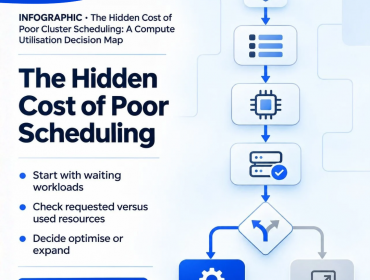
Poor cluster scheduling creates a gap between the computing resources an organisation has and the capacity its workloads can actually access. Jobs may remain in queues even when parts of the cluster are underutilised, resulting in longer turnaround times, inefficient resource allocation and unnecessary pressure to invest in additional infrastructure. Understanding this gap requires looking beyond overall utilisation to how workloads request resources and how the scheduler allocates them. The following decision map outlines six key areas to examine before deciding whether to optimise existing capacity or expand the cluster.
A Decision Map for Better Compute Utilisation
A long HPC queue does not automatically mean the organisation needs more servers. When compute sits idle while jobs continue to wait, teams need a structured way to determine whether the problem is genuine capacity pressure or the way existing resources are being requested and scheduled.
1. Start With the Queue — Begin by asking what the waiting workloads actually need. If demand is higher than total capacity across the cluster, expansion may be justified. But a queue can also form because jobs require a specific resource type, memory profile or node count that is currently scarce. Queue composition gives the first clue about the real constraint.
2. Check Requested vs. Used Resources — Oversized CPU, memory or accelerator requests reduce scheduling flexibility. A job may reserve substantially more capacity than it consumes, preventing other workloads from fitting around it. Comparing requested resources with observed use helps teams improve job profiles and creates more opportunities for the scheduler to use available capacity efficiently.
3. Look for Fragmented Capacity — Free resources may exist but not in the combination required by the next job. For example, spare CPUs can be distributed across several nodes while a workload needs a larger contiguous allocation. Fragmentation explains why a cluster can show unused capacity in aggregate while specific queues still experience long waits.
4. Review Priority Rules — Queue policy should reflect workload urgency, fairness and resource fit. Production jobs, research workloads, short tests and long simulations may need different treatment. If priority rules no longer match the workload mix, smaller or time-sensitive jobs can be delayed unnecessarily even when the cluster has room to process them.
5. Check Node Health — Installed capacity is not the same as usable capacity. Nodes that are unhealthy, under maintenance or unavailable reduce the pool the scheduler can actually use. Monitoring node health helps teams understand whether queue pressure comes from rising demand or from infrastructure that has temporarily fallen out of service.
6. Decide: Optimise or Expand — Once queue behaviour, requests, fragmentation, priority policy and node health have been reviewed together, the team can make a more defensible decision. If existing capacity is poorly matched to demand, optimisation may help. If the environment is already being used deliberately and delays remain, expansion becomes easier to justify with evidence. Tyrone Cluster Manager lists workload management and graphical monitoring in both editions, with a dynamic workload manager in TCM Advanced. Those documented capabilities can support the operating view behind this decision map. The objective is to understand why capacity is idle or why workloads are waiting, then address the real bottleneck rather than defaulting immediately to new hardware.
Get in touch info@tyronesystems.com