A GPU cluster can be expensive and yet challenging to use efficiently. AI training jobs, inference workloads, simulation and research applications may all compete for the same accelerator pool, while GPU memory requirements, job duration and user priorities vary widely. GPU Cluster Management provides the operating discipline needed to understand where accelerators are available, how workloads are queued and whether expensive GPU resources are producing useful work.
The challenge is broader than assigning a GPU to a job. Effective GPU Resource Management depends on workload visibility, queue policy, utilisation data, user or project allocation and the health of the underlying cluster. Infrastructure teams need to connect those signals before they can decide whether a GPU shortage is real, whether scheduling is inefficient or whether workloads need a different resource profile.
What Effective GPU Cluster Management Needs to Make Visible
Effective GPU Cluster Management depends on having a clear picture of how accelerator resources are being used, where capacity constraints exist and why workloads are waiting. Looking beyond basic utilisation metrics helps infrastructure teams identify resource bottlenecks, improve workload placement and make informed capacity decisions. The goal is to connect infrastructure visibility with actual workload performance and operational outcomes.
Availability is not the same as usable capacity
A cluster may have free GPUs, but the next workload may need a specific GPU type, memory capacity, node topology or multi-GPU configuration. Teams need visibility that goes beyond total accelerator count. The useful question is whether the right GPU resources are available for the workload that is waiting.
Queue time needs context
A long GPU queue can come from genuine demand, oversized resource requests, priority rules or fragmented capacity. Looking only at overall GPU utilisation can hide these differences. Operators need to connect queue behaviour with resource requests and job characteristics to understand why workloads are waiting.
Utilisation should be linked to outcomes
High accelerator utilisation can be positive, but it is not the only target. A cluster running inefficient jobs at high utilisation may still deliver poor economics. Teams should look at utilisation alongside throughput, queue time, job completion, failed jobs and the business or research value produced by the workload.
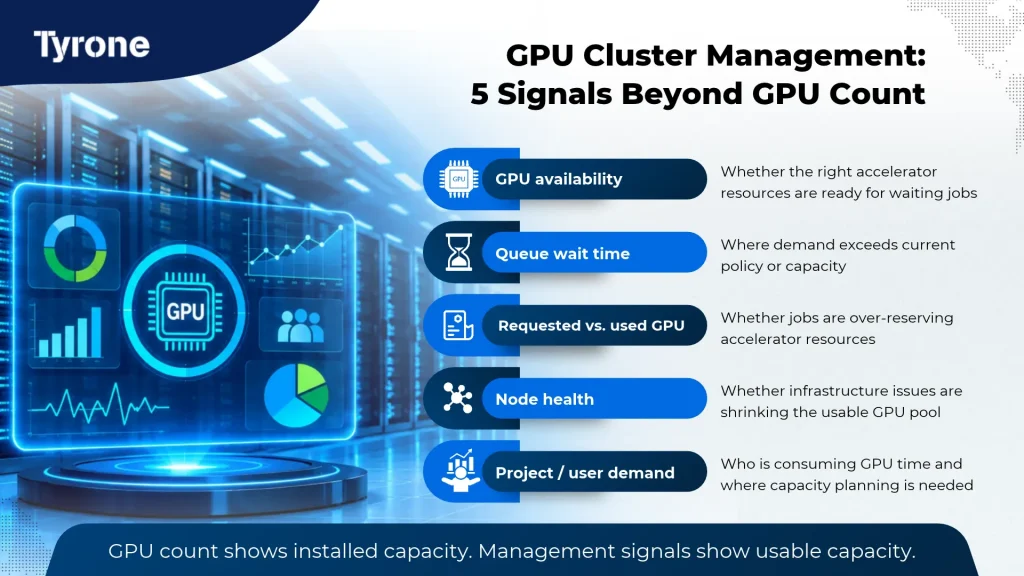
| GPU Management Signal | Question to Ask | Why It Matters |
| GPU availability | Are the required GPU types and memory available? | Total free GPUs may not match workload needs. |
| Queue wait time | Why are GPU jobs waiting? | Separates capacity gaps from policy or fragmentation issues. |
| Requested vs. used resources | Are jobs reserving more GPU capacity than they consume? | Improves scheduling flexibility and cost awareness. |
| Node / cluster health | Is unavailable infrastructure shrinking the GPU pool? | Installed GPU count may exceed usable GPU count. |
| Project or user demand | Who is consuming GPU time and for which workloads? | Supports accountability and capacity planning. |
Building a Better GPU Resource Management Operating Model
Effective GPU resource management requires more than simply making accelerators available to workloads. Organisations need a structured operating model that balances resource allocation, workload visibility, infrastructure efficiency and cost accountability. By establishing clear governance and combining cluster-level management with GPU-specific monitoring, teams can improve utilisation, reduce resource contention and build a scalable foundation for AI and HPC workloads.
Define allocation rules before demand spikes
GPU access becomes contentious when several teams move from experimentation to regular usage at the same time. Organisations should define project priorities, queue rules and resource limits before the cluster becomes saturated. The objective is to make allocation policy predictable rather than negotiated job by job.
Pair cluster-level visibility with GPU-specific telemetry
Cluster management and GPU telemetry solve related but different problems. The cluster layer can show node health, workload status and resource availability, while GPU-specific tooling may be needed for accelerator utilisation, memory, thermals, partitioning or other device-level metrics. Teams should design the monitoring stack so those views can be interpreted together.
Bring cost accountability into the utilisation conversation
GPU infrastructure carries significant capital and operating cost. Teams should understand which projects consume GPU time, where queues are forming and whether capacity is being used for the workloads that justify the investment. This is where GPU Resource Management intersects with FinOps-style questions about ownership, cost and value.
Where Tyrone Cluster Manager fits — and what the product page does not claim
The published TCM feature set includes scalable cluster deployment and management, workload management, graphical monitoring, node health checks and dynamic provisioning, with a dynamic workload manager in the Advanced Edition. These are relevant foundations for operating a cluster that contains GPU resources. However, the TCM page does not document GPU-specific scheduling, GPU partitioning, device-level GPU telemetry or GPU cost accounting. Organisations that require those functions should validate the full software stack separately rather than assuming they are included in TCM.
| Explore Tyrone TCM as the cluster provisioning, workload-management and monitoring foundation: https://tyronesystems.com/platform/tcm.php |
Conclusion: manage GPUs as shared infrastructure, not isolated accelerators
GPU Cluster Management is an operating-model problem. The hardware needs to be visible, workloads need clear allocation rules and teams need enough data to distinguish genuine shortages from poor placement or fragmented demand. A strong cluster foundation helps coordinate the infrastructure, while GPU-specific tools and policies complete the resource-management layer required for AI and HPC workloads.
Frequently Asked Questions
What is GPU Cluster Management?
GPU Cluster Management is the operational process of coordinating shared GPU infrastructure across users and workloads, including visibility, allocation, queues, health and utilisation.
What is GPU Resource Management?
GPU Resource Management focuses on how accelerator capacity is assigned, monitored and used across projects, jobs or users in a shared environment.
Why can GPU queues stay long when some GPUs are idle?
Waiting jobs may require a different GPU type, more memory, a multi-GPU topology or a resource combination that is not currently available, even when other accelerators are free.
Does TCM document GPU-specific management features?
The TCM page documents cluster deployment, workload management, graphical monitoring, node health checks and provisioning. It does not specifically document GPU scheduling, GPU partitioning or device-level GPU telemetry.