A cluster can be “highly available” and still lose hours of application work. Ask these questions before a failure answers them for you.
Resilience Depends on Knowing Which Layer Is Failing
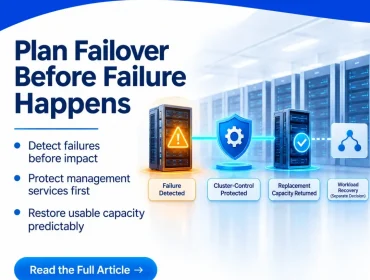
“High availability” is only meaningful when teams know exactly which layer is protected and what happens after a failure. Management services, compute nodes, storage dependencies and application jobs can all fail differently, so recovery planning needs specific answers rather than a single availability label.
1. What exactly is protected? — Start by separating the management plane, scheduler, compute nodes, storage paths and application workloads. Each layer can require a different resilience mechanism. A design that keeps management services available does not automatically protect a running simulation, and node redundancy does not necessarily address a storage or authentication failure.
2. How is failure detected? — Recovery begins with visibility. Health checks and monitoring should identify failed or degraded components quickly enough for administrators or automated processes to act. Slow detection extends the outage window and can allow unhealthy resources to remain in rotation, causing repeated workload failures or reducing effective capacity without a clear explanation.
3. Can the management plane stay available? — Administrators still need to see and control the cluster during an incident. If the management interface or scheduling services disappear at the same time as the failed node, diagnosis and recovery become harder. High Availability for the management layer therefore needs to be evaluated separately from the availability of individual compute resources.
4. How fast can failed capacity return? — Teams should document the steps needed to repair or replace a failed node, rediscover it, reprovision the environment and validate that it is safe to return to service. A repeatable node-recovery process makes recovery time more predictable and prevents important steps from depending entirely on administrator memory during an incident.
5. What happens to running jobs? — Infrastructure recovery and application recovery are not the same thing. Some workloads can restart from the beginning, others rely on checkpoints, and some require manual resubmission or application-specific logic. The expected recovery path should be agreed with application owners before production workloads depend on the cluster.
6. Which dependencies sit outside the compute node? — A node can be healthy while the workload still fails because storage, networking, identity or another shared service is unavailable. Resilience planning should map those dependencies explicitly so teams know which external systems can interrupt execution and who owns the recovery process for each one.
7. When was recovery last tested? — A failover plan that has never been exercised is still an assumption. Testing reveals timing gaps, ownership confusion and hidden dependencies that documentation may miss. Different workload classes should be tested separately because a short batch job, a long simulation and an interactive service may each require a different recovery objective. Tyrone Cluster Manager Advanced Edition explicitly lists High Availability, and the TCM page documents node health checks plus workflows for replacing failed nodes and returning them to action. The page does not document automatic job restart or migration, so job-level recovery should be validated separately. Reliable resilience comes from matching each layer with a tested recovery path.
7 Questions to Ask Before Trusting Cluster Failover and Recovery
“High availability” is only useful when teams know what it protects. Management services, nodes and application jobs can all require different recovery mechanisms. These seven questions help infrastructure teams test whether their resilience plan is specific enough for real HPC failures.
Get in touch info@tyronesystems.com