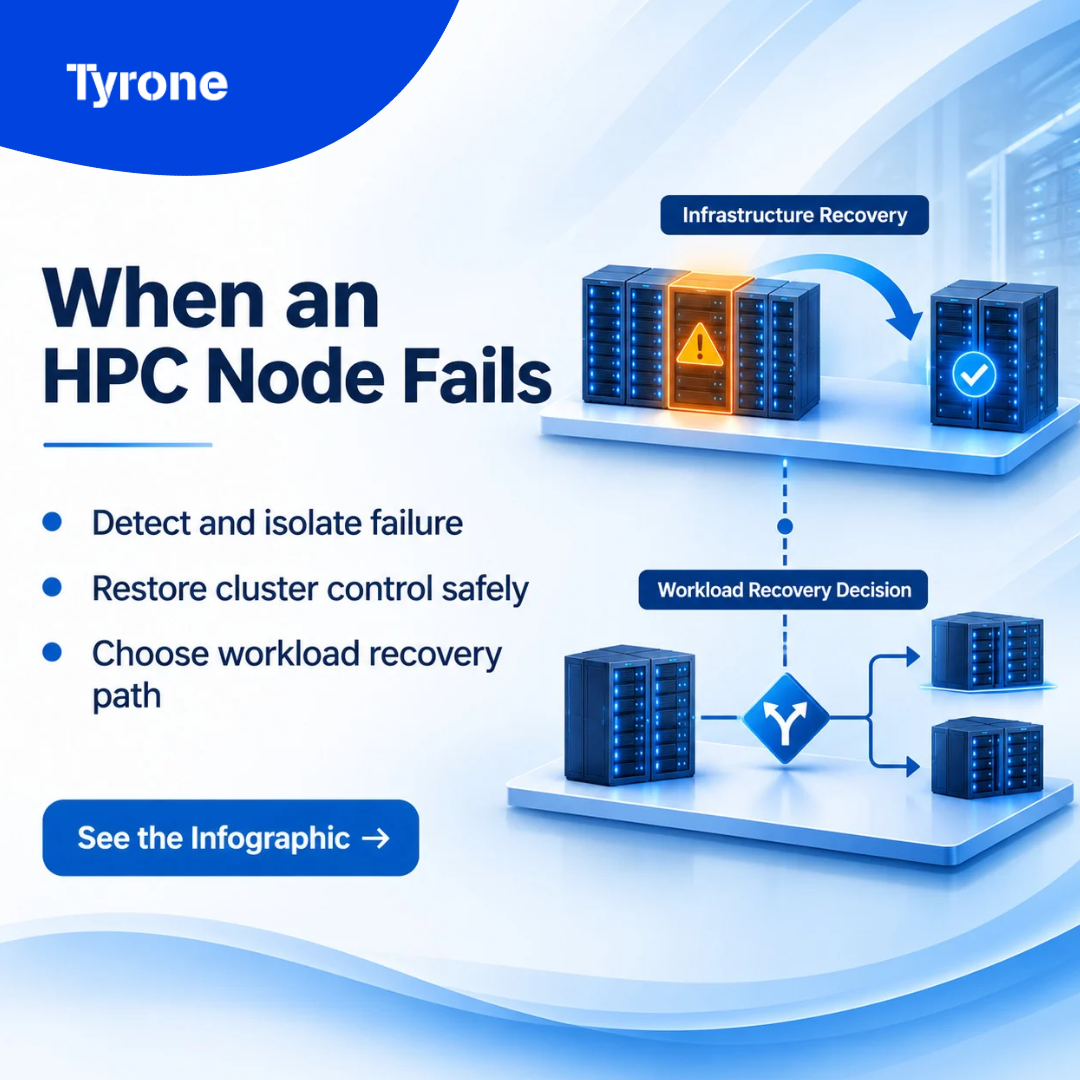
When an HPC node fails, the impact can extend beyond a single compute resource, disrupting running workloads, reducing cluster capacity and delaying critical operations. A successful recovery depends on more than restoring the failed hardware; it requires a coordinated approach that protects cluster availability, preserves workload state wherever possible and brings affected applications back into service with minimal disruption. Understanding how each recovery decision affects workload continuity helps HPC teams respond faster, reduce operational risk and build more resilient infrastructure.
From Failure Detection to Application Recovery
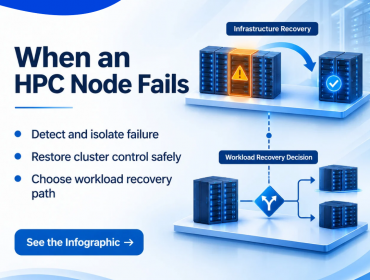
When an HPC node fails, the recovery path crosses several layers. The right response is not simply to restart the job; teams first need to identify the failed component, preserve control of the cluster, restore healthy capacity and then decide how the affected workload should continue.
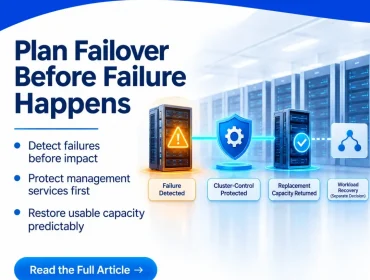
1. Detect the Failure — Health checks and central monitoring should identify the affected node or service as quickly as possible. Detection is the starting point because an unhealthy resource can reduce effective capacity or cause repeated job failures if it remains active. Clear visibility also helps administrators distinguish a node issue from a broader storage, network or service problem.
2. Protect Cluster Control — Management and scheduling services need to remain available so administrators can coordinate the incident. If cluster control is lost alongside the failed node, teams may have limited visibility into remaining capacity or workload state. Keeping the management plane operable gives the recovery process a stable control point even while part of the infrastructure is unavailable.
3. Isolate the Affected Capacity — An unhealthy node should be removed from active use until it is safe to return. Isolation prevents new work from being placed onto a resource that may fail again or corrupt results. It also gives the operations team a clear boundary between healthy capacity that can continue serving users and the component that needs intervention.
4. Restore the Node — The next step is to repair or replace the hardware, rediscover the node, reprovision the required environment and validate that it is ready for workloads. A repeatable recovery workflow reduces variation between incidents and shortens the path from hardware intervention to usable compute capacity.
5. Decide the Workload Path — Returning the node does not restore the application state that existed before the failure. The affected workload may restart from the beginning, resume from a checkpoint or require manual resubmission depending on the application and scheduler. That behaviour should be understood in advance, especially for long-running or business-critical jobs.
6. Test and Improve — After service is restored, teams should measure detection time, isolation time, capacity-restoration time and the time required for the workload to return to a useful state. Those results expose the slowest part of the recovery chain and give teams evidence for improving procedures, application resilience or infrastructure design. Tyrone Cluster Manager Advanced Edition explicitly lists High Availability, while the TCM page documents node health checks and a workflow for replacing failed nodes and returning them to action. It does not state that application jobs are automatically restarted or migrated. Workload continuity is strongest when infrastructure recovery and application recovery are planned and tested as connected but separate layers.
Get in touch info@tyronesystems.com