GPU-optimised computing is changing how developers, researchers and HPC teams think about productivity. The question is no longer only how much compute an organisation owns. It is how quickly teams can access that compute, run containers, test workloads, move between desktop and cluster environments and convert research friction into usable output.
India’s national compute ambitions are also growing. News On AIR reported in February 2026 that a national-scale AI supercomputer with 8 exaflops of peak compute capacity is planned in India, roughly 19 times the combined 410 AI petaflops of AIRAWAT and PARAM Siddhi-AI. This points to a broader shift: AI and HPC productivity will increasingly depend on infrastructure that is accessible, scalable and developer-ready.
Why productivity is now an infrastructure metric
Developer productivity in AI and HPC is often lost in small delays: environment setup, dependency mismatch, slow testing cycles, resource queues, data movement and inconsistent runtime environments. These delays can make powerful infrastructure feel distant from the teams that need it most.
A GPU-optimised supercomputer approach reduces this gap by bringing accelerated computing closer to the workflow. When developers can work with GPU-accelerated containers, validated frameworks and HPC applications more easily, they spend less time managing infrastructure friction and more time improving models, simulations and applications.
How GPU-optimised computing reduces friction
The productivity gain comes from combining compute, software and workflow readiness. GPUs provide acceleration, but the surrounding environment decides how useful that acceleration becomes. Developers need access to frameworks, containers, libraries, job scheduling and performance visibility. HPC teams need cluster-level performance without forcing every user into complex manual setup.
This is especially relevant when AI and HPC workloads overlap. Researchers may need notebooks, containers and interactive environments. Engineers may need simulation tools. Data teams may need GPU-accelerated pipelines. A productive infrastructure model should support all of these without creating separate silos.
Traditional development vs GPU-accelerated productivity
| Area | Traditional Development Environment | GPU-Optimised Productivity Stack |
| Setup | Manual dependency and tool configuration | Preconfigured containers and validated environments |
| Compute access | Delayed by queues or fragmented machines | Local workstation or cluster-level GPU access |
| Performance | CPU-bound workflows and longer test cycles | Accelerated compute for AI and HPC workloads |
| Collaboration | Inconsistent environments across users | Standardised frameworks and repeatable workflows |
| Scaling | Difficult jump from desktop to cluster | Pathway from workstation to GPU cluster performance |
Improve developer and research productivity with Tyrone GPU Optimised Supercomputer and Kubyts powered workstations and clusters. Explore GPU-accelerated containers, AI frameworks and HPC application support: https://tyronesystems.com/products/gpu-optimised-supercomputer.php
From workstations to clusters
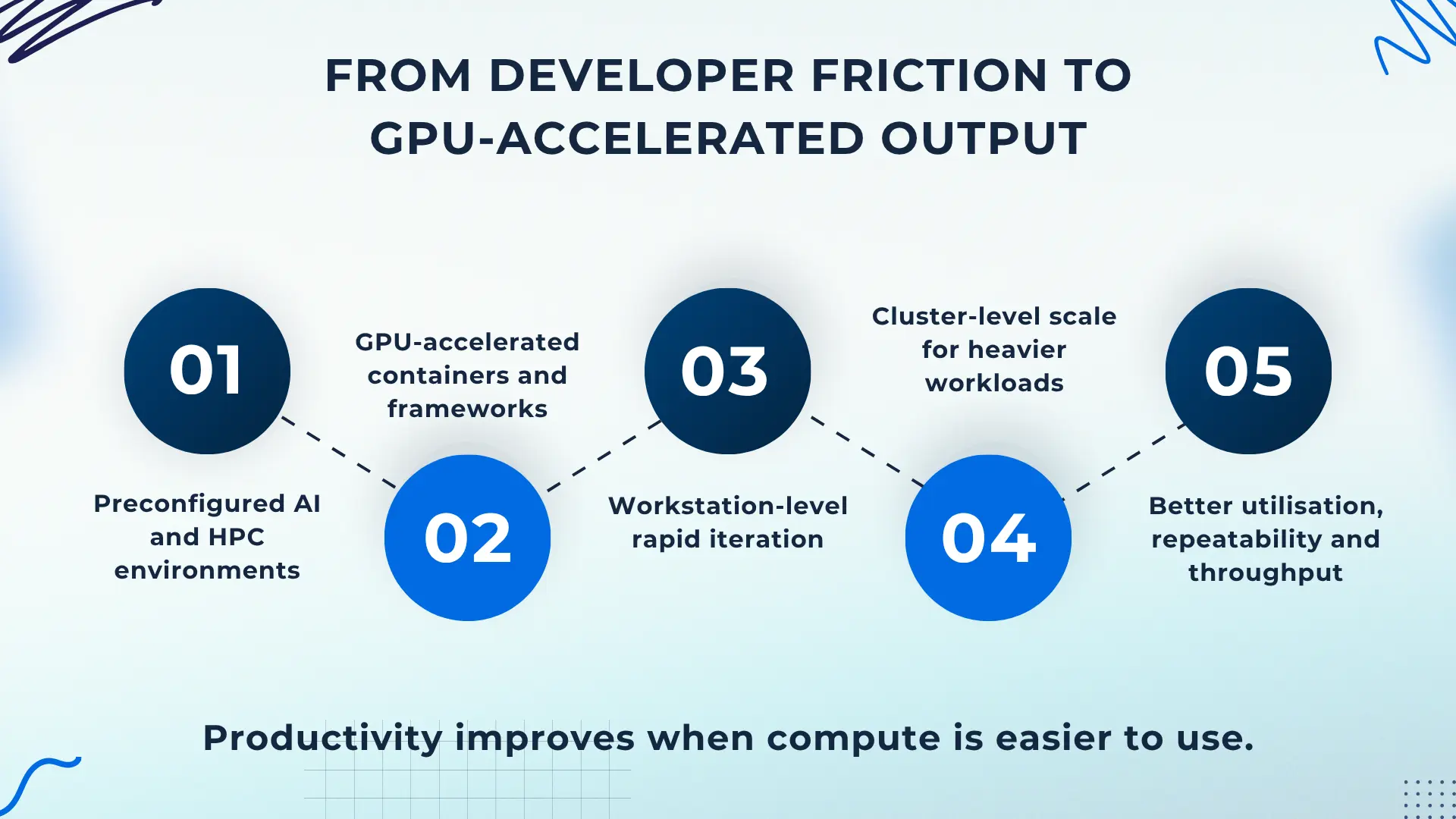
The future of AI and HPC productivity will not be one-size-fits-all. Some workloads need desktop-level access for rapid iteration. Others need cluster-scale performance for heavier jobs. A flexible productivity stack should let organisations support both modes without splitting teams across unrelated environments.
This helps developers test faster, researchers run more ambitious workloads and infrastructure teams standardise how GPU resources are used. It also supports a more practical adoption path: begin with GPU-accelerated workstations, then expand into larger GPU clusters as workloads mature.
GPU Optimised Supercomputer / Kubyts for developer productivity
For developer and research productivity, the GPU Optimised Supercomputer portfolio and Kubyts powered workstations and clusters fit the workflow layer. They help bring GPU-accelerated containers, AI frameworks and HPC applications closer to the teams building, testing and scaling AI and simulation workloads.
This makes the portfolio relevant where productivity depends on faster setup, smoother experimentation, cluster-level performance and reduced infrastructure friction. For researchers, engineers, developers and HPC users, Kubyts helps turn accelerated infrastructure into a more usable everyday productivity layer.
Conclusion
GPU-optimised computing is reshaping productivity because it connects infrastructure power with everyday developer and research workflows. The teams that can access accelerated environments faster will be better placed to build, test, simulate and scale with less friction. Explore Tyrone GPU Optimised Supercomputer and Kubyts powered workstations and clusters for developer and research productivity: https://tyronesystems.com/products/gpu-optimised-supercomputer.php
Frequently Asked Questions
What is AI inference infrastructure?
AI inference infrastructure is the compute, memory, networking, monitoring and deployment layer used to serve trained AI models in production.
How is inference different from training?
Training builds or fine-tunes models, while inference uses trained models to generate outputs for applications, users or workflows.
Why does compact AI compute matter?
Compact AI compute helps enterprises deploy more inference capability in limited space while improving density, reliability and operational efficiency.
Where does Camarero SNG100E1T-14 fit?
It fits compact AI compute needs for training, inference, LLM and generative AI workloads where high-density Grace Hopper architecture is valuable.