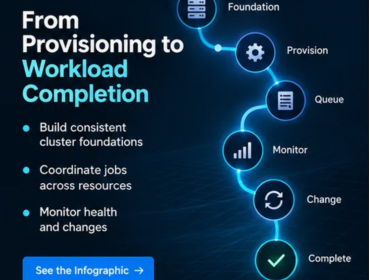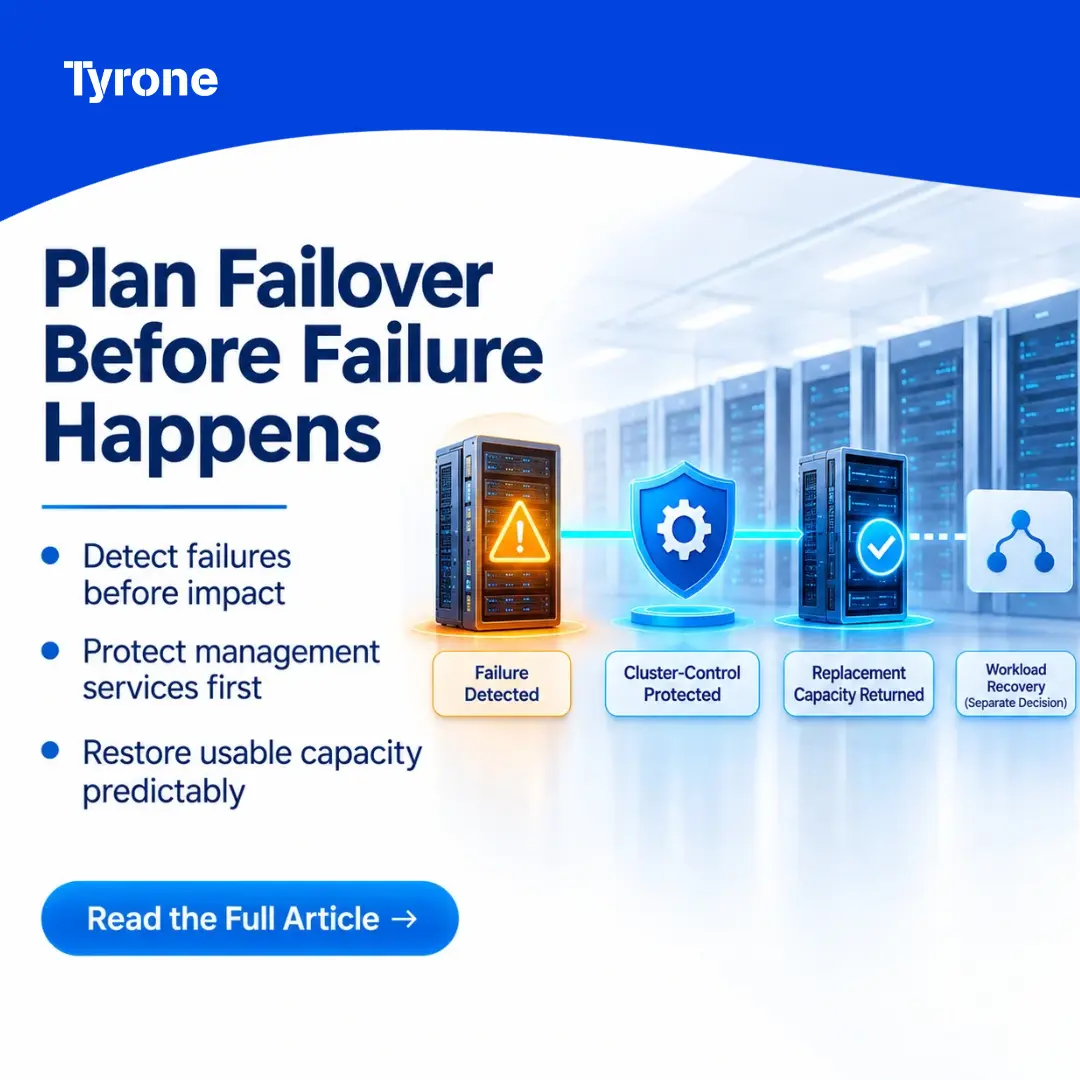
Node failures are normal in large compute environments. The resilience question is not whether something will fail, but how quickly the cluster can detect the problem, protect critical services and restore usable capacity. A cluster failover manager sits within a broader High Availability Cluster Management strategy that defines what needs redundancy, what can be recovered and which failures require application-level action.
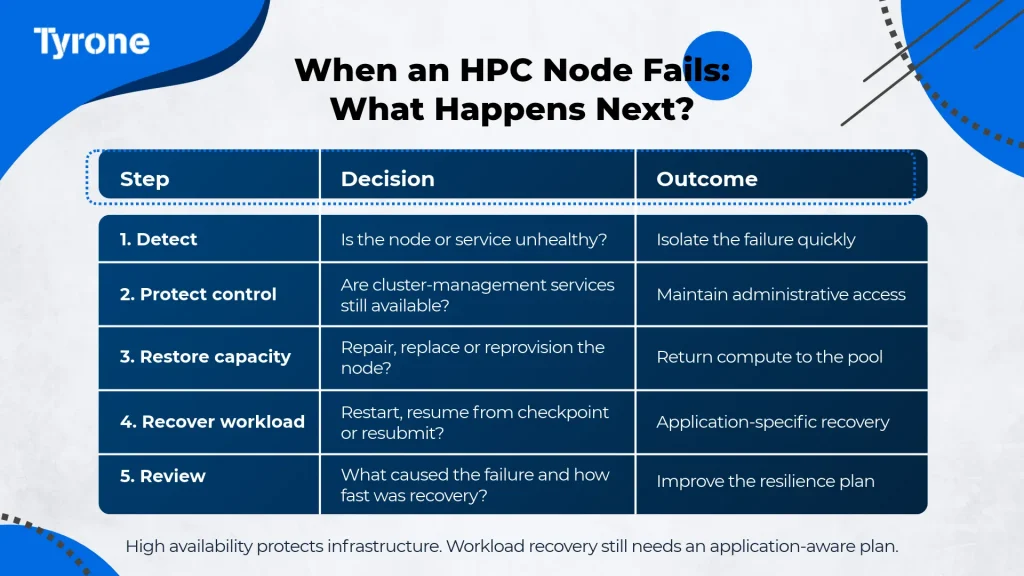
That distinction matters in HPC. Keeping the cluster-management plane available is different from restarting a failed application job. Replacing a failed compute node is different from restoring a multi-hour simulation from its last checkpoint. Effective resilience planning separates infrastructure availability, node recovery and workload recovery so each layer has a clear response.
What Cluster Failover Management Needs to Protect
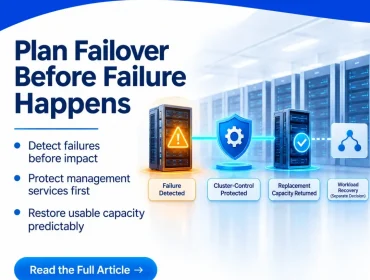
Cluster failover management is about more than keeping a cluster running when a component fails. It requires a clear strategy for maintaining visibility, preserving administrative control and restoring compute capacity with minimal disruption. To build a resilient environment, teams need to focus on three key areas: detecting failures early, protecting the right layers of the infrastructure and ensuring failed resources can return to service efficiently.
Detect node and service failures quickly
Resilience begins with visibility. Administrators need health checks and monitoring that make failed or degraded components visible before they reduce cluster capacity for long periods. Detection should cover the management services and compute nodes that keep the environment usable. The faster an issue is identified, the sooner teams can isolate the affected component and decide whether to repair, replace or reprovision it.
Separate management-plane availability from workload recovery
High availability can refer to several layers. Management services may need redundancy so administrators can still control the cluster during a failure. Compute nodes may need to be replaced or reprovisioned. Individual applications may require checkpointing, job restart or application-specific recovery. A resilient design should state which layer is protected and avoid treating infrastructure HA as automatic recovery for every workload.
Plan the path back to usable capacity
A failed node becomes an operational problem when the cluster cannot return capacity to service efficiently. Teams need a documented process for identifying the node, replacing or repairing it, reprovisioning the environment and validating that it is ready for work. This path should be tested before a production failure forces administrators to improvise it.
| Failure Scenario | What Must Be Protected | Recovery Question |
| Management service failure | Cluster control and administration | Can administrators still manage the environment? |
| Compute-node failure | Usable cluster capacity | How quickly can the node be replaced or reprovisioned? |
| Long-running job interruption | Application progress | Does the application support checkpoint/restart? |
| Network or storage dependency issue | Data and inter-node communication | What redundancy exists outside the compute node? |
| Repeated hardware fault | Operational reliability | Can health data identify patterns before the next outage? |
Building a High Availability Cluster Management Strategy
Define which services are truly critical
Not every component needs the same availability target. The management plane, scheduler, authentication services, shared storage and network paths can have different consequences when unavailable. Teams should classify dependencies, define acceptable interruption windows and decide where redundancy is necessary.
Test node replacement and reprovisioning workflows
Recovery plans should include routine hardware failure, not only disaster scenarios. Teams can test how quickly a failed node is identified, replaced, rediscovered, reprovisioned and returned to the pool. Rehearsing this process exposes operational gaps before they affect a critical workload.
Design workload recovery at the application layer
Long-running HPC jobs may need checkpointing or application-specific restart mechanisms. That capability is not automatically provided by cluster high availability. Infrastructure teams should work with application owners to decide which jobs can restart from the beginning, which need checkpoints and which require more advanced workflow-level recovery.
Where TCM Advanced fits — and what still needs validation
Tyrone Cluster Manager Advanced Edition explicitly lists High Availability. The TCM product page also documents node health checks and states that failed nodes can be replaced and brought back into action through its discovery and provisioning workflow. However, the published page does not state that TCM automatically restarts, migrates or resumes failed application jobs. If job-level failover is a requirement, that capability should be validated separately alongside the application and workload-manager design.
| Explore documented High Availability and cluster-management capabilities in TCM Advanced Edition: https://tyronesystems.com/platform/tcm.php |
Conclusion: resilience is a layered design
A resilient HPC environment does not depend on one failover feature. It combines monitoring, management-plane availability, node replacement, infrastructure redundancy and application recovery. A cluster failover manager can support that operating model, but the most important step is defining which layer is responsible for each type of failure before the failure occurs.
Frequently Asked Questions
What is a cluster failover manager?
A cluster failover manager is part of the software and operational design used to keep critical cluster services available and coordinate recovery when components fail.
What is High Availability Cluster Management?
High Availability Cluster Management is the practice of designing cluster services, monitoring and recovery processes so critical infrastructure can continue operating or be restored quickly after failures.
Does high availability automatically recover HPC jobs?
Not necessarily. Infrastructure high availability can protect cluster services or capacity, while application-level job recovery may require checkpointing, restart logic or workload-manager capabilities.
What High Availability capability is documented for Tyrone TCM?
Tyrone TCM lists High Availability in the Advanced Edition and documents node health checks and node replacement/provisioning workflows. The product page does not document automatic job restart or migration.