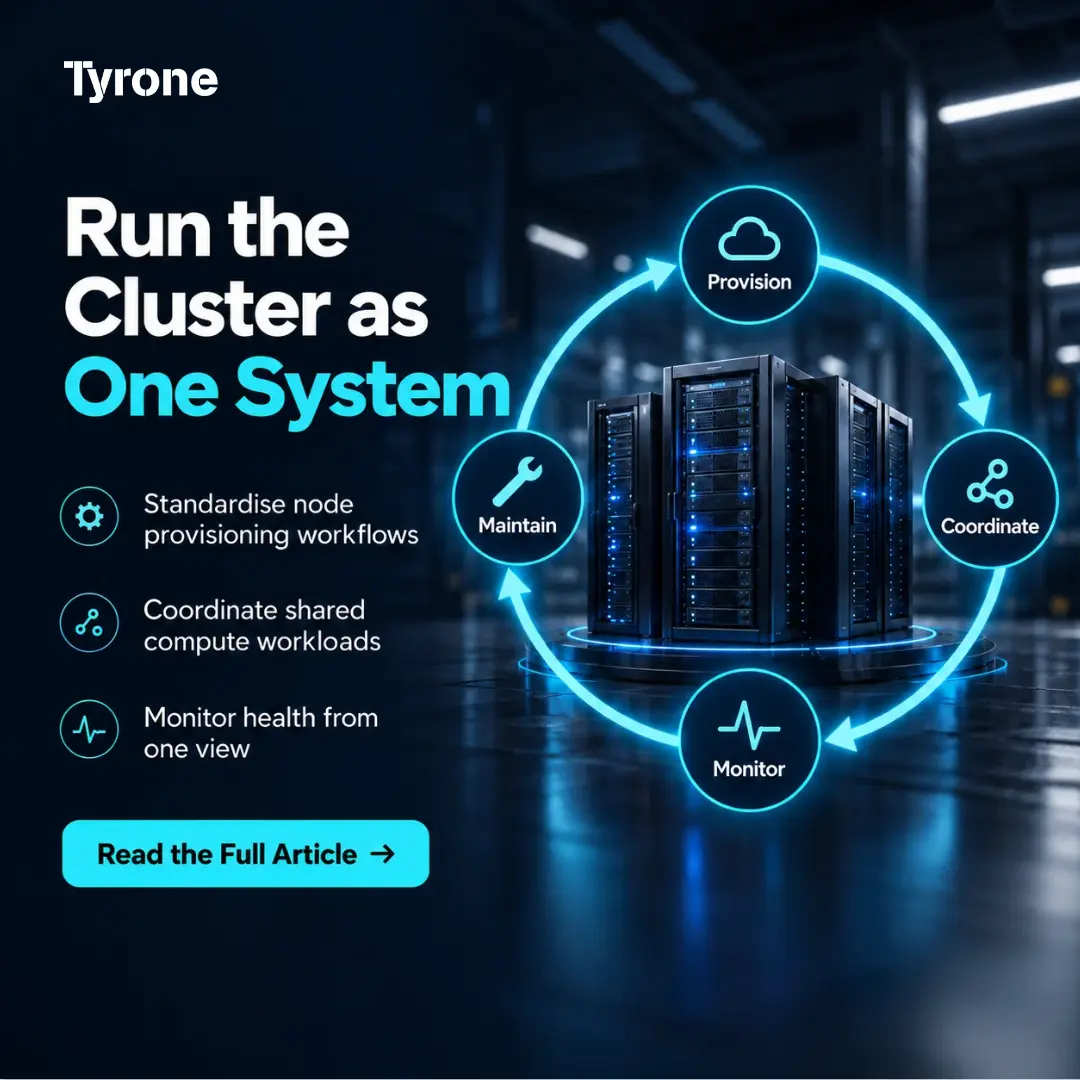
An HPC cluster can contain powerful compute nodes, fast interconnects, shared storage and specialised software, but none of those components manage themselves. As the number of nodes, users and jobs grows, the operational challenge shifts from owning compute capacity to controlling how that capacity is configured, accessed and used. HPC Cluster Management Software provides the management layer that helps infrastructure teams run the cluster as one coordinated environment rather than a collection of individual systems.
At a practical level, HPC Management Software brings together tasks such as cluster deployment, node provisioning, health monitoring, workload coordination and administrative visibility. The objective is not simply to make a cluster easier to look at. It is to reduce the amount of manual effort required to prepare compute resources, keep them available and move workloads through the environment consistently.
What HPC Cluster Management Software Actually Manages
Cluster deployment and node provisioning
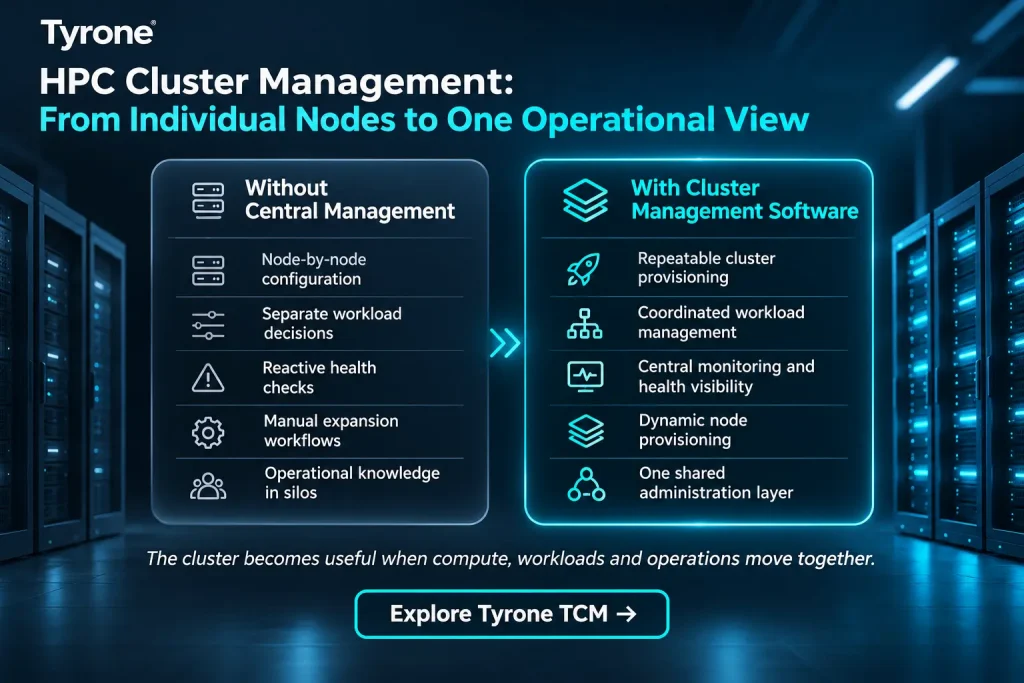
The first operational problem is getting nodes into a consistent state. Infrastructure teams need a repeatable way to configure management services, provision operating systems, discover nodes and apply a common configuration across physical or virtual machines. Without a central management layer, node-by-node administration can create configuration drift and turn cluster expansion into a slow manual process. A cluster manager reduces that friction by treating deployment and provisioning as shared workflows.
Compute resource and workload coordination
Once a cluster is available, users need a controlled way to submit work and consume compute resources. The management layer must connect available capacity with jobs, queues and user requirements. Workload management helps prevent the environment from becoming a first-come, first-served collection of manually assigned nodes. In larger HPC Cluster solutions, this coordination becomes essential because different applications may compete for CPUs, memory, accelerators or time-sensitive execution windows.
Monitoring, health and day-to-day administration
Cluster administrators also need visibility into whether nodes are healthy, whether services are available and where operational issues are developing. Graphical monitoring, health checks and reporting help teams move from reactive troubleshooting toward more structured operations. The value is especially clear as clusters grow: a problem on one node should be visible without requiring an administrator to log in to every system individually.
| Management Layer | Operational Question | Role of Cluster Management Software |
| Provisioning | How are new or rebuilt nodes configured? | Standardise node discovery, OS provisioning and configuration workflows. |
| Workload management | Who gets compute, and when? | Coordinate jobs and shared compute resources through workload policies. |
| Monitoring | Which nodes or services need attention? | Provide central health, status and utilisation visibility. |
| Administration | How are cluster changes managed consistently? | Reduce repetitive node-by-node operational tasks. |
| Lifecycle operations | How does the cluster stay usable as it grows? | Support repeatable expansion, maintenance and day-2 operations. |
How to Evaluate HPC Management Software for Your Cluster
Start with the operational model, not the feature list
The right platform depends on how the cluster will actually be used. A research environment with many users and short jobs has different operational priorities from a simulation cluster running long, tightly coupled workloads. Teams should map user groups, application types, resource requirements, maintenance windows and expected cluster growth before comparing software. That makes the evaluation about time-to-compute and operating effort rather than a checklist of isolated functions.
Look for one operational view across deployment, workloads and health
Fragmented tools can force administrators to move between provisioning utilities, command-line monitoring and separate job-management views. A stronger operating model gives infrastructure teams a consistent way to understand what is deployed, what is running and what needs intervention. This does not eliminate specialist tools, but it reduces the number of routine decisions that depend on tribal knowledge.
Plan for scale, resilience and day-2 operations
Cluster management is not finished when the first nodes come online. New nodes will be added, failed hardware will be replaced, workloads will change and software environments will evolve. Evaluation should therefore include how easily the platform handles node discovery, provisioning, monitoring, workload changes and availability requirements over the full lifecycle of the cluster.
Where Tyrone Cluster Manager fits
Tyrone Cluster Manager (TCM) is documented as a web-accessible cluster management suite for deploying and managing HPC clusters. The published feature set includes scalable cluster deployment and management, workload management, graphical monitoring, node health checks, OS provisioning and dynamic node provisioning. TCM Advanced Edition adds a dynamic workload manager and High Availability. These capabilities position TCM as the operational layer for teams that want cluster provisioning, monitoring and workload management in a single interface.
| Explore Tyrone Cluster Manager for cluster deployment, graphical monitoring and workload management: https://tyronesystems.com/platform/tcm.php |
Conclusion: manage the cluster as one system
The value of HPC infrastructure depends on more than peak compute specifications. It depends on how quickly resources can be made available, how clearly administrators can see the environment and how consistently workloads move through it. HPC Cluster Management Software gives organisations a way to manage those operational decisions as one system, helping HPC teams spend less time coordinating infrastructure manually and more time keeping compute available for useful work.
Frequently Asked Questions
What is HPC Cluster Management Software?
HPC Cluster Management Software is the management layer used to deploy, configure, monitor and coordinate compute resources across a high-performance computing cluster.
What does HPC Management Software manage?
Typical functions include node provisioning, cluster monitoring, workload coordination, health checks, reporting and administrative control across multiple compute nodes.
Why is cluster management important in HPC?
HPC environments contain shared compute resources and many interdependent components. Central management reduces manual administration and helps teams coordinate users, jobs, nodes and operational changes more consistently.
What TCM features are documented for HPC cluster management?
Tyrone Cluster Manager documents scalable cluster deployment and management, workload management, graphical monitoring, node health checks and OS provisioning. TCM Advanced Edition also lists a dynamic workload manager and High Availability.