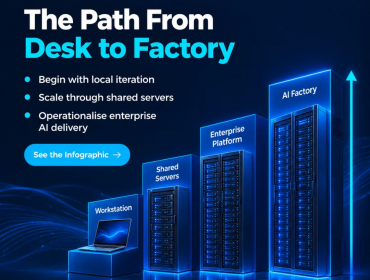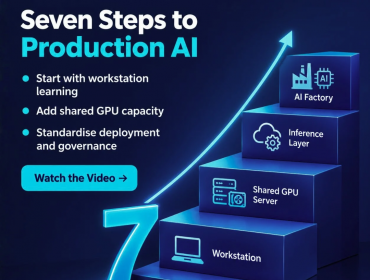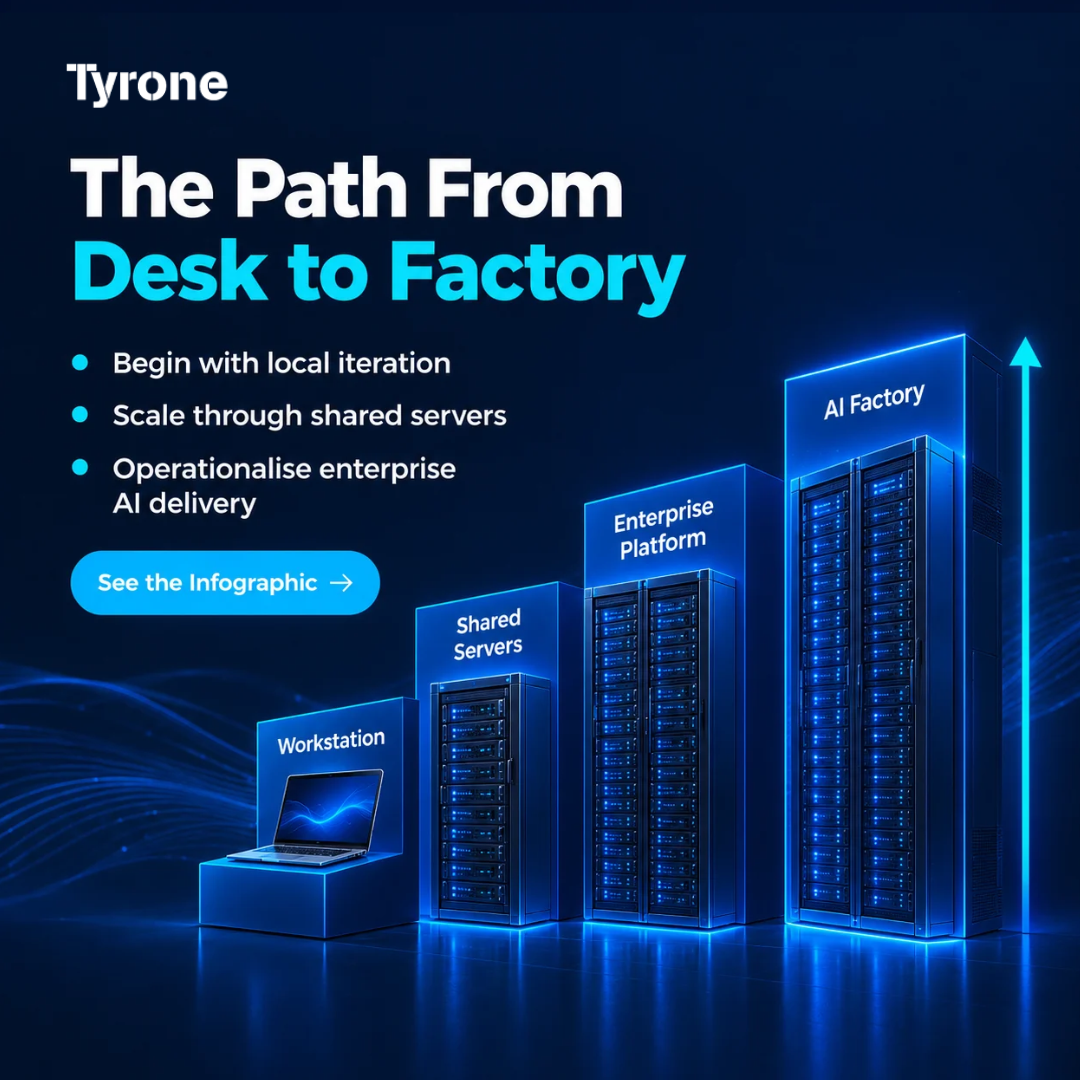
A small GenAI experiment can be the beginning of a much larger enterprise service. What works on one developer’s workstation may eventually need to support multiple teams, connect to enterprise data and respond reliably to growing demand. The challenge is to expand AI capabilities while keeping infrastructure manageable, secure and aligned with workload requirements.
Four Connected Layers for Different AI Requirements
Layer 1: AI Workstation — Experiment and Validate
A capable workstation gives developers direct access to compute for prototyping, model evaluation, RAG workflows and early AI agent development. The goal is rapid iteration and validation before wider deployment. Workstations remain valuable for development even when an organisation operates larger shared infrastructure.
Layer 2: Shared GPU Server — Coordinate and Accelerate
As more users need compute or workloads exceed individual workstation capacity, shared GPU servers provide centrally managed accelerator resources. Scheduling, resource allocation and usage visibility help teams coordinate demand and improve resource utilisation across workloads.
Layer 3: Production Inference — Deploy and Serve
When an AI application supports a business process, operational requirements become as important as model capability. Applications may need to serve concurrent requests, retrieve enterprise data and maintain predictable response times during periods of high demand. Monitoring, workload prioritisation and resource isolation help teams manage performance and reduce interference from development or training jobs.
Layer 4: AI Factory Infrastructure — Integrate and Operate
As AI adoption expands across teams and business functions, organisations need repeatable ways to provision compute, connect storage and networking, manage data access, monitor workloads and enforce security controls. An AI Factory brings these capabilities together in an integrated environment that supports AI development, training, inference and ongoing operations.
Scale When Your Workloads Demand It
These layers describe an adoption journey, not a mandatory purchasing sequence. A large enterprise may already have shared GPU infrastructure, while a research team may continue working effectively on local systems. The right environment depends on workload complexity, concurrency, performance requirements, security needs and operational maturity.
Portability helps connect each stage. Documenting model versions, software dependencies and data access requirements makes it easier to reproduce successful experiments on other infrastructure. As applications enter production, defined response-time targets, monitoring and capacity planning help teams prepare for changing demand.
Build Your AI Compute Foundation with Tyrone
The Tyrone Camarero Series offers GPU-optimised server options for organisations building shared compute environments and expanding their AI infrastructure. Combined with appropriate software, deployment practices and operational controls, the right server foundation can help enterprises move from experimentation towards production-ready AI services.
| Explore Tyrone Camarero Series AI servers: https://tyronesystems.com/servers/Latest_Generation.php |
Get in touch info@tyronesystems.com