The Breaking Point of Traditional NAS in AI Infrastructure
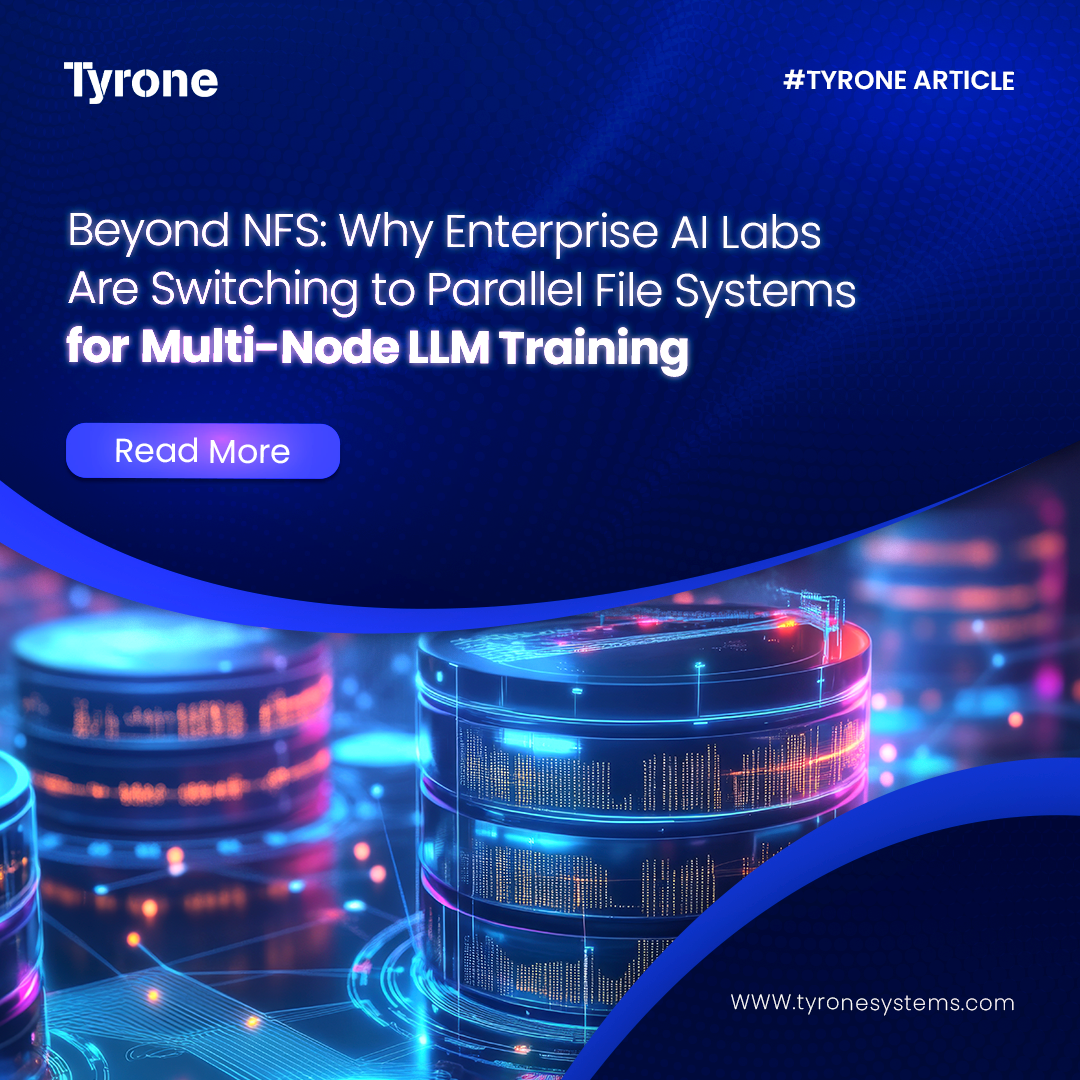
Enterprise AI labs are rapidly outgrowing legacy NAS architectures such as NFS, not because they are obsolete, but because they were never designed for the scale and I/O patterns of multi-node LLM training. Modern AI workloads generate highly parallel, bursty data access patterns that traditional systems cannot sustain without introducing bottlenecks.
Large-scale LLM training clusters now demand sustained throughput exceeding 100 GB/s to even 1 TB/s, alongside millions of small-file reads during preprocessing (Source: Castle Rock Digital). In this context, even minor I/O inefficiencies directly translate into GPU underutilization and wasted capital.
For stakeholders evaluating an AI data storage solution, the issue is no longer storage capacity, it is data delivery at scale.
Why NFS Architectures Fail at Scale
NFS-based systems fundamentally rely on centralized metadata handling and serialized access paths. While enhancements like pNFS attempt to parallelize access, the architecture still inherits limitations tied to backend storage design and metadata coordination.
In multi-node training environments:
- Single metadata bottlenecks increase latency under concurrency
- Throughput does not scale linearly with node count
- Data access contention impacts checkpointing and training cycles
This becomes critical when training distributed models across hundreds or thousands of GPUs. Even a 20% I/O wait time can waste 20% of compute investment (Source: Castle Rock Digital).
From a business standpoint, this inefficiency directly impacts time-to-model and infrastructure ROI, key metrics for any big data storage solution strategy.

Parallel File Systems: Purpose-Built for AI at Scale
A parallel file system for enterprise environments addresses these constraints by fundamentally redesigning how data is stored and accessed. Instead of funneling requests through a single controller, parallel file systems distribute both data and metadata across multiple nodes.
Modern implementations like Velox are emerging as purpose-built PFS solutions for AI, designed to handle extreme concurrency, GPU-scale throughput, and hybrid infrastructure environments without the traditional complexity overhead.
Key architectural advantages include:
1. Linear Scalability Through Distributed Design
Parallel file systems stripe data across multiple storage nodes, allowing simultaneous reads and writes. This enables throughput to scale proportionally with infrastructure expansion.
2. High Throughput for GPU-Hungry Workloads
Systems such as Velox are engineered to deliver hundreds of GB/s to multi-terabyte per second throughput, ensuring GPUs remain continuously utilized rather than starved for data.
3. Elimination of Metadata Bottlenecks
Distributed metadata architectures remove single points of contention, improving performance consistency across large-scale workloads.
4. Native Support for Multi-Node Access
Thousands of compute nodes can concurrently access shared datasets without duplication, enabled by a unified global namespace.
This makes parallel systems the best storage solution for AI workloads where concurrency, not just capacity, defines success.
Aligning Storage with LLM Training Realities
LLM pipelines introduce unique stress patterns on storage infrastructure:
- Massive sequential writes during checkpointing
- Random read bursts during data preprocessing
- Continuous streaming reads during training cycles
Parallel file systems, especially modern architectures like Velox, are designed to handle this “bipolar I/O” pattern, delivering both high IOPS and sustained bandwidth within a single scalable system.
Additionally, technologies like GPU Direct Storage and NVMe-based backends allow data to bypass CPU bottlenecks entirely, further improving efficiency in HPC storage solutions.
Global Namespace: The Strategic Advantage
One of the most overlooked advantages for enterprise stakeholders is the global namespace capability. Parallel file systems provide a unified view of data across clusters, regions, and hybrid environments.
Velox, for instance, integrates this capability as a core design principle, enabling seamless data access across distributed AI pipelines without duplication.
This has direct implications for:
- Data governance and compliance
- Multi-site collaboration
- Hybrid cloud AI pipelines
- Eliminating data silos
Rather than duplicating datasets across environments, organizations can operate on a single logical dataset, reducing storage overhead and operational complexity.
Cost Efficiency Beyond CapEx
While parallel file systems are often perceived as premium infrastructure, the cost narrative shifts when evaluated against GPU utilization and training efficiency.
Consider:
- Idle GPUs can cost thousands per hour in lost productivity
- Faster checkpointing reduces training cycle time
- Improved throughput accelerates experimentation velocity
Solutions like Velox directly optimize these variables, making them a high-impact AI data storage solution despite higher upfront investment.
The Transition Strategy: From NAS to Parallel
Enterprises are not abandoning NFS entirely, they are augmenting it. The emerging model involves:
- Retaining NAS for general-purpose workloads
- Deploying parallel file systems (such as Velox) for AI training pipelines
- Leveraging tiered storage (NVMe + object storage) for lifecycle management
This phased approach reduces disruption while enabling a modern scalable storage architecture.
Conclusion: Storage as a Competitive Differentiator
The shift from NFS to parallel file systems is not a trend, it is a structural evolution driven by the realities of AI at scale.
For enterprise stakeholders, the decision is no longer about choosing a storage protocol. It is about selecting a big data storage solution that aligns with:
- GPU-intensive workloads
- Distributed training architectures
- Long-term AI scalability
Parallel file systems, led by next-generation platforms like Velox, deliver the performance, concurrency, and flexibility required to support modern AI infrastructure.Storage is no longer just backend infrastructure. It is now a core competitive advantage.