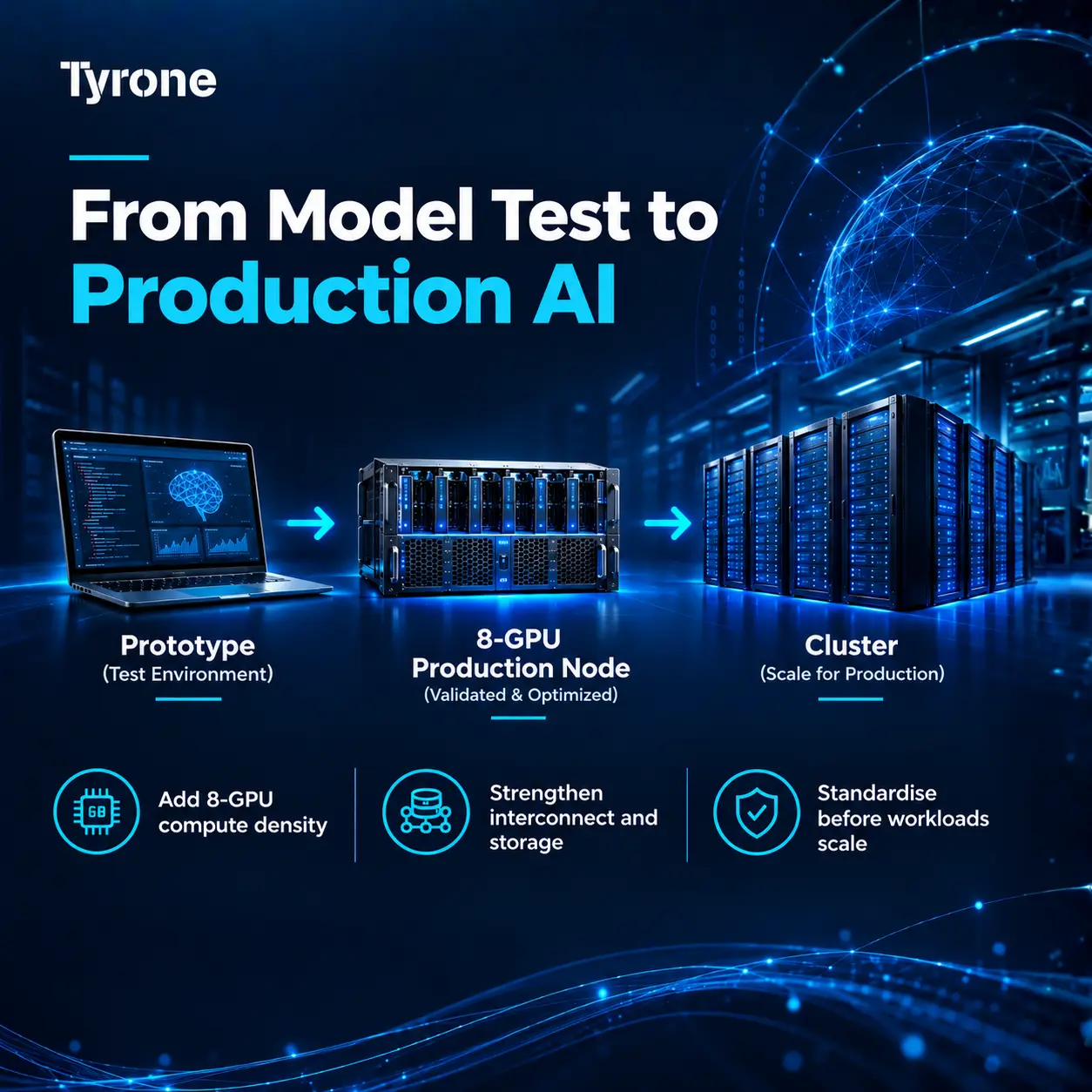
Enterprise AI usually starts with small model tests, but production AI requires a different class of infrastructure. As workloads grow, teams need servers that can support larger models, heavier training cycles, distributed workloads, high-speed interconnect and operational resilience. Artificial Intelligence Servers with 8-GPU architecture are becoming an important step for organisations moving from experimentation to standardised production AI.
Why Model Tests Need a Production Path
Early AI experiments often run on shared workstations, cloud instances or smaller GPU servers. This is useful for discovery, but it does not always create a reliable path to production. Once use cases mature, AI teams need repeatable environments, more memory, higher GPU density, better interconnect and enough local storage to support model artefacts, checkpoints and datasets.
Without a production path, AI teams can get trapped between proof-of-concept success and deployment complexity. The model works, but it cannot be trained at scale. The use case is promising, but inference performance is inconsistent. The business wants outcomes, but infrastructure cannot support the throughput. This is where 8-GPU Artificial Intelligence Servers become relevant.
Why GPU Server Demand Reflects Production AI Momentum
IDC reported that worldwide server market spending grew 30.7% in the first quarter of 2026, driven by continued mass deployment of GPU servers. This reflects a larger enterprise shift: AI is moving from isolated experiments into infrastructure investment, and GPU server architecture is becoming central to that transition.
What 8-GPU Architecture Changes for Enterprise AI
An 8-GPU system gives enterprises a stronger foundation for larger model training, fine-tuning, simulation, retrieval workflows and production inference. The important point is not only the number of GPUs. It is the surrounding architecture: CPU support, memory capacity, NVSwitch, high-speed networking, hot-swappable storage, power redundancy and management controls.
For Enterprise AI Solutions, this architecture helps standardise the environment between experimentation and deployment. Teams can consolidate workloads, improve utilisation and design clusters that grow with AI demand. However, success still depends on matching the server to the workload. A team running small prototypes may not need full 8-GPU density immediately. A team moving toward production models, multi-user environments or cluster-scale AI may need it earlier.
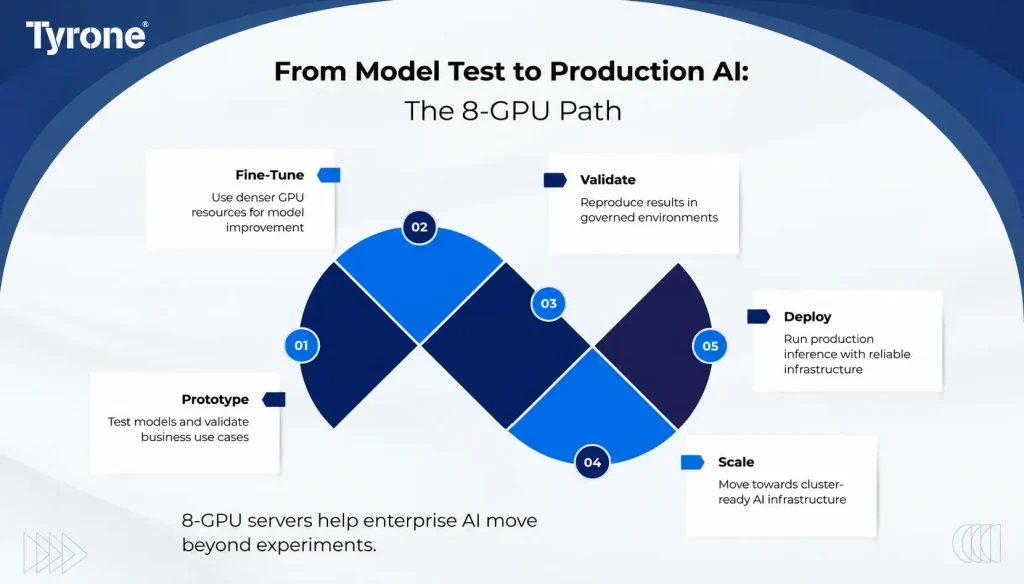
From Model Test to Production Cluster
| Stage | Infrastructure Need | Risk if Ignored |
| Prototype | Flexible GPU access for testing | Ideas remain disconnected from infrastructure planning |
| Fine-tuning | More GPU memory and faster interconnect | Training cycles become slow or expensive |
| Validation | Repeatable environments and local data access | Results become hard to reproduce |
| Production | High availability, networking and storage | Inference quality and uptime become inconsistent |
| Scale | Cluster-ready 8-GPU architecture | AI demand outgrows the original stack |
Standardise the 8-GPU Layer for Enterprise AI
For organisations moving from model tests to production clusters, Tyrone Camarero series provides an 8-GPU HGX B300 platform with NVSwitch, high-speed InfiniBand ports, hot-swappable NVMe bays and redundant power. Explore the system here: https://tyronesystems.com/servers/PDI300A2HG-812.php
Where Tyrone Camarero Series Fits Into Production AI
Tyrone Camarero series supports Intel Xeon 6th Gen processors, NVIDIA HGX B300 8-GPU with NVSwitch, 8 OSFP 800Gbps InfiniBand ports, 12 hot-swappable 2.5-inch NVMe bays and a redundant Titanium power supply configuration. This makes it relevant for production AI infrastructure where GPU density, memory scale, interconnect and serviceability matter together.
In an AI Factory roadmap, the 8-GPU layer can support larger model development, production-grade inference, AI research clusters, enterprise AI platforms and workloads that need a more standardised acceleration environment. It provides the next step after smaller AI labs and before wider cluster expansion.
Conclusion
Artificial Intelligence Servers are becoming the bridge between promising AI experiments and production-ready enterprise AI. The 8-GPU path matters because it gives teams a stronger way to standardise compute, interconnect, storage and operations around real workload demand. Enterprises that plan this transition early can move from model testing to AI deployment with fewer infrastructure gaps.
Frequently Asked Questions
What are Artificial Intelligence Servers?
Artificial Intelligence Servers are purpose-built systems designed to support AI workloads such as model training, fine-tuning, inference and accelerated analytics.
Why use an 8-GPU AI server?
An 8-GPU AI server can support larger models, heavier workloads, faster training and more standardised production AI environments.
How do 8-GPU servers support Enterprise AI?
They provide GPU density, high-speed interconnect, memory capacity, storage and reliability features needed for enterprise-scale AI workloads.