AI projects do not fail only because models underperform. Many fail earlier, when data cannot move fast enough, remain consistent enough, or stay accessible across the teams that need it. An AI Storage Solution is therefore not a back-office layer. It is the data foundation that decides whether training, inference, analytics and HPC workflows can move from experiment to production.
Why AI Storage Has Become a Production Issue
Enterprise AI changes how data is used. Traditional business applications usually access structured data in predictable patterns. AI workloads are different. They work with large files, unstructured datasets, model checkpoints, embeddings, image libraries, logs, simulations and continuously changing training data. When these assets sit across fragmented storage systems, AI teams spend more time finding, copying and staging data than improving models.
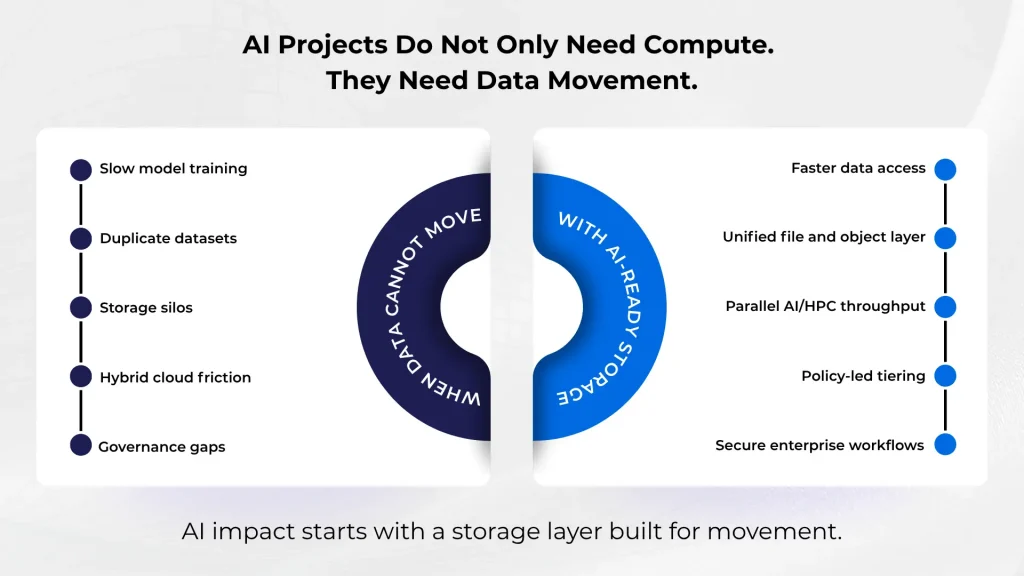
This is why AI-ready storage should be evaluated through workload flow, not only capacity. The practical questions are: can teams access the same data without creating duplicate copies? Can storage support file and object access patterns? Can data move between on-prem, cloud and archive tiers without breaking the workflow? Can large workloads scale without a controller bottleneck? If these questions are ignored, AI infrastructure becomes expensive but slow.
The Link Between Data Readiness and AI Impact
AI impact depends on usable data. A model that waits for data, trains on stale datasets, or cannot access governed production information will not create reliable outcomes. Gartner has warned that 63% of organisations either do not have, or are unsure if they have, the right data management practices for AI, and also predicts that through 2026, 60% of AI projects unsupported by AI-ready data will be abandoned. This makes storage strategy a direct AI execution issue, not only an IT infrastructure decision.
How Data Movement Shapes AI Outcomes
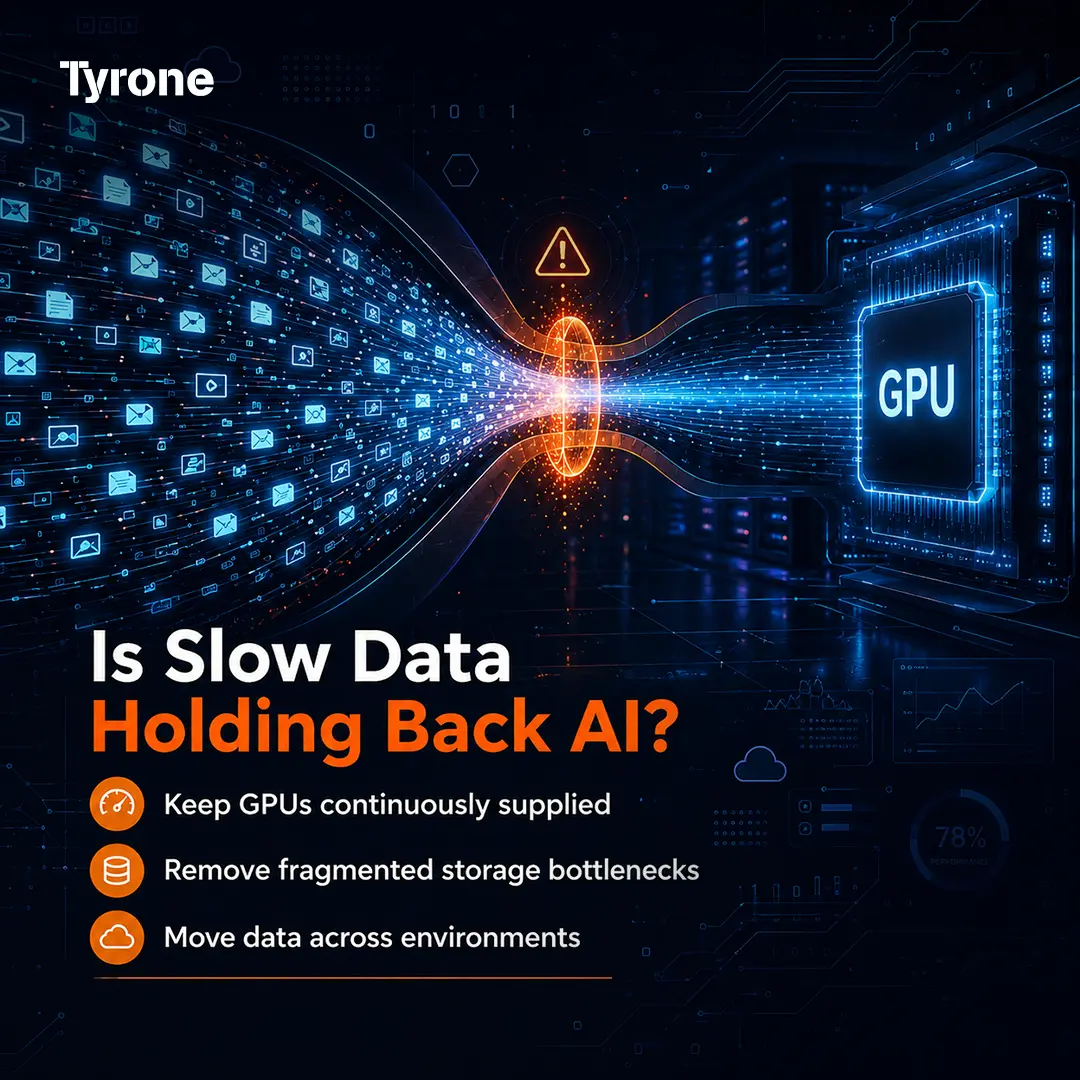
AI teams often think first about GPUs, but GPUs only perform when data pipelines can keep them supplied. Training needs high-throughput access to large datasets. Inference needs reliable access to model artefacts and live data. HPC and simulation workflows need parallel I/O and consistent file access. Hybrid cloud teams need data mobility without uncontrolled copies. In every case, the Enterprise Storage Solution becomes the common layer that connects compute, data and governance.
A strong AI Storage Solution should therefore support scale, concurrency, protocol flexibility, resilience and policy-based data movement. This helps organisations avoid the common pattern where one AI team builds a pipeline, another creates a duplicate data lake, and a third moves sensitive information into a separate cloud environment because local storage cannot keep pace.
Legacy Storage vs AI-Ready Storage
| Storage Question | Legacy Approach | AI-Ready Requirement |
| Data access | Separate silos across teams and locations | Unified access through a consistent data layer |
| Performance | Bottlenecks under concurrent AI and HPC workloads | Parallel throughput for high-volume pipelines |
| Hybrid cloud | Manual movement and duplicate copies | Policy-driven movement across on-prem and cloud |
| Workload support | File or object handled separately | File, object and analytics access on shared data |
| Governance | Manual controls and inconsistent visibility | Security, snapshots, auditability and role-based access |
Explore Velox for AI-Ready Data Movement
For enterprises evaluating AI-ready storage, Velox is designed to unify file and object data, support AI/ML, analytics and hybrid cloud workloads, and remove the silos that slow production AI. Explore Velox here: https://tyronesystems.com/velox/
Where Velox Fits Into the AI Data Backbone
Velox supports the storage requirements behind AI, HPC and enterprise workloads by creating a more unified data foundation. It is positioned for AI/ML acceleration, analytics at scale and hybrid cloud workloads, while supporting enterprise-grade performance, reliability and simplified operations. Its architecture addresses common pain points such as fragmented storage, rising storage costs, performance bottlenecks, global collaboration challenges, data format incompatibility, security pressure and hybrid cloud complexity.
For AI teams, the value is practical. Velox can help reduce duplicate data movement, support parallel I/O, provide native access across multiple protocols and apply policy-based data management. For infrastructure leaders, it creates a route towards Unified Storage that can support both modern AI pipelines and existing enterprise workloads.
Conclusion
AI projects need more than models and compute. They need a data backbone that keeps training, inference, HPC and hybrid cloud workflows connected. Organisations that treat storage as a strategic AI layer will be better prepared to move from experimentation to production. To evaluate how Velox can support enterprise AI, HPC and data centre storage requirements, book a consultation with the Tyrone/Netweb team.
Frequently Asked Questions
What is an AI Storage Solution?
An AI Storage Solution is a storage architecture designed to support AI workloads such as model training, inference, analytics, simulation and hybrid cloud data movement.
Why does AI storage matter for enterprise AI?
AI storage matters because GPUs, models and AI platforms depend on fast, governed and consistent access to large datasets.
How does Unified Storage help AI teams?
Unified Storage reduces data silos by allowing different teams and workloads to access data through a common storage layer.
Where does Velox fit in enterprise storage planning?
Velox fits as a data backbone for AI/ML, analytics, HPC, hybrid cloud and enterprise storage workloads that need scale, reliability and simplified management.