AI conversation is shifting from building models to deploying them reliably. Training creates the model, but inference is where AI meets users, applications, workflows and business decisions. As generative AI adoption grows, enterprises need compact AI compute that can support production workloads without creating deployment complexity.
ResearchAndMarkets projects India’s generative AI market to grow from INR 85.34 billion in 2024 to INR 671.83 billion by 2030, at a CAGR of about 42.07%. This level of growth points to a simple infrastructure reality: more generative AI applications will need reliable inference capacity close to where decisions are made.
Why inference is the next infrastructure layer
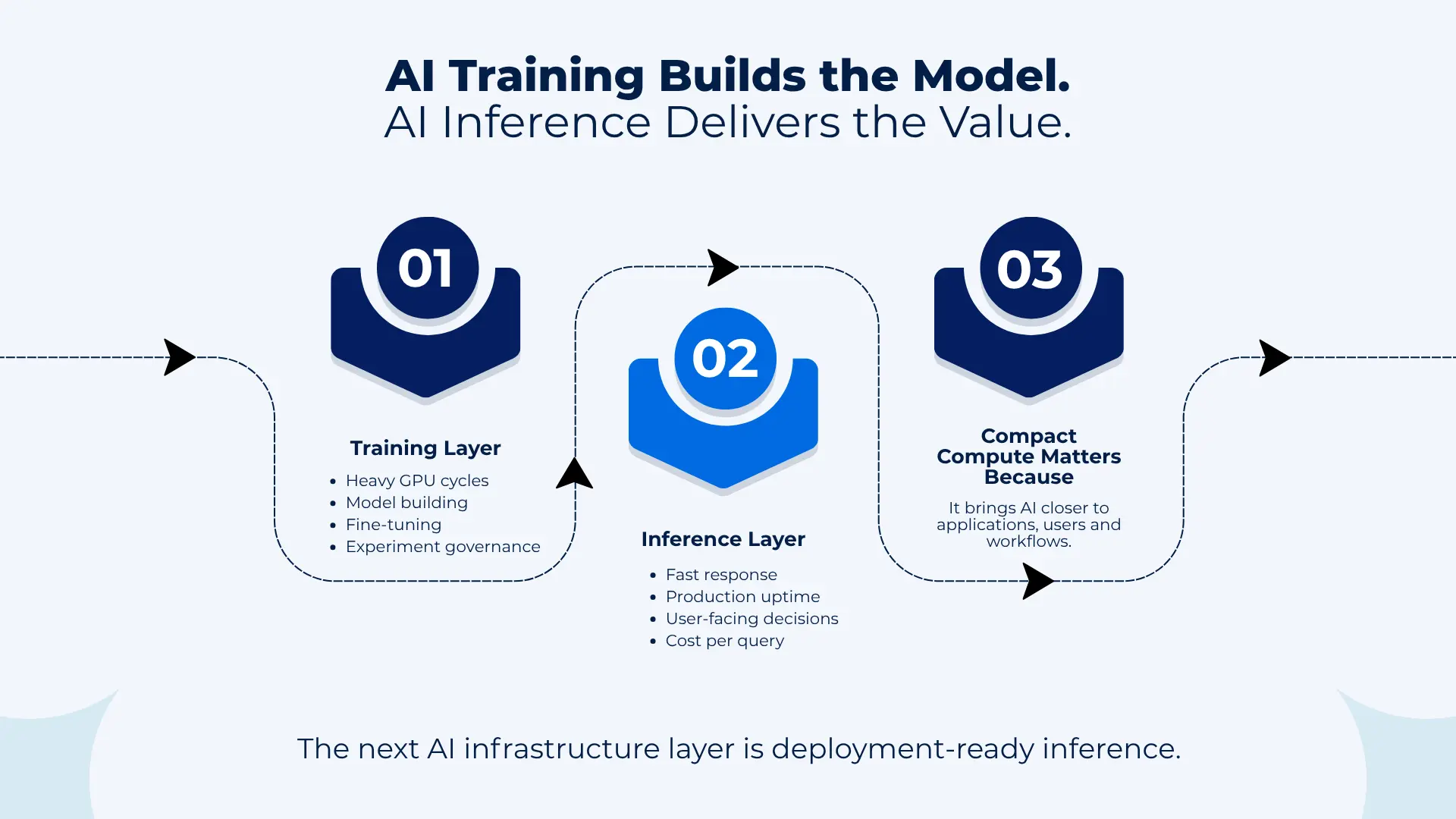
During the pilot phase, many enterprises focus on training, model access and experimentation. Once AI begins supporting real applications, inference becomes the critical layer. It determines response time, uptime, cost per query, user experience and operational reliability. A powerful model is not useful if inference is slow, expensive or difficult to control.
Inference also changes infrastructure economics. Unlike training jobs that may run in planned cycles, inference can be continuous, user-facing and latency-sensitive. This means deployment-ready AI compute must be designed for density, efficiency, reliability and workload governance.
What compact AI compute solves
Compact AI compute helps enterprises place more inference capability into smaller physical footprints. This matters for data centres, edge environments, research labs, private AI deployments and regulated organisations where space, power and operational simplicity are important. Compact infrastructure can support production AI without forcing every workload into oversized training systems.
It also allows teams to separate training and inference more clearly. Training environments can be optimised for model development and heavy GPU utilisation, while inference environments can be optimised for response time, memory access, application integration and service continuity.
Training infrastructure vs inference infrastructure
| Dimension | AI Training Infrastructure | AI Inference Infrastructure |
| Main purpose | Build, fine-tune and optimise models | Serve model outputs to users and applications |
| Workload pattern | Heavy scheduled compute cycles | Continuous or real-time production usage |
| Key priority | Throughput and model iteration speed | Latency, uptime and cost per request |
| Risk focus | Sensitive datasets and experiment governance | Reliable decisions and monitored outputs |
| Infrastructure shape | Large multi-GPU systems | Compact, dense and deployment-ready compute |
Move to the next layer of AI infrastructure with Camarero SNG100E1T-14. Explore compact, deployment-ready AI compute for training, inference, LLM and generative AI workloads: https://tyronesystems.com/servers/SNG100E1T-14.php
Designing deployment-ready AI compute
Deployment-ready AI compute should begin with the expected inference workload. Will the system support generative AI applications, LLM responses, recommendation engines, analytics dashboards or domain-specific AI assistants? Each use case has different requirements for memory, latency, networking and uptime.
The best inference layer is also observable. Teams need to monitor usage, performance, errors and demand patterns. This visibility helps decide when to scale, when to optimise and when a workload should move into a different deployment model.
SNG100E1T-14 for deployment-ready AI compute
For the next layer of Sovereign AI infrastructure, Camarero SNG100E1T-14 fits compact, deployment-ready AI compute. It is positioned for AI/deep learning training and inference, LLM and generative AI workloads in a high-density 1U, two-node NVIDIA Grace Hopper based system.
This makes SNG100E1T-14 suitable for enterprises moving from model development into production AI, where inference performance, memory access, density and operational efficiency matter. It can act as the next compute layer after larger training infrastructure, especially for compact private AI and generative AI deployments.
Conclusion
AI infrastructure is entering a new stage. Training remains important, but production value depends on inference. Enterprises that design compact, deployment-ready AI compute now will be better prepared to serve real applications, LLM workloads and generative AI systems at scale. Explore SNG100E1T-14 as the next compact AI compute layer: https://tyronesystems.com/servers/SNG100E1T-14.php
Frequently Asked Question
What is AI inference infrastructure?
AI inference infrastructure is the compute, memory, networking, monitoring and deployment layer used to serve trained AI models in production.
How is inference different from training?
Training builds or fine-tunes models, while inference uses trained models to generate outputs for applications, users or workflows.
Why does compact AI compute matter?
Compact AI compute helps enterprises deploy more inference capability in limited space while improving density, reliability and operational efficiency.
Where does Camarero SNG100E1T-14 fit?
It fits compact AI compute needs for training, inference, LLM and generative AI workloads where high-density Grace Hopper architecture is valuable.