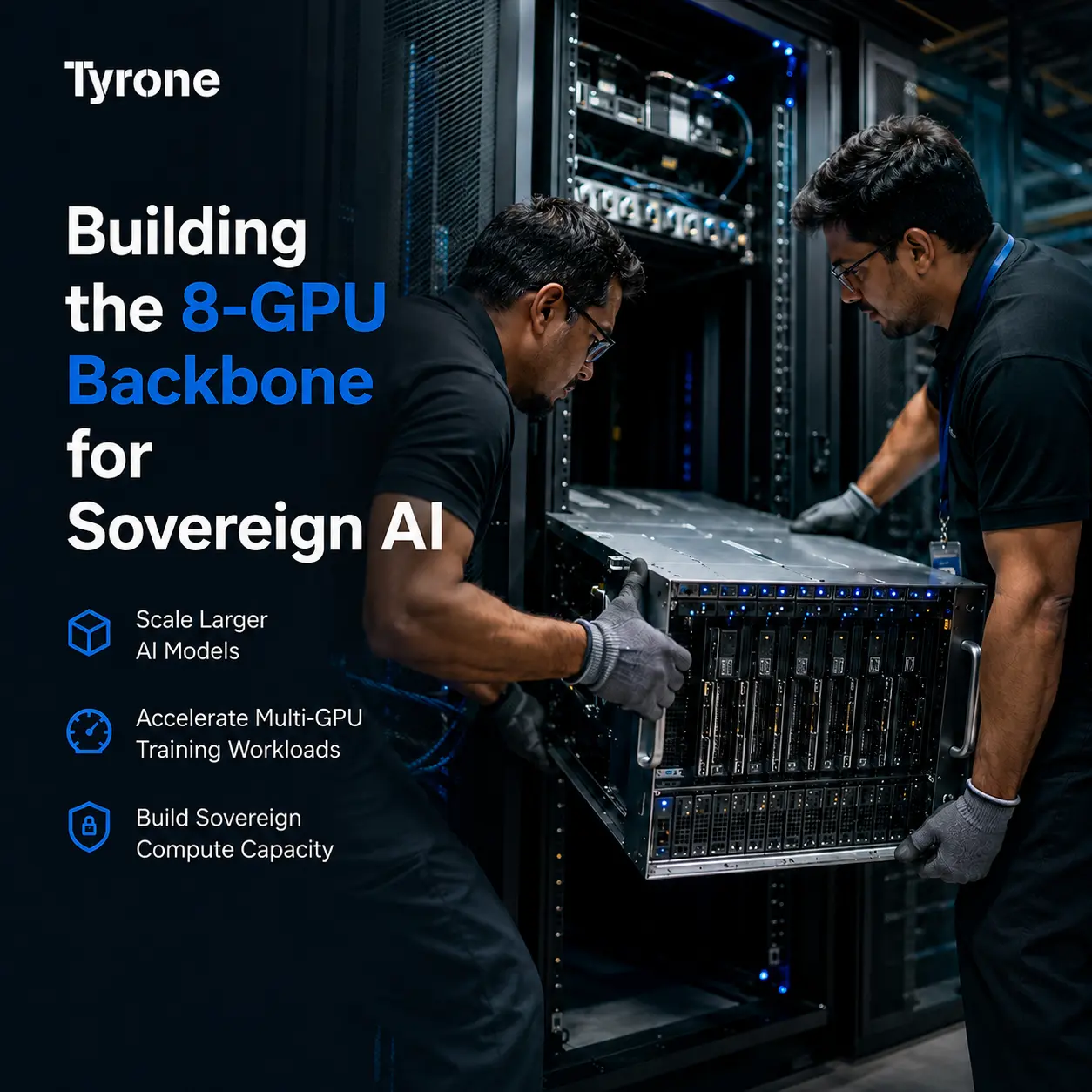
Sovereign AI infrastructure in India will not scale on general-purpose compute alone. As enterprises, research institutions and regulated sectors move from small AI pilots to larger model development, they need a GPU infrastructure backbone that can support training, fine-tuning, simulation and high-throughput data movement with predictable performance.
India is already entering a period of AI-ready infrastructure expansion. KPMG India has highlighted that the AI-specific data centre infrastructure market was about USD 588.6 million in 2024 and is expected to reach USD 3.55 billion by 2030, growing at a 35.1% CAGR. The implication for enterprise leaders is clear: demand for AI training infrastructure will increase, and underpowered infrastructure decisions will become more expensive to correct later.
Why India needs a stronger AI backbone
Sovereign AI requires local capability, but local capability must be powerful enough to handle real workloads. AI training is compute-intensive, memory-intensive and data-intensive. A small environment may support early experiments, but it can quickly become a bottleneck when teams start training larger models, fine-tuning foundation models or running multiple AI projects in parallel.
The backbone also affects governance. A stronger, well-designed GPU infrastructure layer helps enterprises centralise usage, plan capacity and apply policies consistently. Without it, teams often create fragmented environments that are difficult to monitor and harder to align with security or compliance requirements.
What an 8-GPU architecture changes
An 8-GPU system changes the enterprise AI conversation because it gives organisations a more serious platform for large-scale training and HPC-class AI workloads. It can support parallel processing, higher model throughput, larger datasets and faster experiment cycles. For AI teams, this can reduce waiting time and accelerate iteration. For infrastructure teams, it creates a more consolidated system to govern, monitor and scale.
The important point is balance. AI training infrastructure is not only about GPU count. It also needs processor capability, high memory capacity, fast storage, interconnect performance, cooling and power design. If any layer is weak, the full system underperforms. That is why 8-GPU backbone planning should be treated as an architecture decision, not just a hardware purchase.
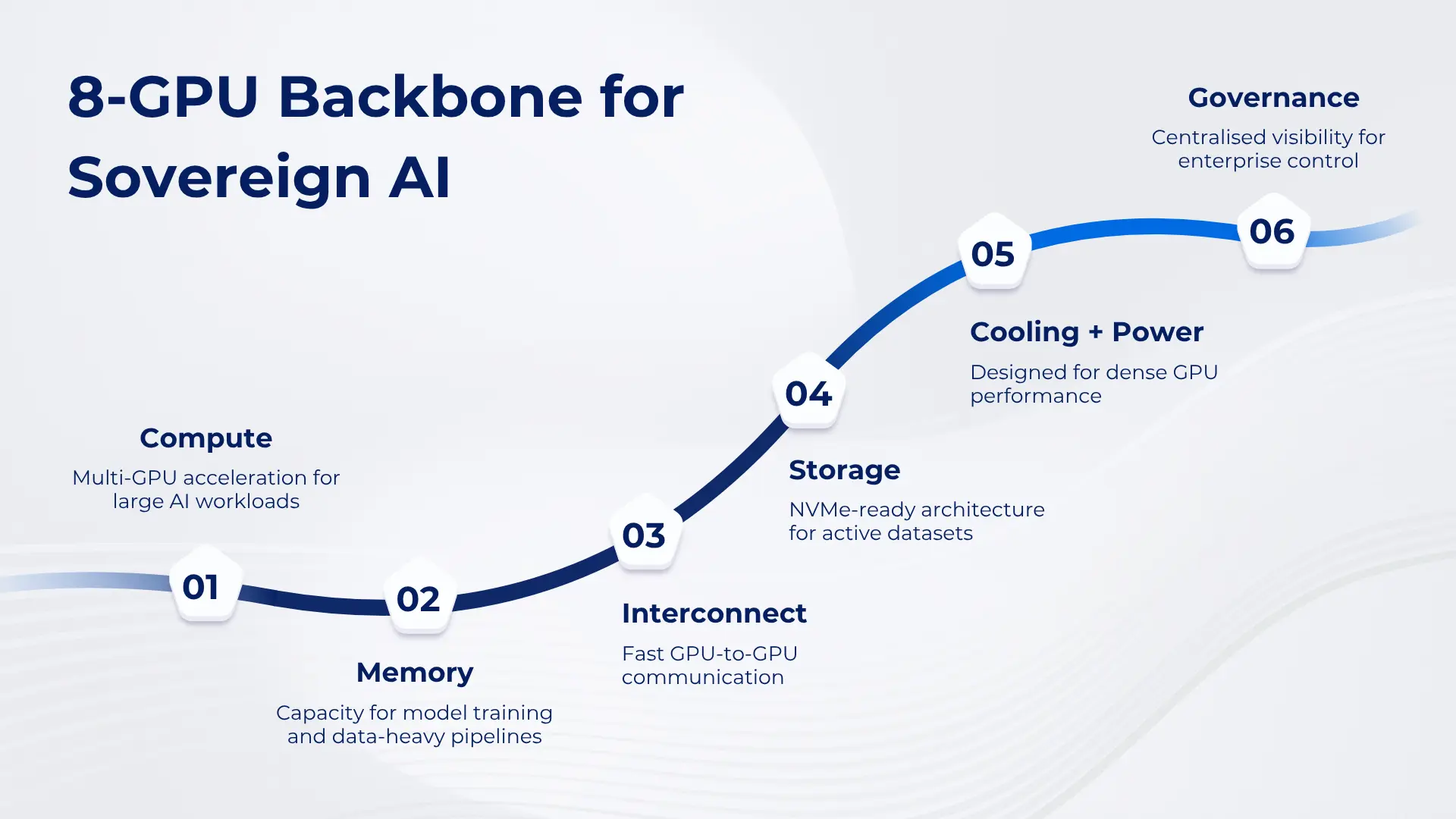
Standard compute vs AI training backbone
| Layer | Standard Compute Approach | AI Training Backbone Approach |
| GPU capability | Limited acceleration for heavy models | Multi-GPU acceleration for training and fine-tuning |
| Memory | Enough for routine applications | Designed for large datasets and model pipelines |
| Interconnect | Basic server connectivity | High-speed GPU-to-GPU and CPU-to-GPU paths |
| Cooling and power | Built for moderate loads | Designed for dense GPU thermal and power needs |
| Governance | Fragmented project-level systems | Centralised capacity planning and workload visibility |
Build the backbone of Sovereign AI infrastructure in India with Camarero SDI200A2G-820. Explore an 8U NVIDIA HGX H100/H200 8-GPU system designed for AI/deep learning training, HPC and other demanding workloads: https://tyronesystems.com/servers/SDI200A2G-820.php
Planning AI training infrastructure for sovereign workloads
A sovereign workload roadmap should begin with the type of models the organisation expects to run. LLM training, domain fine-tuning, drug discovery, climate modelling, computer vision and industrial AI do not place the same load on infrastructure. The right approach is to map workloads by compute intensity, data sensitivity, expected scale and production relevance.
This planning also helps finance and technology teams avoid two common mistakes: overbuilding for low-value experiments or underbuilding for strategic workloads. Sovereign AI infrastructure should be sized for realistic growth, not just immediate demonstrations.
SDI200A2G-820 for sovereign AI infrastructure
For organisations building the backbone of Sovereign AI infrastructure in India, Camarero SDI200A2G-820 fits the heavy AI training and HPC layer. It brings an 8U NVIDIA HGX H100/H200 8-GPU architecture with high memory capacity, high-speed interconnect options, NVMe-ready storage and enterprise-grade power and cooling design.
This makes SDI200A2G-820 relevant for AI/deep learning training, HPC, analytics, drug discovery, climate modelling and other demanding workloads where Sovereign AI infrastructure needs more than standard compute. It gives enterprises a stronger platform for performance, control and future workload scale.
Conclusion
Sovereign AI infrastructure in India needs more than policy alignment. It needs a compute backbone that can support demanding AI training workloads with performance, scale and control. For enterprises planning that backbone, SDI200A2G-820 should be evaluated as a serious infrastructure layer for heavy AI and HPC workloads: https://tyronesystems.com/servers/SDI200A2G-820.php
Frequently Asked Questions
What is Sovereign AI infrastructure?
Sovereign AI infrastructure is locally controlled compute, storage, networking, security and governance designed to support trusted AI workloads.
Why does Sovereign AI need strong GPU infrastructure?
Training and fine-tuning AI models require accelerated compute, high memory bandwidth, fast storage and reliable interconnects.
What is the role of an 8-GPU backbone?
An 8-GPU backbone gives enterprises a more powerful platform for AI training, LLM workloads, HPC and multi-team model development.
Where does the Camarero SDI200A2G-820 fit?
It fits AI training and HPC use cases that require NVIDIA HGX 8-GPU acceleration, scalable processors, large memory capacity and enterprise-grade infrastructure design.