Enterprise AI is moving from experiments to infrastructure planning. As model sizes, data volumes and inference requirements grow, organisations need AI Factory environments that can support sustained compute, dense networking, efficient cooling and predictable scale. Liquid-cooled servers are entering the conversation because AI Infrastructure is no longer only about adding GPUs. It is about designing a data centre-ready system that can run demanding workloads without power, heat or throughput becoming the limiting factor.
Why AI Factory Infrastructure Needs a New Design Lens
AI Factory infrastructure is the operating foundation that turns models, data and compute into repeatable AI output. Unlike isolated AI labs, an AI Factory must support multiple teams, heavier workloads, faster iteration and production inference. This requires a stronger balance across compute density, memory, interconnect, storage, power and cooling.
The old approach of treating servers as standalone boxes is becoming less practical. Enterprise AI Solutions now need rack-level thinking, workload orchestration and data centre planning. If the compute layer is powerful but cooling is weak, performance can throttle. If networking is underbuilt, distributed workloads slow down. If power planning is reactive, infrastructure expansion becomes difficult.
Why Cooling Is Now a Strategic AI Infrastructure Question?
AI-optimised servers are changing power and cooling profiles inside data centres. Gartner forecasts global data centre electricity consumption to grow 26% in 2026, and estimates that AI-optimised server adoption will account for 31% of data centre power consumption in 2026. These figures make cooling efficiency a business issue for enterprises planning large-scale AI Infrastructure.
What Liquid Cooling Changes for Enterprise AI?
Liquid cooling helps infrastructure teams support higher-density compute environments while improving thermal control. For AI workloads, this matters because sustained training and inference jobs push systems harder than many traditional enterprise applications. Liquid-cooled architecture can support denser GPU and CPU configurations, reduce heat-related constraints and create a more predictable path for AI Factory scale.
The goal is not simply to adopt liquid cooling because it sounds advanced. The goal is to match the infrastructure design to the workload profile. Enterprises should evaluate model size, batch behaviour, training frequency, inference latency requirements, networking needs and data centre constraints before standardising the AI Factory stack.
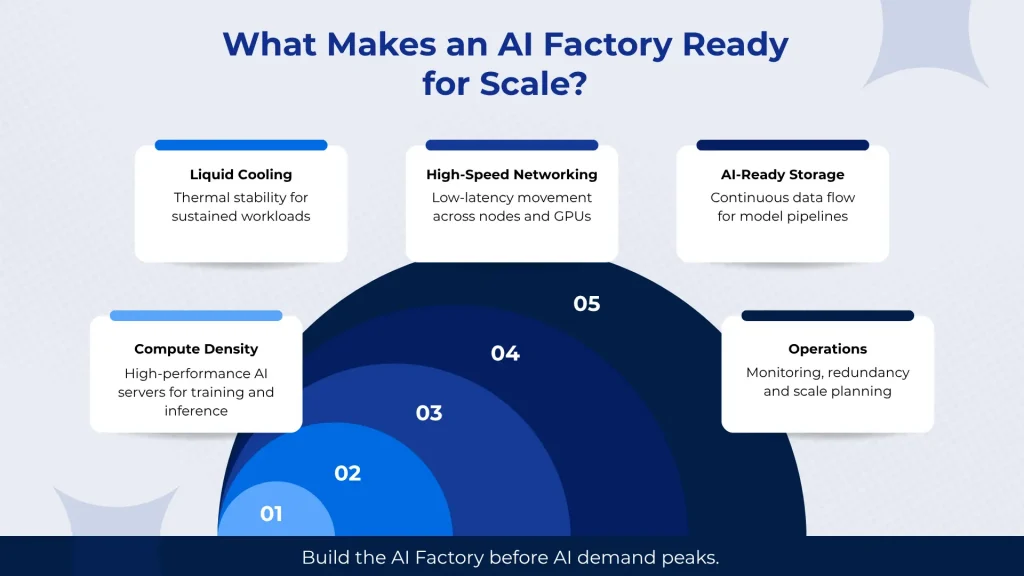
AI Factory Design Questions
| AI Factory Layer | Question to Ask | Why It Matters |
| Compute | Can servers support sustained AI workloads? | Avoids performance gaps during training and inference |
| Cooling | Can thermal design handle dense AI systems? | Prevents throttling and protects uptime |
| Networking | Can GPUs and nodes communicate at scale? | Supports distributed workloads and faster iteration |
| Storage | Can data feed compute continuously? | Reduces GPU wait time and pipeline delays |
| Operations | Can the stack be monitored and expanded? | Keeps AI Infrastructure manageable over time |
Build the Backbone of Your AI Factory
For enterprises planning liquid-cooled AI Infrastructure, Camarero TDN100E1B-28N4 LC is positioned as a dense AI Factory server with liquid cooling, Grace CPU architecture, high-speed networking options and enterprise-ready redundancy. Explore the system here: https://tyronesystems.com/servers/TDN100E1B-28N4-LC.php
Where Camarero TDN100E1B-28N4 LC Fits Into AI Factory Planning
TDN100E1B-28N4 LC supports dual NVIDIA 72-core Grace CPUs, up to 960GB ECC LPDDR5X memory, quad GB200 GPUs, high-speed expansion options and direct-to-chip liquid cooling. It is built for organisations evaluating high-density AI compute where performance, thermal stability and infrastructure efficiency need to be planned together.
In an AI Factory roadmap, this type of artificial intelligence server can serve as the compute backbone for large model training, accelerated AI workloads, research pipelines and enterprise AI applications that need more than conventional compute. The infrastructure decision should still begin with workload mapping, but the solution fit becomes clearer when AI teams need dense, liquid-cooled acceleration.
Conclusion
The AI Factory is not a single server or a single model. It is an infrastructure operating model for repeatable enterprise AI. Liquid-cooled servers are becoming important because AI scale is creating new pressure on compute density, power and cooling. Enterprises evaluating AI Factory infrastructure should plan the full stack early, from compute and interconnect to storage, governance and data centre readiness.
Frequently Asked Questions
What is AI Factory infrastructure?
AI Factory infrastructure is the compute, storage, networking, cooling and operating stack used to build, train, deploy and run enterprise AI workloads at scale.
Why are liquid-cooled servers important for enterprise AI?
Liquid-cooled servers help support dense AI workloads by improving thermal control and supporting sustained performance in high-power environments.
What should enterprises evaluate before building an AI Factory?
Enterprises should evaluate workload scale, model size, power availability, cooling, networking, storage throughput, governance and operational support.
Where does TDN100E1B-28N4 LC fit?
TDN100E1B-28N4 LC fits as a liquid-cooled AI Factory server for dense enterprise AI infrastructure and demanding AI workloads.