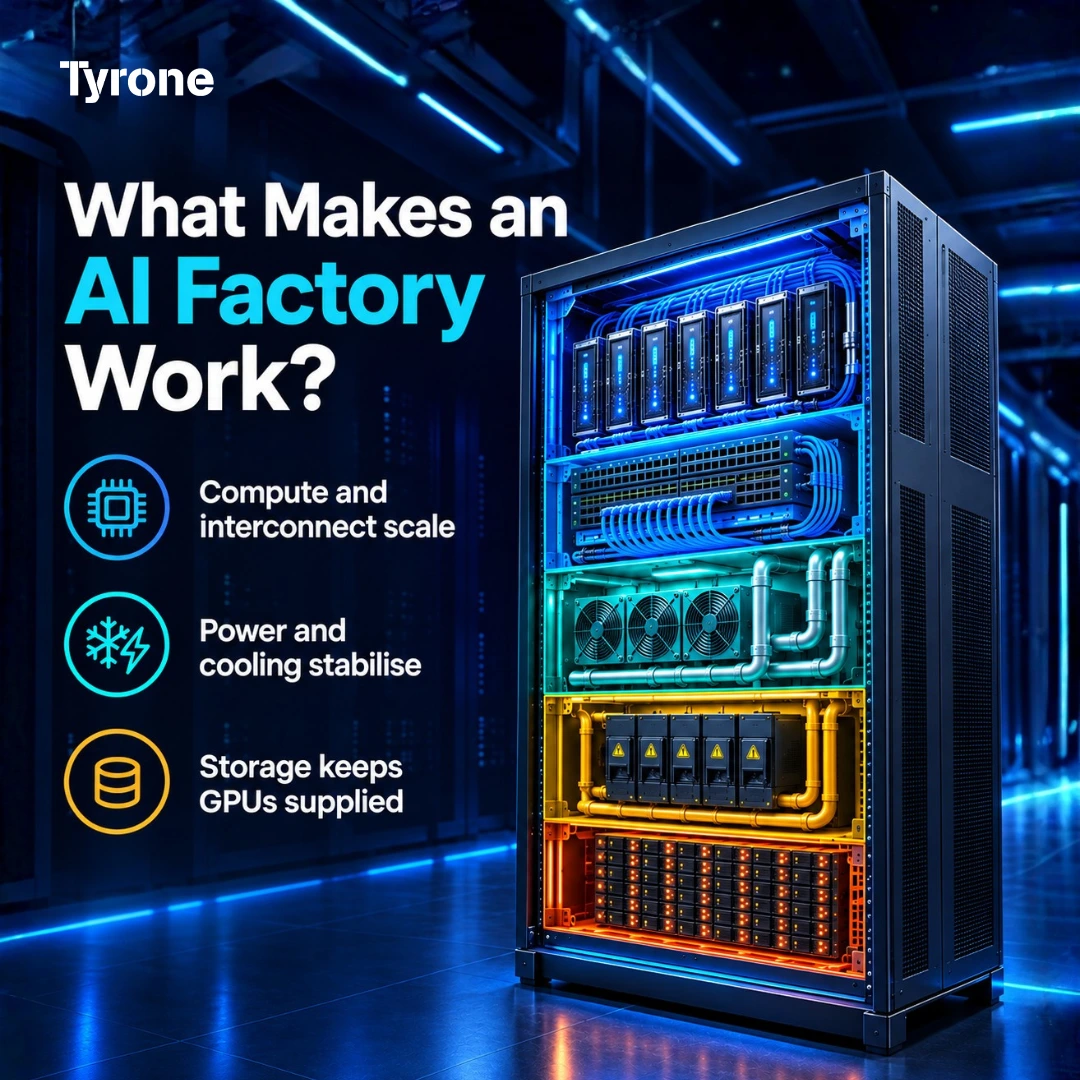
Why compute, interconnect, power, cooling and storage must be planned together
Enterprise AI cannot scale on disconnected infrastructure decisions. A powerful server without sufficient cooling creates operational risk, while dense compute without high-speed networking can slow distributed workloads. Likewise, a strong GPU stack without adequate storage throughput can leave teams waiting for data.
This is why AI Factory planning requires a systems-thinking approach, where every infrastructure layer works together.
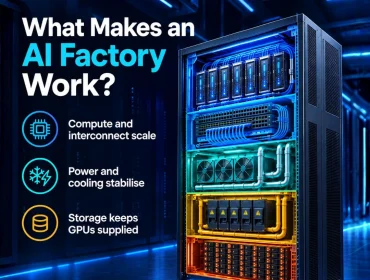
➤ Layer 1: Compute — Artificial Intelligence Servers
Artificial Intelligence Servers provide the acceleration required for model training, fine-tuning and inference. Enterprises need scalable compute capacity that can support growing AI workloads without creating infrastructure bottlenecks.
➤ Layer 2: Interconnect — High-Speed AI Networking
As AI workloads spread across multiple nodes and GPUs, high-speed networking and interconnects become critical. Efficient data movement helps the environment operate as a coordinated AI system rather than a collection of isolated resources.
➤ Layer 3: Power — AI Infrastructure Capacity
AI Infrastructure is becoming increasingly power dense. Enterprises must plan for power capacity, redundancy and future expansion limits before AI demand reaches peak levels. Power availability should be treated as a strategic infrastructure consideration, not an afterthought.
➤ Layer 4: Cooling — Liquid Cooling for AI
Liquid cooling helps manage thermal pressure in high-density AI environments, particularly when workloads operate continuously for extended periods. Evaluating cooling requirements early can help enterprises prepare for increasing compute density and thermal demands.
➤ Layer 5: Storage — AI Data Throughput
AI Factories require data to move continuously into training and inference pipelines. High-performance storage and sufficient data throughput are therefore essential components of the AI infrastructure roadmap and should be planned alongside compute capacity.
➤ The Result: A Production-Ready AI Factory
When compute, interconnect, power, cooling and storage are planned as one connected infrastructure strategy, enterprise AI becomes easier to scale, operate and optimise.
Instead of adding servers reactively, organisations can design an AI Factory that connects infrastructure capacity with business outcomes. That is the difference between simply owning AI hardware and building a production-ready enterprise AI capability.
Get in touch info@tyronesystems.com