Cloud and data centre infrastructure are important for enterprise AI, but not every AI workflow should begin there. Developers, researchers and data science teams often need a local AI Development Workstation to test models, build agents, experiment with workflows and validate ideas before scaling them into shared infrastructure. DGX Spark-style systems are bringing data centre-class AI development closer to the desk, lab and engineering team.
Why Local AI Workstations Matter in Enterprise Workflows
Enterprise AI teams often face a practical gap. Cloud-scale environments are powerful, but they may introduce queue times, governance approvals, cost concerns or workflow friction for early-stage development. Local workstations help teams move faster during exploration, testing and iteration. They give developers a controlled environment for building AI workflows before larger infrastructure is required.
This is especially relevant for Agentic AI, where teams may need to test tool use, memory, retrieval, orchestration and multi-step reasoning loops repeatedly. Running early experiments locally can reduce dependency on shared GPU queues and allow teams to debug workflows before moving them into production platforms.
Why DGX Spark Has Made Local AI Development Strategic
NVIDIA describes DGX Spark as a compact AI supercomputer that delivers up to 1 petaflop of AI performance and 128GB of unified memory in a desktop form factor. NVIDIA also states that it can support local inference on models up to 200 billion parameters and fine-tuning models up to 70 billion parameters. This signals a broader shift: local AI development is becoming a serious enterprise workflow, not only a developer convenience.
How DGX Spark-Style Systems Support Agentic AI
Agentic AI workflows require frequent iteration. Teams may test model behaviour, connect tools, validate retrieval pipelines, simulate user journeys and evaluate safety controls. A Workstation for AI can shorten this cycle by giving teams a local environment for experimentation before workloads move to cloud, data centre or AI Factory infrastructure.
The value is not that local workstations replace enterprise infrastructure. They create a practical first layer. Developers can explore, build and validate. Research teams can test model and data approaches. Infrastructure teams can reserve shared GPU clusters for workloads that are mature enough to scale. This creates a healthier workflow from desk to data centre.
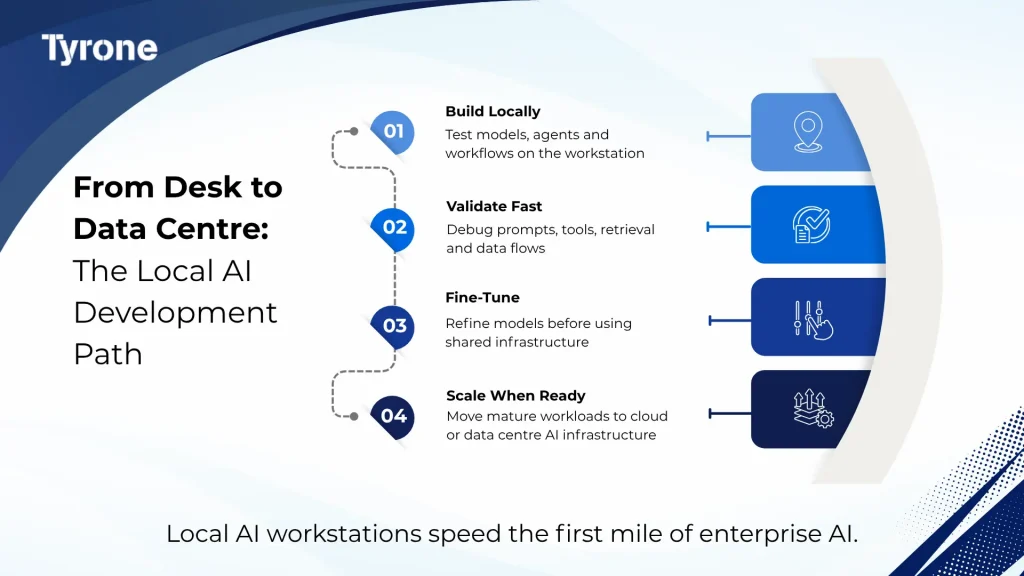
Local Workstation vs Cloud-Scale Deployment
| Workflow Stage | Local AI Workstation Role | Cloud/Data Centre Role |
| Ideation | Fast experimentation and debugging | Not always required |
| Agent building | Tool, retrieval and prompt workflow testing | Scale testing and integration |
| Fine-tuning | Small to medium local model refinement | Larger training and production runs |
| Validation | Developer-level reproducibility | Team-wide governance and deployment |
| Production | Pre-production preparation | Enterprise hosting, monitoring and uptime |
Move Faster From Desk to Data Centre
For enterprises evaluating local AI development, Tyrone Spark offers a compact AI workstation built around the GB10 Grace Blackwell Superchip, 128GB unified memory, DGX OS and datacentre-class AI performance on the desktop. Explore the workstation here: https://tyronesystems.com/servers/Spark-NGB10D1.php
Where Tyrone Spark Fits Into the AI Workflow
Tyrone Spark is positioned as a compact desktop AI supercomputer powered by the GB10 Grace Blackwell Superchip, delivering up to 1 PetaFLOP of AI performance with 128GB unified memory. It includes DGX OS, 1TB or 4TB NVMe M.2 storage options, high-speed networking, Wi-Fi 7 and a compact 1.2kg system weight.
For enterprises, this type of AI Development Workstation can support AI engineers, researchers and developers who need local model work, agent development, fine-tuning, inference testing and workflow validation. It creates a practical bridge between personal productivity and data centre-scale AI.
Conclusion
DGX Spark-style workstations are changing how enterprise AI teams think about the first mile of development. They do not replace cloud or data centre infrastructure. They make early AI work faster, more accessible and easier to validate before scale. For organisations building Agentic AI, local AI workstations can help developers move from idea to tested workflow with less friction.
Frequently Asked Questions
What is DGX Spark?
DGX Spark is a compact AI supercomputer category designed to bring high-performance AI development capabilities into a desktop form factor.
Why do enterprises need an AI Development Workstation?
An AI Development Workstation helps teams test models, build agents, validate workflows and iterate locally before moving to shared infrastructure.
How does a workstation support Agentic AI?
It allows developers to test tool use, retrieval, reasoning workflows and agent behaviour locally before production deployment.
Where does Tyrone Spark fit?
Tyrone Spark fits as a compact Workstation for AI for engineers, developers and researchers working on local AI development and agentic workflows.