For many enterprises, the AI journey started in a familiar way: one team experimenting with a model, another testing a chatbot, a business unit running a pilot, and leadership asking when these experiments would start producing real business value.
That is the point where the conversation changes.
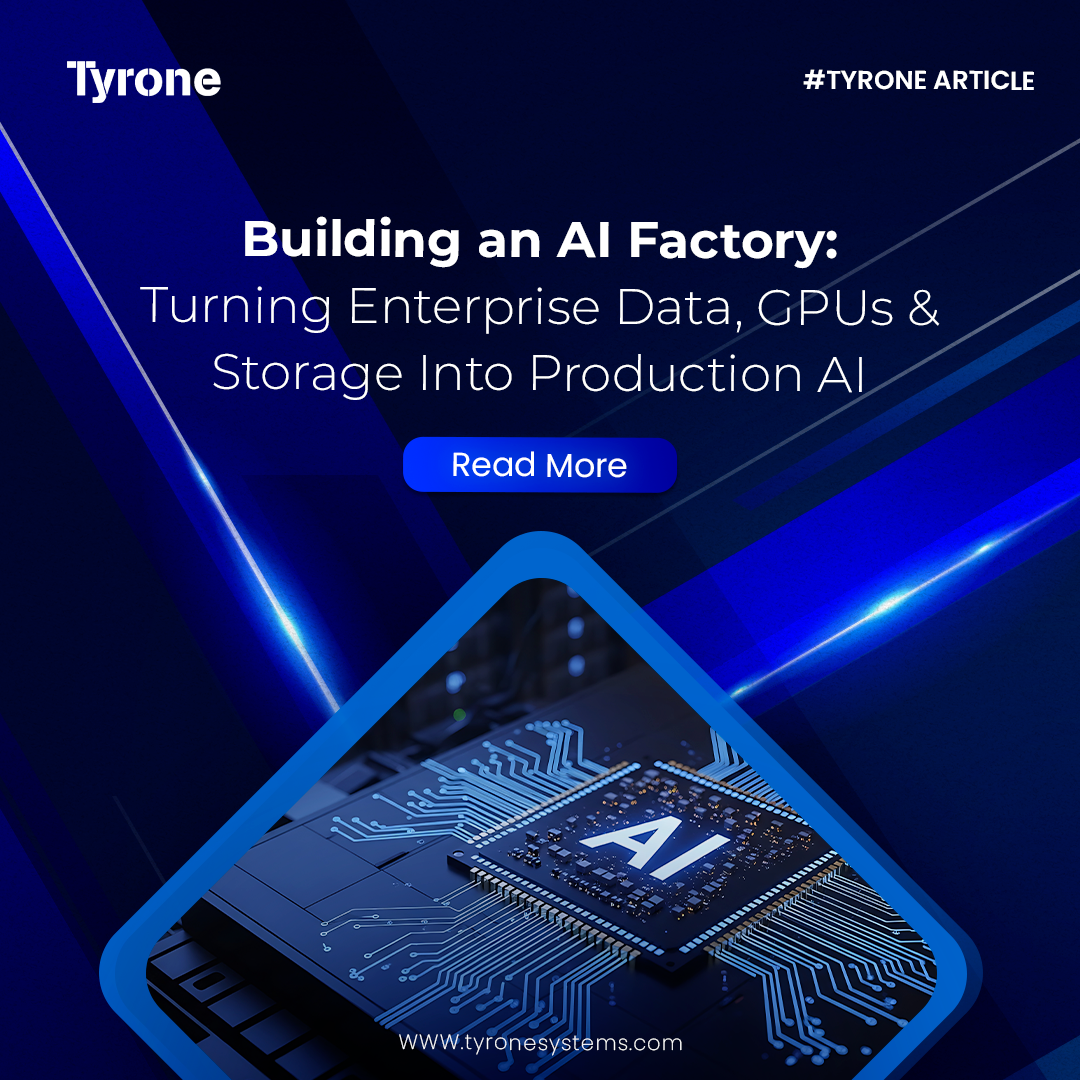
AI can no longer be treated as a series of disconnected proof-of-concepts. Once organizations move beyond pilots, they need a repeatable way to convert data, compute, storage and models into production-ready intelligence. This is where the idea of an AI factory becomes important.
An AI factory is not just a branding term. It is an operating model.
Like a manufacturing plant, it has raw materials, production lines, scheduling systems, quality checks, safety controls, monitoring and capacity planning. The only difference is the output. Instead of physical goods, an AI factory produces predictions, recommendations, tokens, simulations, insights and automated decisions that can be embedded into real business workflows.
The scale of this shift is already visible. IDC reports that full-year 2025 AI infrastructure spending reached USD 318 billion, more than double the USD 153 billion recorded in 2024, and projects the global AI infrastructure market will exceed USD 1 trillion by 2029 (Source: IDC). Gartner also forecasts worldwide AI spending at nearly USD 1.5 trillion in 2025 and more than USD 2 trillion in 2026 (Source: Gartner).
But these numbers should not be read only as market growth. In my view, they show something deeper: AI capacity is becoming a core business resource, much like cloud, cybersecurity or enterprise networks became in previous technology cycles.

Every AI Factory Starts With the Right Inputs
In a traditional factory, poor raw material slows down the entire production process. The same is true for AI.
Data is the raw material, but it must be curated, governed, tagged and made accessible. Compute is the production engine, but it must be matched to the right workload. Storage acts like the supply chain, ensuring datasets, checkpoints and model artifacts move fast enough to keep GPUs productive. Energy, cooling and facility design determine how much capacity can be deployed sustainably. Governance defines what the factory is allowed to produce and under which controls.
This is where many organizations face their first challenge. They invest in one layer without aligning the others.
A GPU cluster without storage throughput creates idle capacity. A data platform without governance creates deployment risk. A sovereign environment without local compute creates dependency. An AI factory works only when these inputs are designed as one connected system, not as separate infrastructure decisions.
The Production Lines of Enterprise AI
Once the inputs are in place, the AI factory needs production lines.
In most enterprises, these lines include training, fine-tuning, retrieval-augmented generation and inference. Each one serves a different purpose and places different demands on infrastructure.
Training requires dense GPU clusters, fast interconnects and parallel storage. Fine-tuning needs flexible GPU access, curated datasets and experiment tracking. RAG depends on high-quality data pipelines, vector search, security-aware retrieval and freshness controls. Inference requires low latency, high concurrency, observability and cost discipline.
This is why a one-size-fits-all infrastructure approach rarely works. A scalable AI factory must support different workload patterns without forcing every team into the same environment.
Scheduling Is What Turns Capacity Into Throughput
One of the most underestimated parts of an AI factory is scheduling.
As AI adoption grows, multiple teams begin competing for the same infrastructure. Data scientists need GPUs for experiments. Engineering teams need compute for fine-tuning. Business applications need inference capacity. Research groups need longer training runs. Without scheduling discipline, premium GPUs can be consumed by low-priority workloads while critical projects wait in line.
This is where infrastructure starts becoming an internal AI service.
Composable infrastructure and workspace management can help organizations create shared capacity pools, allocate GPU resources by priority, isolate workloads, manage role-based access and improve utilization visibility. Skylus.ai can be positioned as the workspace control layer that helps teams use GPU infrastructure more efficiently instead of leaving capacity trapped in static islands.
For stakeholders, this matters because AI infrastructure is expensive. The goal is not just to buy more GPUs. The goal is to make every GPU-hour count.
Quality Control Cannot Be an Afterthought
Every factory needs quality control. AI factories are no different.
For AI, quality control includes dataset validation, model evaluation, drift monitoring, prompt testing, retrieval testing, security review, access governance and cost observability. These controls cannot be added after deployment. They need to be part of the model lifecycle from the beginning.
This becomes even more important in regulated and enterprise environments. Teams should be able to trace which data version, model version, infrastructure environment and policy state produced a specific output. That level of auditability is critical for industries such as financial services, healthcare, manufacturing, defence and the public sector, where AI decisions can affect risk, service delivery and compliance.
In my opinion, this is where the AI factory idea becomes most valuable. It brings discipline to AI adoption. It helps organizations move from experimentation to repeatability, and from isolated innovation to governed production.

The Real Outcome Is Production AI Capacity
The business case for an AI factory is not simply faster experimentation. It is production AI capacity.
That means the ability to move an idea from data to model to deployment repeatedly, securely and economically. It is the difference between running impressive demos and building AI systems that actually support business functions at scale.
Tyrone, Velox, ParallelStor and Skylus.ai can be positioned together as infrastructure layers for this operating model. GPU systems provide accelerated compute. AI storage solutions enable high-throughput data movement. Unified data platforms support hybrid and HPC workloads. Composable workspaces improve resource efficiency across teams.
For enterprise stakeholders, the value lies in integration. An AI factory is not about buying isolated technology components. It is about building an architecture where enterprise AI infrastructure, GPU infrastructure, AI storage solutions and scalable AI computing work together as one production system.
That is what turns infrastructure investment into repeatable AI capability.And as AI moves deeper into enterprise operations, this may become the real competitive question: not who has experimented with AI, but who has built the factory to produce it at scale.