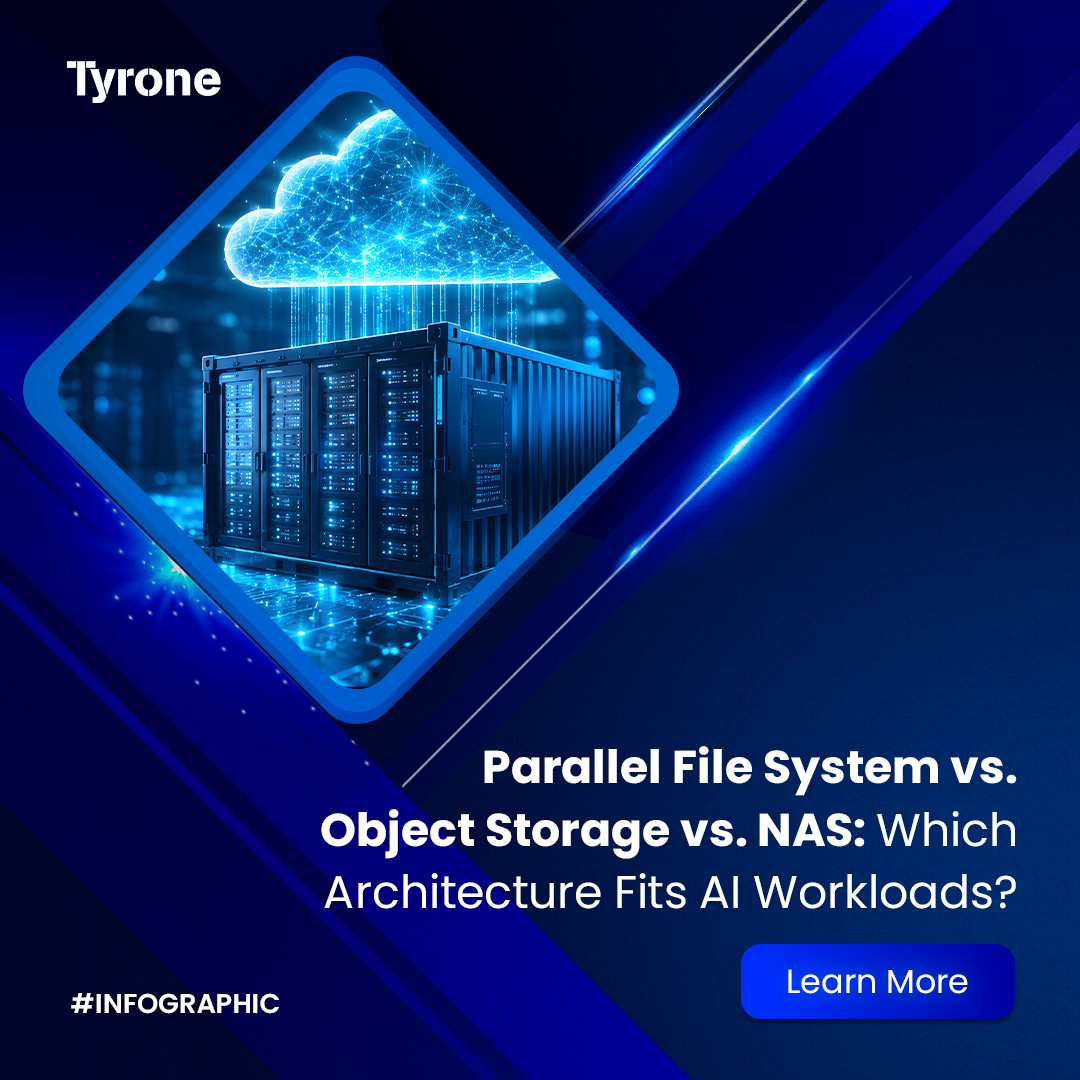
The storage architecture you choose for AI workloads is not a trivial decision—it directly determines whether your expensive GPU cluster runs at 80% utilization or idles at 40%. Three dominant architectures compete for enterprise AI deployments: Parallel File Systems, the high-throughput workhorses of traditional HPC; Object Storage, the cloud-native scale-out solution for unstructured data; and Network Attached Storage (NAS), the familiar enterprise standard now evolving with parallel capabilities. Each brings distinct strengths and critical weaknesses to AI workloads. Modern parallel file systems deliver the sustained throughput needed to keep thousands of GPUs data-saturated during training—often achieving 100GB/s or more across large clusters . Object storage provides the exabyte-scale capacity and cost-efficiency for AI data lakes, but its RESTful API and higher per-operation latency can cripple iterative training loops . NAS offers enterprise familiarity and simplified management but struggles under the metadata pressure of billions of small training files . The reality is that no single architecture wins across all AI stages—from data ingest to training to inference. This infographic provides a head-to-head comparison across the metrics that matter most: sustained throughput under multi-GPU load, metadata scalability to billions of files, checkpoint write latency, and the ability to handle both high-performance training and real-time inference workloads. For organizations building Enterprise AI Infrastructure, the choice extends beyond raw performance to include operational complexity, total cost of ownership, and the ability to integrate with existing data pipelines. Understanding these architectural trade-offs is the first step toward selecting the Best storage solution for AI workloads for your specific use case.
1. Parallel File Systems: The Performance Standard for AI Training
- What It Is: A storage architecture that distributes file data across multiple servers and storage devices, allowing hundreds or thousands of clients to access the same files in parallel. Data is striped across many nodes, enabling aggregate throughput that scales with cluster size .
- When to Choose: Parallel file systems excel at AI training workloads, where large datasets must be streamed sequentially to thousands of GPUs. They deliver the sustained throughput—often exceeding 100GB/s—required to keep accelerators saturated. Traditional HPC parallel file systems like Lustre, GPFS, and PanFS have proven highly effective for training, which resembles modeling and simulation workloads in its high-bandwidth sequential read patterns .
- Key Strengths: High sustained throughput for large files; low-latency metadata operations; POSIX compliance enabling existing AI frameworks to run without modification; support for RDMA and GPU-direct technologies; proven scalability to thousands of nodes .
- Critical Weaknesses: Traditional parallel file systems struggle with the “large number of small files” problem common in AI datasets. Where HPC environments may have millions of files, AI workloads often involve billions of individual files as small as 64KB, creating metadata storms . Checkpointing—writing model state during training—remains write-intensive and can stall GPUs if the file system is not optimized for burst writes .
- Modern Evolution: Next-generation parallel file systems are evolving to address these weaknesses. NVMe-optimized architectures with distributed metadata engines and integrated object storage tiers now handle both training and inference workloads more effectively .
2. Object Storage: The Cost-Effective Data Lake Foundation
- What It Is: A storage architecture that manages data as objects with unique identifiers, using a flat namespace rather than a hierarchical file system. Accessed via RESTful HTTP APIs (typically S3-compatible), object storage is designed for exabyte-scale capacity and cost-efficient data retention .
- When to Choose: Object storage is the foundation of the AI data lake—the central repository for raw data in native formats. It excels at storing the massive volumes of unstructured data (images, video, text, sensor streams) that AI training requires. For inference and Retrieval-Augmented Generation (RAG), object storage can serve as the long-term repository for vectorized data and document stores .
- Key Strengths: Exabyte-scale capacity; low cost per terabyte; flat namespace supporting billions of objects; rich metadata tagging for search and data management; independent scaling of compute and storage; cloud-native API compatibility .
- Critical Weaknesses: Traditional object storage is too slow for active training—the higher per-operation latency and lack of POSIX compatibility can starve GPUs. While asynchronous checkpointing and optimized frameworks are reducing this gap, direct training on object storage remains challenging for latency-sensitive workloads .
- Emerging Capability: Object storage is evolving to be an “active participant” in AI workflows, with vendors integrating S3 compatibility into parallel file system deployments. The distinction between file and object is blurring, with modern platforms providing both interfaces over a unified data fabric .
3. Network Attached Storage (NAS): The Evolving Enterprise Standard
- What It Is: A file-level storage architecture that provides shared access to files over a network, typically using NFS or SMB protocols. Modern “hyperscale NAS” solutions leverage parallel NFS (pNFS) to deliver high throughput while maintaining enterprise management simplicity .
- When to Choose: NAS remains relevant for organizations with existing enterprise storage expertise seeking a familiar management model. Solutions leveraging pNFS can deliver performance approaching parallel file systems while maintaining NAS-style simplicity. Meta’s AI Research SuperCluster, for example, uses pNFS-based hyperscale NAS to feed 24,000 GPUs at 12.5TB/s on commodity hardware .
- Key Strengths: Enterprise-grade management tools; familiar protocols (NFS, SMB); standards-based implementation (pNFS v4.2) using commodity hardware; multi-protocol support including S3 access; no specialized HPC skills required .
- Critical Weaknesses: Traditional NAS was not designed for the scale or concurrency of AI workloads. While pNFS addresses many limitations, pure NAS implementations can still struggle with the metadata demands of billions of small files and the peak throughput required for large-scale training .
4. The Convergence Trend: Unified Data Platforms
- What It Is: A new category of storage platforms that combine the performance of parallel file systems with the scalability and cost-efficiency of object storage in a single, unified architecture .
- Why It Matters: The historic trade-off between performance and scale is being engineered away. Modern data platforms provide object-storage scalability with local NVMe drive performance through intelligent caching and workload-aware data placement . Organizations can store massive datasets cost-effectively while keeping GPUs data-saturated .
- Key Features: True parallel performance across NVMe; integrated value tiers for cost-effective capacity; distributed metadata engines for billion-file scalability; multi-protocol support (POSIX, NFS, SMB, S3); global namespace across sites and clouds; automated tiering and data lifecycle management .
5. Decision Framework: Which Architecture for Your AI Workload?
Conclusion: The Right Architecture for Your AI Pipeline
The “best” storage architecture for AI workloads depends on where you are in the pipeline. For training, parallel file systems remain the performance standard—delivering the sustained throughput and low-latency metadata operations that keep GPUs saturated . For data lakes and cost-effective scale, object storage provides the capacity and economics of exabyte-scale unstructured data management . For organizations seeking simplicity and enterprise-grade management, hyperscale NAS offers a familiar path with evolving performance capabilities . However, the industry is converging toward unified data platforms that combine the strengths of all three—parallel performance, object scalability, and multi-protocol access in a single architecture . For enterprises building Sovereign AI Infrastructure or scaling Generative AI production, the choice is no longer binary. Modern AI Storage Solutions provide the flexibility to serve training, inference, and archival workloads from a unified fabric—eliminating the costly data movement and management overhead of siloed storage.
Get in touch info@tyronesystems.com