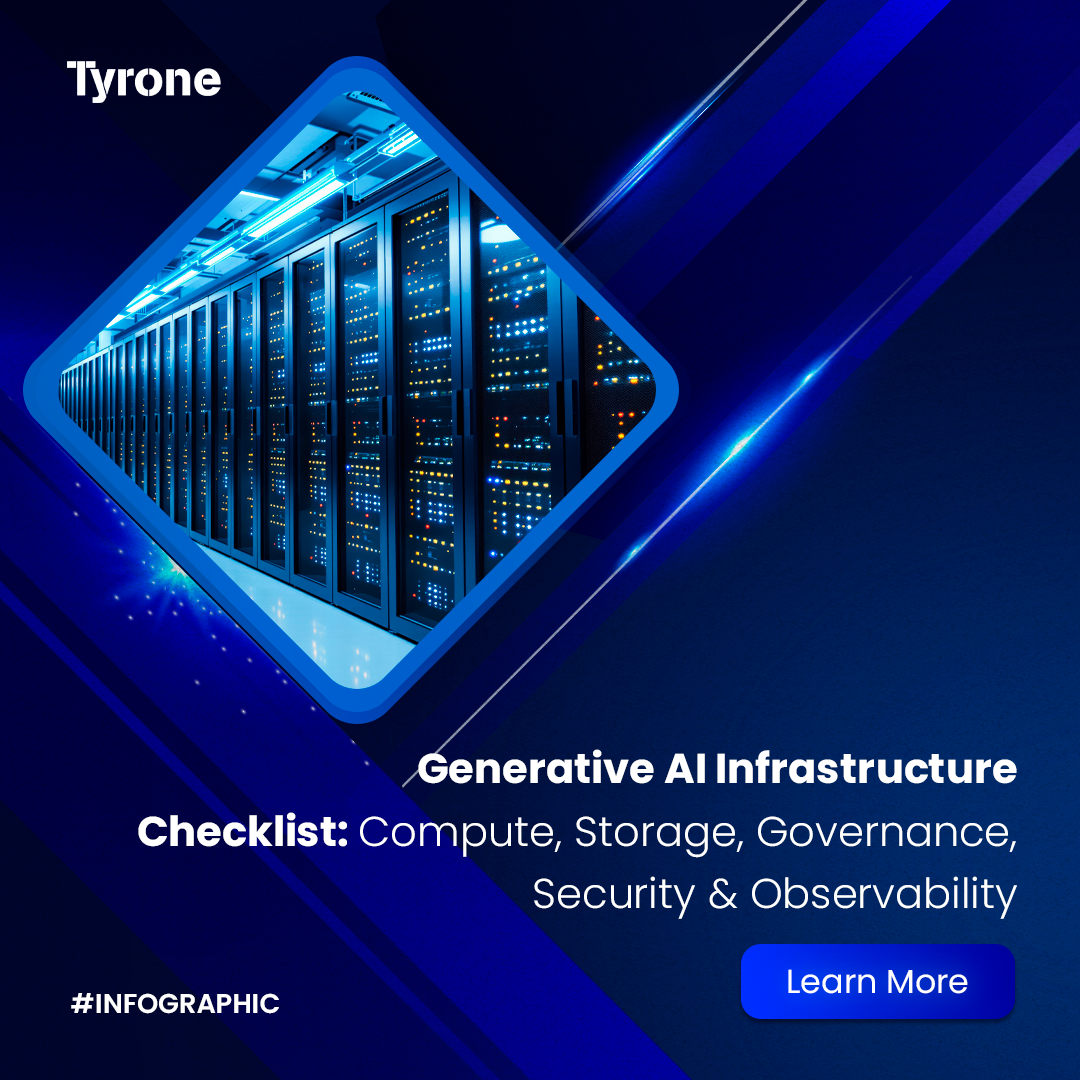
Moving generative AI from a promising pilot to a reliable, enterprise-grade production system is a complex undertaking that requires careful planning across multiple infrastructure dimensions. What works in a controlled experimentation environment often fails when exposed to real-world demands: unpredictable usage patterns, stringent security requirements, and the need for consistent performance at scale . The gap between ambition and infrastructure readiness is where many AI initiatives stall, making a systematic approach to infrastructure planning essential . This checklist breaks down the five critical layers of generative AI infrastructure—compute, storage, governance, security, and observability—providing a practical framework for organizations building Enterprise AI Infrastructure that can reliably deliver Generative AI value at scale. Each layer addresses specific challenges that production AI systems must overcome to earn stakeholder trust and meet operational requirements.
1. Compute: The Engine of Generative AI
- What It Covers: The hardware foundation—GPUs, AI accelerators, and specialized compute instances—along with the orchestration layer that transforms raw silicon into a consumable, multitenant service . This includes cluster management, job scheduling, and the network fabric connecting compute nodes.
- Critical Questions to Answer:
- Have you validated end-to-end latency under realistic load conditions? Measure complete application response time including model inference, vector database retrieval (for RAG), and integration latency .
- Do you understand your “request shape”—the average input and output tokens per request? TPM (Tokens Per Minute) and RPM (Requests Per Minute) are interrelated through the formula: TPM = RPM × (input tokens + output tokens per request). Different use cases exhibit distinct shapes: chatbots typically have low tokens per request but high RPM, while document summarization shows the opposite pattern .
- Is your scaling strategy validated? Test that your chosen approach (on-demand or provisioned capacity) performs reliably under production-like peak loads .
- Have you planned for the distributed nature of modern AI applications? Production systems rarely rely on a single model but instead combine multiple specialized models—from large reasoning models to task-specific smaller models and lightweight I/O processors—into compound systems .
- Key Implementation Elements: A diversified GPU Infrastructure portfolio matching specific use cases; lossless, RDMA-capable network fabrics for distributed training; job schedulers that abstract hardware complexity and enable multitenant resource sharing . Container orchestration (Kubernetes) serves as the universal control plane across on-prem, cloud, and edge environments .
2. Storage: The Data Delivery Fabric
- What It Covers: The storage architecture that feeds data to compute resources—encompassing parallel file systems, object storage, and the data lifecycle from raw ingestion to model training to archival. Traditional capacity-optimized storage fails to meet generative AI’s performance demands; the modern imperative is a multitiered data fabric balanced to maximize throughput and eliminate accelerator starvation .
- Critical Questions to Answer:
- Can your storage deliver the sustained throughput required to keep thousands of GPUs data-saturated during training? A single training epoch may read terabytes of data sequentially, requiring hundreds of GB/s or more .
- Does your architecture handle the metadata demands of billions of training files without creating I/O bottlenecks?
- Have you implemented tiered storage—NVMe for hot training data, flash for intermediate results, and cost-effective object storage for long-term archives?
- Can your storage support the entire AI data pipeline: raw ingestion, preprocessing, feature extraction, training, checkpointing, validation, inference, and continuous retraining without data copying or staging delays?
- Key Implementation Elements: AI Storage Solutions with high-performance parallel file systems as the “hot tier” for training; all-flash distributed file systems and/or object storage platforms as the core data lake ; Global namespace to unify data across geographically distributed infrastructure; intelligent tiering that moves data between performance and capacity tiers based on access patterns; support for both POSIX and S3 protocols to accommodate diverse AI frameworks.
3. Governance: Control, Compliance, and Reproducibility
- What It Covers: The policy framework that ensures AI workloads are developed, deployed, and monitored in line with regulatory requirements and organizational standards. This includes data lineage, model versioning, audit trails, and policy enforcement mechanisms .
- Critical Questions to Answer:
- Can you answer “Which prompt used what data?” in seconds? Column- and row-level lineage emitted from every pipeline is essential .
- Have you established a cost tagging framework that identifies cost centers, business units, projects, and applications for proper cost attribution? Amazon Bedrock now enables customers to allocate and track on-demand foundation model usage using AWS cost allocation tags .
- Do you have a model and prompt registry that treats prompts and chains as immutable artifacts—hashed, tested, and rolled forward with blue/green deploys, just like microservices ?
- Have you implemented “shadow evals”—nightly canaries that replay live prompts against the last 3 model versions and regress if quality, bias, or cost drifts beyond SLOs ?
- Key Implementation Elements: Policy-as-code gates (using Open Policy Agent or similar) for every pipeline and endpoint; dynamic risk tiers that auto-route high-risk generations to human review; audit snapshots materializing quarterly “model cards” and “prompt cards” with datasets, hyperparameters, evaluation scores, and incident tickets . A unified data foundation (lakehouse with open table formats like Delta, Iceberg, or Hudi) ensures analytics, ML, and GenAI workloads draw from consistent, well-controlled sources .
4. Security: Protecting Data, Models, and Access
- What It Covers: The security layers that protect sensitive data, model artifacts, and access controls—from infrastructure-level encryption to application-level guardrails. Most tech stacks stop short of what actually makes AI production-safe, missing the layers that transform a capable model into a trusted, observable, and compliant system .
- Critical Questions to Answer:
- Have you implemented hardware-rooted trust and encrypted memory paths for sensitive workloads?
- For regulated industries, does your architecture ensure data never leaves jurisdictional boundaries (Sovereign AI Infrastructure)?
- Have you deployed runtime guardrails to intercept unsafe prompts and prevent data exfiltration? Tools like LlamaGuard, Prompt Armor, and Azure Content Safety provide this capability .
- Do you have an inference firewall for toxicity, PII detection, and jailbreak protection ?
- Have you implemented a data clean-room pattern for sensitive corpora—masking or tokenizing in a quarantined zone, generating embeddings there, then exposing only vectors to LLMs ?
- Key Implementation Elements: Security mesh integrating DLP, IAM, zero-trust access, and encrypted audit logs ; confidential computing environments for data-in-use protection; identity-based and attribute-based access controls; immutable audit trails for compliance verification.
5. Observability: Visibility into Performance, Cost, and Quality
- What It Covers: The monitoring and telemetry systems that provide visibility into model performance, usage patterns, costs, and quality metrics. Without evaluation, generative AI is essentially “taking shots in the dark”—outputs can be non-deterministic and difficult to measure using traditional techniques .
- Critical Questions to Answer:
- Are you monitoring both accuracy and latency? Accuracy measures how well the model performs on a task, ensuring reliable predictions, while latency refers to the time it takes to generate a response .
- Do you understand your two-part latency profile: Time To First Token (TTFT)—the initial delay between prompt submission and receiving the first token—and Output Tokens Per Second (OTPS)—the speed of subsequent token generation? TTFT is particularly important for user experience and perceived responsiveness, especially when using streaming APIs .
- Have you implemented prompt caching to reduce TTFT? By caching prompts, the model retrieves pre-computed token results instead of processing input tokens, significantly reducing latency .
- Do you have instrumentation to detect throttling? Monitor Invocation Throttles metrics and ensure retries are configured for API calls .
- Key Implementation Elements: Integrated observability stack including CloudWatch for critical metrics (invocation counts, latency, errors, token usage); LLM-specific alerts for drift, cost, and safety flags; model invocation logging to capture complete request-response data in S3 or CloudWatch Logs ; OpenSearch Dashboards for visualization and deeper analysis ; feedback loops incorporating human and synthetic labels for continuous improvement .
Conclusion: Infrastructure Determines AI Outcomes
Building production-grade generative AI requires more than model expertise—it demands deliberate, layered infrastructure design . The five layers of this checklist—compute, storage, governance, security, and observability—form the foundation of an AI Factory that can reliably deliver Generative AI value at enterprise scale . Organizations that master these layers will transform AI from experimental pilots into strategic assets; those that treat infrastructure as an afterthought will remain trapped in pilot purgatory. This checklist provides a starting point for evaluating your Enterprise AI Infrastructure readiness; future posts will dive deeper into each layer with implementation patterns and real-world best practices.
Get in touch info@tyronesystems.com