Executive Context: From AI Adoption to AI Sovereignty
Precision medicine is entering a decisive phase where competitive advantage is no longer driven solely by access to data or algorithms, but by control over both. Pharmaceutical enterprises are rapidly integrating AI across R&D, clinical workflows, and commercialization. Generative AI alone is projected to unlock $60–$110 billion annually in value for pharma and medical products (Source: McKinsey) .
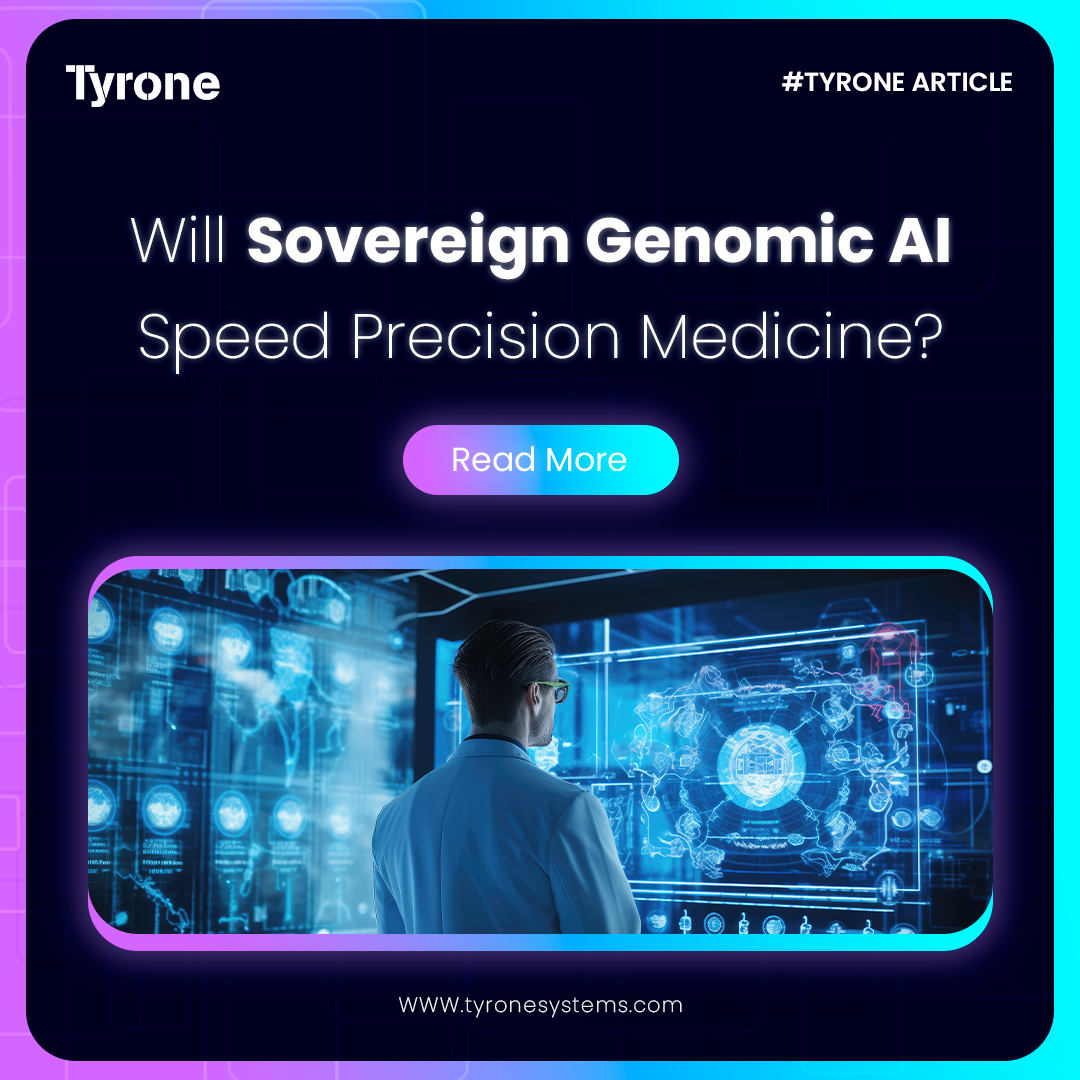
However, this acceleration introduces a structural tension: the more valuable genomic and clinical data becomes, the less viable it is to process it on shared or opaque infrastructure. Sovereign AI clouds, paired with genomic large language models (LLMs), are emerging as the architectural response to this tension, enabling secure, compliant, and high-performance precision medicine pipelines within private pharmaceutical environments.
Why Genomic LLMs Change the Precision Medicine Equation
Genomic data is inherently high-dimensional, multi-modal, and context-sensitive. Traditional bioinformatics pipelines struggle to scale across these dimensions. Genomic LLMs, however, introduce a fundamentally different capability:
- They interpret genomic sequences alongside clinical and literature data, uncovering latent biological relationships.
- They demonstrate state-of-the-art performance across diverse genomic prediction tasks, outperforming specialized models in multiple scenarios.
- They enable natural language interaction with complex biomedical datasets, reducing dependency on specialized coding expertise.
For stakeholders, this translates into a shift from linear discovery pipelines to adaptive, insight-driven R&D systems, where hypothesis generation, validation, and iteration occur in near real time.

The Sovereign AI Imperative in Pharma
While Genomic LLMs provide computational leverage, their effectiveness is constrained without sovereign infrastructure. Pharmaceutical organizations operate in one of the most regulated and IP-sensitive environments globally.
Between 2009 and 2023, over 519 million patient records were exposed in healthcare data breaches in the US alone (Source: Pharmaphorum) . This underscores a critical risk: reliance on external AI platforms introduces exposure across data residency, training pipelines, and model governance.
Sovereign AI clouds address this by ensuring:
- Data residency compliance by design (HIPAA, GDPR, regional mandates)
- Full visibility into model training, inference, and lineage
- Elimination of third-party exposure risks in high-value genomic datasets
For pharmaceutical stakeholders, sovereignty is not a compliance checkbox, it is a strategic control layer over intellectual property and clinical insight generation.
Private Infrastructure as a Competitive Moat
Precision medicine is increasingly defined by proprietary datasets: longitudinal patient records, genomic sequences, and trial outcomes. Moving these datasets across public or shared environments creates friction, both regulatory and operational.
Private pharmaceutical infrastructures integrated with sovereign AI clouds enable:
- In-situ genomic analysis without data movement
- Federated learning across internal silos without exposing raw data
- Custom model fine-tuning on proprietary datasets
This is particularly critical as pharma teams already cite data readiness as a primary barrier to AI adoption. Sovereign architectures allow organizations to standardize, curate, and operationalize data pipelines internally, turning fragmented datasets into AI-ready assets.
Accelerating Drug Discovery and Clinical Translation
The convergence of sovereign AI clouds and genomic LLMs has direct implications across the pharmaceutical value chain:
1. Target Identification and Validation
AI models can traverse genomic and multi-omics datasets to identify novel drug targets with higher precision. This reduces dependency on trial-and-error approaches and shortens discovery cycles.
2. Clinical Trial Optimization
By integrating genomic markers with patient cohorts, LLM-driven systems can improve patient stratification and trial design, leading to higher success probabilities and reduced timelines.
3. Real-Time Translational Insights
Genomic LLMs operating within sovereign environments can continuously analyze incoming trial and real-world data, enabling dynamic protocol adjustments and faster regulatory alignment.
4. Personalized Therapeutics at Scale
The ultimate promise of precision medicine, tailored treatments, becomes operationally feasible when AI systems can securely process patient-specific genomic data within controlled environments.
Strategic Implications for Stakeholders
For CXOs, R&D leaders, and digital transformation heads, the question is no longer whether AI will transform precision medicine, it already is. The strategic question is where that transformation will be controlled and monetized.
Key implications include:
- Infrastructure Decisions Are Strategic Decisions
Choosing sovereign AI over public AI platforms determines long-term control over data, models, and outcomes. - Genomic AI Becomes a Core Capability, Not a Tool
Organizations must treat genomic LLMs as foundational infrastructure, akin to ERP or cloud, not as experimental add-ons. - Partnership Models Will Shift
Collaborations will increasingly favor federated, sovereign frameworks, enabling data sharing without data exposure. - Regulatory Alignment Becomes a Differentiator
Organizations with sovereign architectures will move faster through compliance cycles, gaining time-to-market advantages.

The Road Ahead: From Acceleration to Differentiation
The convergence of sovereign AI clouds and genomic LLMs is not just accelerating precision medicine, it is redefining its operating model.
As precision medicine enters the multi-omics era, where genomics, proteomics, and clinical data converge, organizations that can securely integrate and operationalize these datasets will lead the next wave of pharmaceutical innovation.
Sovereign AI provides the trust layer.
Genomic LLMs provide the intelligence layer.
Private infrastructure provides the control layer.
Together, they form a closed-loop innovation system, one where discovery, validation, and deployment occur within a secure, scalable, and compliant ecosystem.For stakeholders, the conclusion is clear:
Precision medicine will not just be accelerated by AI, it will be owned by those who build it on sovereign foundations.