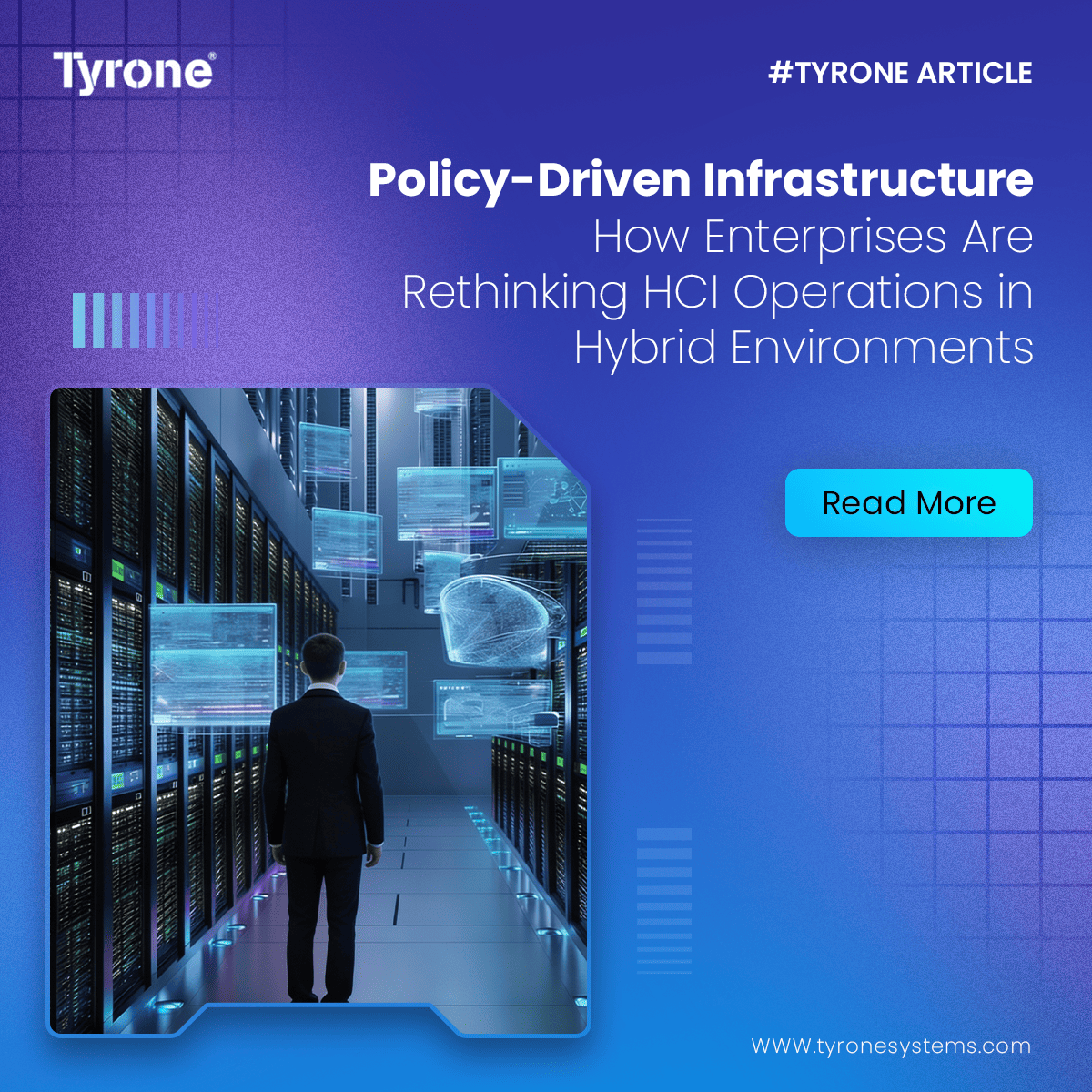
Enterprise IT teams are at an inflection point: traditional infrastructure models are giving way to more dynamic, policy-driven software-defined environments. Hyperconverged Infrastructure (HCI), once a way to simplify data center silos, has re-emerged as a strategic platform underpinning hybrid cloud operations. The combination of policy automation, software-defined management, and hybrid flexibility is prompting stakeholders to rethink how infrastructure is deployed, operated, and governed.
The Strategic Imperative: From Infrastructure to Intelligent Operations
Hyperconverged Infrastructure (HCI) abstracts compute, storage, and networking into a unified software-defined stack, delivering a consistent control plane across on-premises and cloud resources. HCI’s evolution from basic consolidation to a hybrid cloud enabler reflects a broader industry trend toward policy-driven control and automation across environments. Policy-driven infrastructure means that rules and intent, rather than manual configuration, determine how workloads behave, optimizing for performance, cost, compliance, and resilience in real time.
The shift isn’t incremental. Hybrid models are becoming standard: a global technology survey indicated that 82% of organizations have adopted hybrid cloud architectures, underscoring the need for infrastructure that works seamlessly across both on-premises and cloud boundaries (Source: Cisco).

Why Policy-Driven HCI Matters to Stakeholders
1. Unified Governance Across Hybrid Footprints
Policy-driven infrastructure originates in software-defined paradigms that translate high-level operational intent into precise controls. In HCI platforms like VMware vSAN or Nutanix, policies can govern replication, storage tiering, and resource placement automatically, removing the need for repetitive, manual scripting. These policies enforce service-level objectives regardless of where workloads reside, ensuring consistent governance across data center, edge, and public cloud resources. This capability is essential for enterprises that must balance agility with security, compliance, and performance SLAs.
2. Real-Time Optimization Through Automation
Traditional infrastructure relied heavily on expert operators tuning systems manually. Policy-driven HCI turns this into an automated loop where infrastructure constantly evaluates workload needs and adapts in real time. For instance, analytics workloads demanding low latency can trigger higher priority and localized compute resources, while non-critical archival tasks can be automatically demoted to cost-efficient storage tiers. This not only drives operational efficiency but also creates predictable performance outcomes without manual intervention.
3. Reducing Operational Complexity and Risk
As hybrid IT environments proliferate, complexity and risk surge. Policy-driven infrastructure simplifies operations by centralizing control and enabling infrastructure-as-code paradigms. These practices reduce human error, limit configuration drift, and align deployment outcomes with business objectives. For C-suite stakeholders, this reduces operational risk and aligns infrastructure behavior directly with strategic objectives.
4. Amplifying Cost Efficiency and Scalability
Policy enforcement also influences financial efficiency. HCI’s modular node-based design allows capacity to be added incrementally, supporting a “pay-as-you-grow” cost model and reducing the need to overprovision. Indeed, market analysts project rapid expansion of the HCI market, from USD 16.16 billion in 2025 to an expected USD 84.72 billion by 2033, a sign of enterprise confidence in these architectures (Source: SNS). Policies that shift workloads to the most cost-effective compute or storage tiers in real time further amplify ROI.
HCI in Hybrid: Supporting Modern Enterprise Priorities
Hybrid Cloud Integration and Workload Portability
HCI’s software-centric nature makes it inherently cloud-friendly. Workloads can be migrated between private infrastructure and public cloud without service disruption, guided by policies that encode business priorities such as data sovereignty, latency, or cost preferences. This makes HCI a cornerstone of hybrid strategies where sensitive data remains on-premises while elastic capacity is consumed in public clouds when needed.
Enhanced Resilience and Disaster Recovery
In hybrid environments, continuity is non-negotiable. Built-in HCI capabilities like automated snapshots and replication give enterprises sophisticated disaster recovery without complex scripting or additional appliances. Policies can trigger failover, replication frequency, and data placement to meet RTO/RPO objectives defined by business units.
Agility for Emerging Workloads
Modern enterprise workloads, especially AI/ML, real-time analytics, and edge computing, demand agile infrastructures. HCI accommodates this by applying policies that dynamically allocate resources based on expression of workload requirements rather than static capacity plans. This flexibility makes capacity planning more predictive and less reactive.
Governance, Compliance, and Security by Design
In regulated industries, policy-driven HCI offers a means to enforce compliance-centric controls systematically. Policies can dictate encryption, access control, and audit logging centrally, ensuring that infrastructure does not drift outside of compliance constraints, even as workloads shift across hybrid environments. For security leaders, this improves visibility and governance without compromising agility.
Challenges and Considerations for Adoption
While the value proposition is robust, successful adoption of policy-driven HCI in hybrid environments requires disciplined planning:
- Policy Lifecycle Management: Defining and evolving policies to match business realities requires cross-functional collaboration between infrastructure, security, and application teams.
- Skill Modernization: IT teams need expertise in software-defined architectures and integration patterns with cloud platforms.
- Platform Standardization: Bringing multiple HCI implementations under a consistent policy framework can be complex without unified tooling.

Conclusion
For enterprise stakeholders, policy-driven infrastructure represents more than automation, it’s a foundational shift in how operations are defined, implemented, and governed. Hyperconverged Infrastructure, with its software-defined backbone and hybrid cloud integration, is ideally positioned to deliver this shift at scale.By converting business intent into real-time infrastructure behavior, enterprises can drive performance, cost, and compliance outcomes in a predictive and auditable manner. This elevates infrastructure from a cost center into a strategic enabler of digital transformation.