Introduction
Enterprise AI labs are becoming the bridge between AI ambition and AI impact. Many organisations have data scientists, models and use cases, but they still struggle with GPU access, resource conflicts, long setup cycles and poor utilization. GPU Workspaces help solve this by giving AI teams a controlled, scalable and efficient environment for model development. This blog explains how enterprise AI labs can use GPU Workspaces to move faster from experimentation to measurable impact.
Why enterprise AI labs need structure
The first generation of enterprise AI efforts often grew organically. Teams used available servers, cloud instances, shared notebooks and ad hoc GPU access to build early models. That approach may work for pilots, but it does not scale. As more teams demand compute, AI labs face bottlenecks: idle GPUs in one project, overbooked GPUs in another, unclear ownership, inconsistent environments and delays in provisioning. The result is slower innovation even when the organisation has already invested in expensive infrastructure.
GPU Workspaces as an operating model
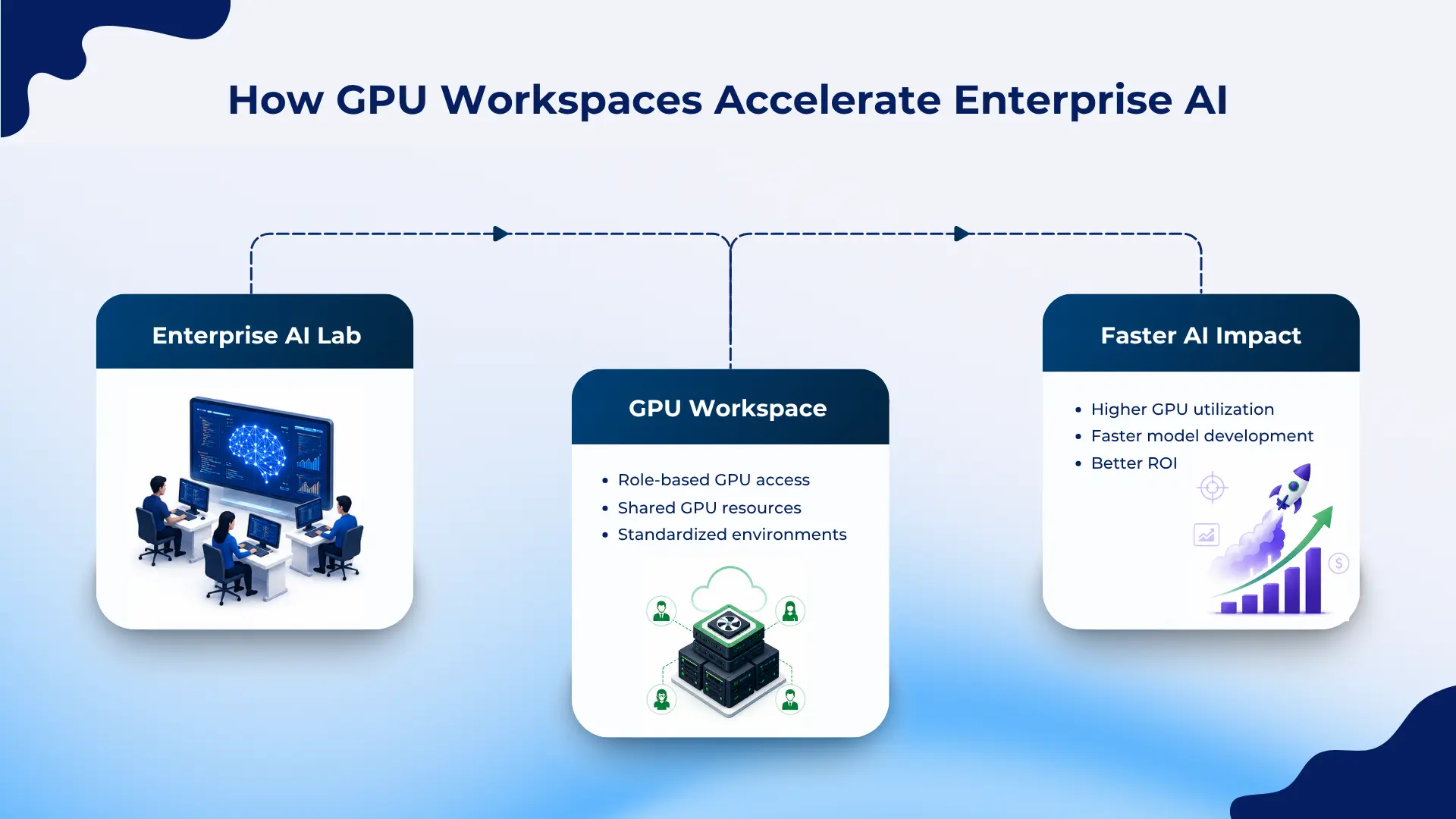
GPU Workspaces create a more disciplined operating model for enterprise AI. Instead of giving every team unmanaged access to hardware, organisations can allocate GPU resources by role, project, workload and priority. This supports better utilization, faster onboarding and stronger governance. For stakeholders, the value is not only technical. Better GPU management improves cost visibility, reduces infrastructure waste and helps AI teams deliver more predictable outcomes.
Building enterprise AI labs with Skylus AI
Rather than treating GPU Workspaces as a standalone infrastructure layer, many enterprises look for a platform that combines resource management, governance and AI development into a single operating model. Skylus AI delivers this through GPU Workspaces, AI/ML infrastructure management, role-based access controls and centralized resource visibility. The Skylus AI Lab Appliance helps organizations create governed AI environments without unmanaged GPU access or inconsistent setup cycles. For organizations running larger-scale AI training, simulation or research workloads, Tyrone High Performance Computing (HPC) extends this foundation with scalable compute infrastructure that supports enterprise and scientific computing needs.
How GPU Workspaces support AI lab efficiency
GPU Workspaces support AI lab efficiency by giving AI/ML teams controlled access to accelerated computing while helping infrastructure teams maintain visibility and governance. Instead of relying on ad hoc servers, disconnected notebooks or unmanaged GPU access, a structured workspace model gives teams a more consistent environment for development, training and experimentation. This helps reduce setup friction while keeping utilization, allocation and project ownership easier to track.
From utilization to AI impact
GPU utilization is not a vanity metric. It is a direct indicator of whether the AI lab is translating investment into output. Low utilization means capital is trapped. Poor scheduling means teams wait. Fragmented environments mean models take longer to reproduce. When GPU Workspaces are designed well, AI teams spend less time managing infrastructure and more time building, testing and deploying models. That is where faster AI impact begins.
What leaders should measure
Enterprise leaders should track time-to-provision, GPU utilization, number of active AI projects, average experiment turnaround time, production conversion rate and cost per workload. These metrics connect AI lab infrastructure with business value. They also help leadership decide when to expand compute, where to optimize storage and how to prioritise workloads across teams.
The hidden cost of unmanaged AI labs
Unmanaged AI labs create costs that are not always visible in the hardware budget. Data scientists wait for resources, infrastructure teams troubleshoot inconsistent environments, and leaders struggle to prove return on AI investment. Over time, this slows down the conversion of ideas into deployed use cases. GPU Workspaces help reduce this hidden cost by giving teams a structured way to access and use shared GPU infrastructure.
Why utilization is a leadership metric
GPU utilization should be visible to leadership because it connects infrastructure investment with AI throughput. If utilization is low, the issue may be allocation, scheduling or workflow design. If demand is high but delivery is slow, the organisation may need better workspace orchestration. Either way, utilization data helps stakeholders decide whether to optimize the current environment or expand capacity.
From AI lab to enterprise capability
The long-term goal is not simply to create a better lab. It is to create an enterprise AI capability that can support multiple business functions, research teams and production use cases. GPU Workspaces make this possible by standardizing how teams access compute, manage projects and move models forward. This is where infrastructure becomes an enabler of repeatable AI impact.
What a mature AI lab looks like
A mature enterprise AI lab has standard environments, clear ownership, workload prioritisation, GPU usage visibility, project-level access and a path from experimentation to production. It also gives business leaders a way to understand the output of the lab. Instead of asking how many GPUs were purchased, they can ask how many models moved forward, how quickly teams iterated and which use cases are closest to business deployment.
Quick Comparison Table
| AI Lab Challenge | Impact on Teams | GPU Workspace Response |
| Unmanaged GPU Access | Resource conflicts and delays | Role-based allocation and scheduling |
| Low Utilization | Poor infrastructure ROI | Shared GPU pools and visibility |
| Slow Environment Setup | Longer experiment cycles | Standardized workspaces |
| Weak Governance | Security and access risks | Project-level controls and monitoring |
| Fragmented Tools | Inconsistent workflows | Unified AI lab operating layer |
Infrastructure experience affects adoption
AI teams adopt platforms faster when the environment is easy to access, consistent and reliable. A better workspace experience reduces internal resistance and helps organisations standardize AI development without slowing down innovation.
Conclusion
Enterprise AI impact depends on more than model ambition. It depends on whether AI teams can access the right compute at the right time, within a governed environment. GPU Workspaces and AI Lab appliances give organisations a practical way to improve utilization, reduce friction, and accelerate AI outcomes. For Indian enterprises building AI capability, the AI Lab is becoming the new engine of measurable innovation.
Explore Skylus AI’s GPU Workspace and AI Lab solutions to build a secure, scalable AI environment that empowers your teams to innovate faster and deliver measurable business outcomes.
What is an enterprise AI lab?
An enterprise AI lab is a structured environment where teams develop, test and operationalize AI models using shared infrastructure and governance.
What are GPU Workspaces?
GPU Workspaces are controlled environments that let AI teams access GPU resources for development, training and experimentation.
How do GPU Workspaces improve AI impact?
GPU Workspaces reduce provisioning delays, improve GPU utilization and help teams move from experiments to production faster.
Which Skylus AI product supports enterprise AI labs?
Skylus AI GPU Workspaces and the Skylus AI Lab Appliance support enterprise AI labs by improving GPU allocation, utilization visibility, access control and AI/ML workflow consistency.