How HPC infrastructure supports heavier AI workloads, simulations and innovation at scale
Enterprise AI is becoming more compute-intensive with every new use case. Larger models, real-time analytics, simulation-led decision-making and data-heavy workloads all need infrastructure that goes beyond standard enterprise IT. This is why High Performance Computing (HPC) is becoming essential for organisations that want to move AI from proof of concept to meaningful outcomes.
Modern AI workloads need accelerated computing, fast storage and high-throughput infrastructure. GPU computing reduces the time required for model training and simulation, while computational clusters distribute demanding jobs across coordinated resources. This improves throughput and gives enterprises the ability to solve complex problems faster, whether the workload is scientific modelling, financial analytics, manufacturing simulation or research.
HPC also brings simulation and intelligence closer together. Enterprises can use high performance scientific computing to validate designs, model scenarios, optimise processes and combine those insights with AI-driven analysis. This is especially relevant for industries such as pharmaceuticals, manufacturing, finance, education, energy and research, where faster computation can improve decision quality and shorten development cycles. Storage cannot be treated as a secondary layer in this environment. Data-heavy AI and HPC workloads fail when storage cannot keep pace with compute. Networking also matters because clusters need low-latency communication to behave like one coordinated system. When compute, GPU acceleration, storage, networking and workload management work together, HPC becomes more than back-end infrastructure. It becomes the innovation layer that helps enterprise AI perform at scale.
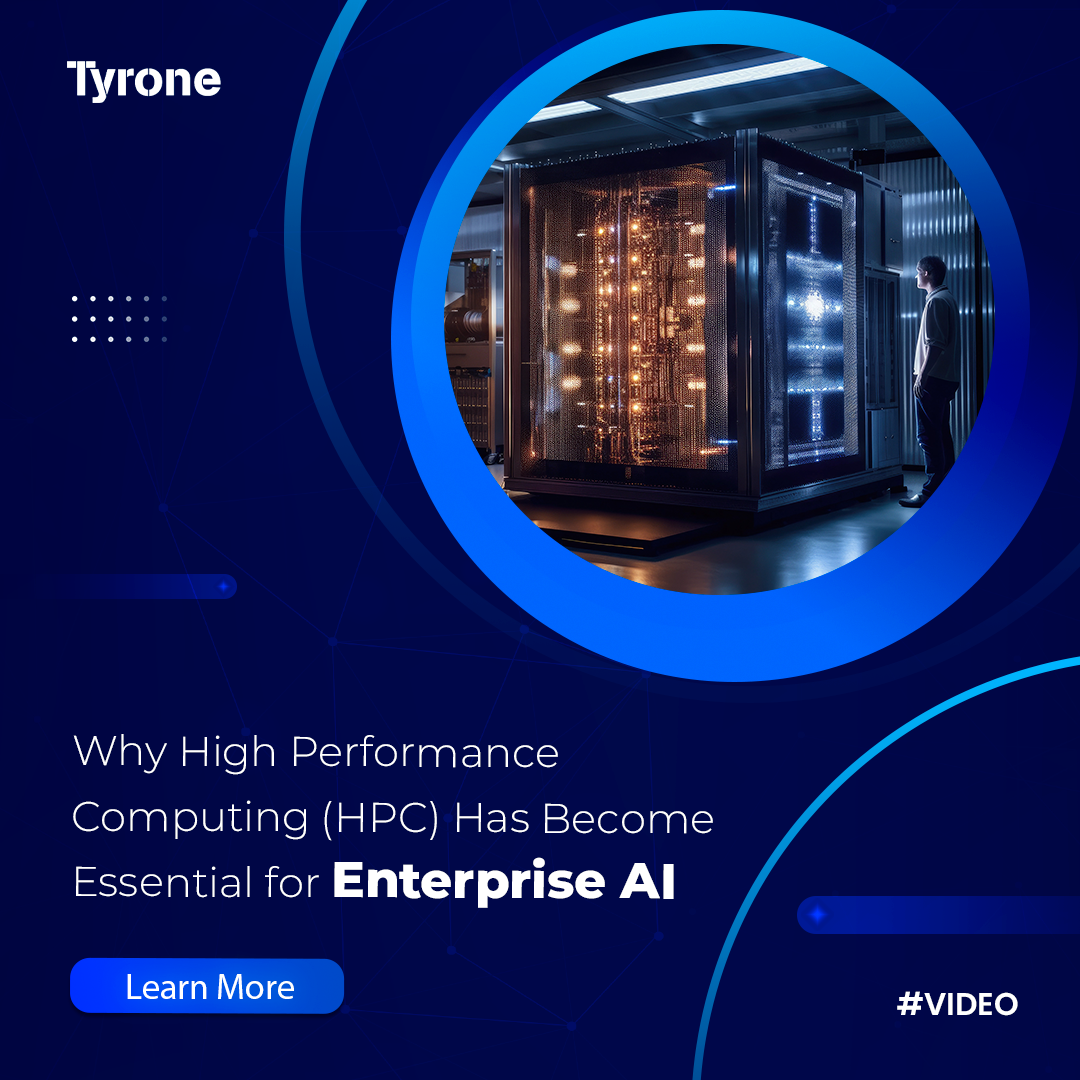
Why High Performance Computing Has Become Essential for Enterprise AI?
High Performance Computing has moved from research labs to enterprise strategy. As AI workloads become larger, HPC infrastructure is becoming critical for faster modelling, simulations and innovation.
Get in touch info@tyronesystems.com