The Strategic Convergence: Sovereign AI, Digital Twins, and Private Cloud
Manufacturing supply chains are entering a phase where optimization is no longer about incremental efficiency gains, it is about systemic intelligence, control, and resilience. Sovereign AI digital twins deployed on private clouds represent this shift. They combine three strategic imperatives: data sovereignty, real-time simulation intelligence, and secure, high-performance infrastructure.
Sovereign AI ensures that all data, models, and decision logic remain under enterprise control, mitigating regulatory, geopolitical, and intellectual property risks. Meanwhile, private cloud environments provide the deterministic performance and compliance frameworks required for mission-critical manufacturing workloads. Together, they form the foundation for digital twins that are not just analytical tools, but operational decision engines.
From Passive Visibility to Autonomous Supply Chain Orchestration
Traditional supply chain systems have long struggled with fragmented visibility and reactive decision-making. Sovereign AI digital twins fundamentally redefine this paradigm.
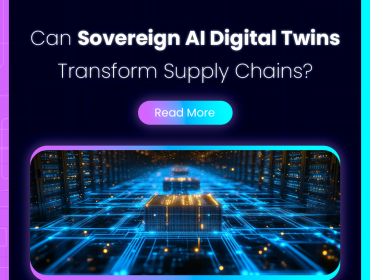
Unlike legacy dashboards, modern digital twins operate as state-aware, continuously updating replicas of the entire supply chain, from factory floors to logistics networks. When embedded with AI agents, these twins evolve into autonomous systems capable of negotiating logistics, predicting disruptions, and executing decisions in real time.
This transition delivers three critical optimizations:
- Real-time synchronization: Continuous ingestion of IoT and operational data ensures decisions reflect current realities, not historical snapshots.
- Predictive and prescriptive intelligence: AI models simulate thousands of scenarios, enabling proactive adjustments to production, inventory, and logistics.
- Autonomous execution: Multi-agent systems act on insights instantly, reducing human latency in decision cycles.
For stakeholders, this means shifting from planning cycles measured in days or weeks to continuous optimization loops operating at machine speed.
End-to-End Supply Chain Optimization Through Simulation Intelligence
Sovereign AI digital twins enable a unified, end-to-end optimization layer across the supply chain. Rather than optimizing isolated functions, procurement, production, or distribution, they orchestrate decisions across the entire value chain.
Digital twins integrate with existing supply chain management systems to simulate complex trade-offs between cost, speed, and resilience. This enables:
1. Dynamic Production and Inventory Alignment
Digital twins synchronize production planning with real-time demand signals and downstream logistics constraints. This eliminates overproduction and reduces working capital tied up in inventory.
2. Scenario-Based Risk Mitigation
Manufacturers can simulate disruptions, supplier failures, geopolitical constraints, or logistics bottlenecks, and pre-emptively adjust sourcing or routing strategies.
3. Network-Level Optimization
Instead of optimizing individual nodes, digital twins optimize the entire network, balancing manufacturing costs with transportation efficiencies and service-level commitments.
The impact is measurable. Companies leveraging digital twins have reduced freight and logistics costs by up to 8% in real-world deployments. (Source: McKinsey)
Sovereign Private Cloud: The Trust Layer for Industrial AI
While digital twins provide intelligence, sovereign private clouds provide trust and control, a non-negotiable requirement for modern manufacturing ecosystems.
Manufacturing data, ranging from CAD models to sensor telemetry, is effectively the “DNA of competitive advantage.” Exposing this data to external jurisdictions or hyperscale environments introduces strategic risk.
Sovereign private clouds address this by:
- Ensuring data residency and compliance with regional regulations (e.g., GDPR, ITAR)
- Protecting intellectual property through controlled access and zero-trust architectures
- Maintaining operational autonomy, reducing dependency on external cloud providers
This is particularly critical as supply chains become geopolitically sensitive. Sovereign AI transforms infrastructure from a technical choice into a board-level strategic decision tied to resilience and competitiveness.
Quantifiable Impact: Efficiency, Resilience, and Growth
The adoption of AI-powered digital twins is not theoretical, it is delivering measurable outcomes across manufacturing ecosystems:
- Manufacturing organizations using digital twins can reduce development time by up to 50% and significantly improve operational efficiency (Source: Industrial Sage)
- The global digital twin market is projected to reach $125–150 billion by 2032, growing at 30–40% annually (Source: McKinsey)
Beyond these metrics, the strategic value lies in resilience and adaptability. Digital twins enable “self-healing” supply chains that continuously recalibrate in response to disruptions, an essential capability in volatile global markets.
Enabling a Self-Optimizing Supply Chain Ecosystem
The ultimate advantage of sovereign AI digital twins lies in their ability to create self-optimizing supply chain ecosystems.
By combining:
- Verified, real-time data streams
- AI-driven simulation and decision-making
- Secure, sovereign infrastructure
manufacturers can transition from reactive operations to autonomous, continuously improving systems.
In such ecosystems:
- Inventory levels dynamically adjust to demand fluctuations
- Logistics routes reconfigure in response to disruptions
- Supplier networks are continuously optimized for cost, risk, and sustainability
This is not incremental transformation, it is a re-architecture of supply chain intelligence.
Conclusion: A Strategic Imperative for Manufacturing Leaders
For stakeholders, the question is no longer whether to adopt digital twins or sovereign AI, but how quickly they can operationalize them at scale.
Sovereign AI digital twins on private clouds deliver a unique combination of control, intelligence, and agility. They enable manufacturers to:
- Safeguard critical data and intellectual property
- Achieve real-time, end-to-end supply chain visibility
- Transition to autonomous, AI-driven decision-making
In an era defined by supply chain volatility and geopolitical fragmentation, these capabilities are not just competitive advantages, they are prerequisites for sustained growth and resilience.For Sovereign AI Cloud providers, this represents a pivotal opportunity: to become the trusted backbone of next-generation manufacturing ecosystems, where intelligence, sovereignty, and performance converge.