Indian enterprises are adopting artificial intelligence faster than ever, but the real test is no longer AI experimentation, it is AI impact.
Across industries, many AI proofs of concept still fail to move into production. The issue is not a lack of ambition, use cases, or innovation. The deeper challenge is infrastructure. Most Indian enterprises do not have an AI problem; they have an AI infrastructure problem that artificial intelligence has exposed.
Data remains scattered across disconnected systems. Workflows depend on manual handoffs. Compute resources are often fragmented. GPU computing capacity is not always matched to the right workload. When organisations deploy AI agents or generative AI models on top of this environment, they do not accelerate transformation, they automate the chaos.
The IndiaAI Mission is changing this landscape by expanding sovereign compute capacity, improving access to high-performance GPUs, and strengthening India’s domestic AI infrastructure ecosystem. But infrastructure without strategy is still just hardware. For enterprise AI to create measurable outcomes, organisations need to connect compute, storage, networking, governance, and business value into one scalable AI infrastructure model.
This infographic breaks down five infrastructure decisions that can help Indian enterprises move from AI pilots to production-ready AI impact.
- Start With Compute
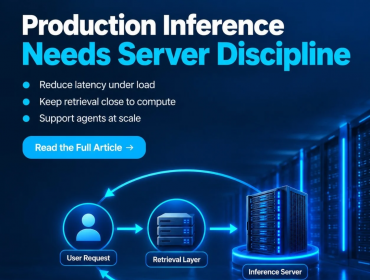
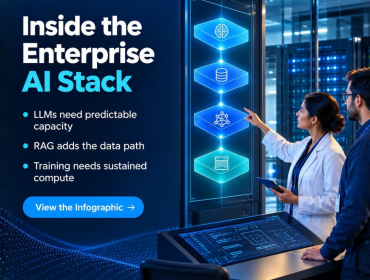
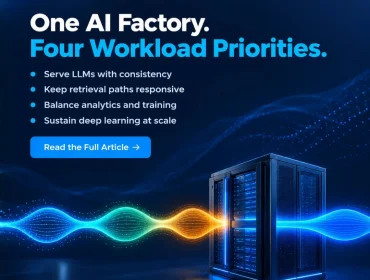
GPU computing and High Performance Computing (HPC) infrastructure give AI teams the acceleration needed for model training, inference, simulation, and advanced analytics. But compute must be matched to workload reality. AI training infrastructure needs sustained throughput and high-memory bandwidth, while AI inference infrastructure needs low latency, availability, and cost efficiency. Under the IndiaAI Mission, improved access to GPU infrastructure can help enterprises, startups, researchers, and AI labs scale faster-provided compute is planned strategically. - Keep Data Moving
AI infrastructure is only as strong as the data pipeline behind it. GPUs lose value when they wait for data. Modern AI storage solutions, high-throughput networking, and low-latency data architectures are essential for keeping training, inference, and analytics workloads moving. Enterprises need infrastructure designed for data movement, not just data storage. Parallel file systems, scalable storage architecture, and high-performance networking help reduce bottlenecks across the full AI lifecycle. - Add Governance
As enterprise AI expands across banking, healthcare, government, manufacturing, and public-sector workloads, governance becomes critical. Sovereign AI infrastructure supports data sovereignty, data residency, access control, auditability, and regulatory confidence. For Indian enterprises, local AI infrastructure is not just a compliance choice; it is a strategic foundation for sensitive and regulated AI workloads. Strong governance ensures that AI systems remain secure, accountable, and enterprise-ready. - Measure the Outcome
AI impact must be measured through infrastructure performance and business conversion, not just model accuracy. Key metrics include GPU utilisation, time-to-provision, model cycle time, workload availability, and production conversion rates. Without observability, enterprises risk investing in AI infrastructure without knowing whether it is improving business outcomes. The right measurement framework helps CIOs connect AI infrastructure investments to real enterprise value. - Build for India’s Sovereign Future
India is not just adopting AI; it is building the infrastructure to lead in AI. The IndiaAI Mission, sovereign compute expansion, domestic AI platforms, and HPC infrastructure are creating the foundation for India’s intelligent future. The enterprises that will lead this transition are not the ones that run the most experiments. They are the ones that build scalable computing foundations, clean data pipelines, governed workflows, and production-ready AI infrastructure before scaling models.
From GPU computing and AI storage solutions to Sovereign AI, Data Sovereignty, HPC infrastructure, and enterprise AI governance, the journey from AI infrastructure to AI impact depends on intentional decisions.
For Indian enterprises, the message is clear: AI impact does not begin with the model. It begins with the infrastructure.
Get in touch info@tyronesystems.com