The Shift from AI Adoption to AI Control
Indian enterprises are no longer debating whether to adopt AI, they are now grappling with how to control it. Over the past two years, AI adoption across India has accelerated at a pace exceeding global benchmarks, with organizations aggressively integrating AI into core workflows. In fact, 98% of Indian organizations are already using generative AI tools (Source: AWS study via Business Today) .
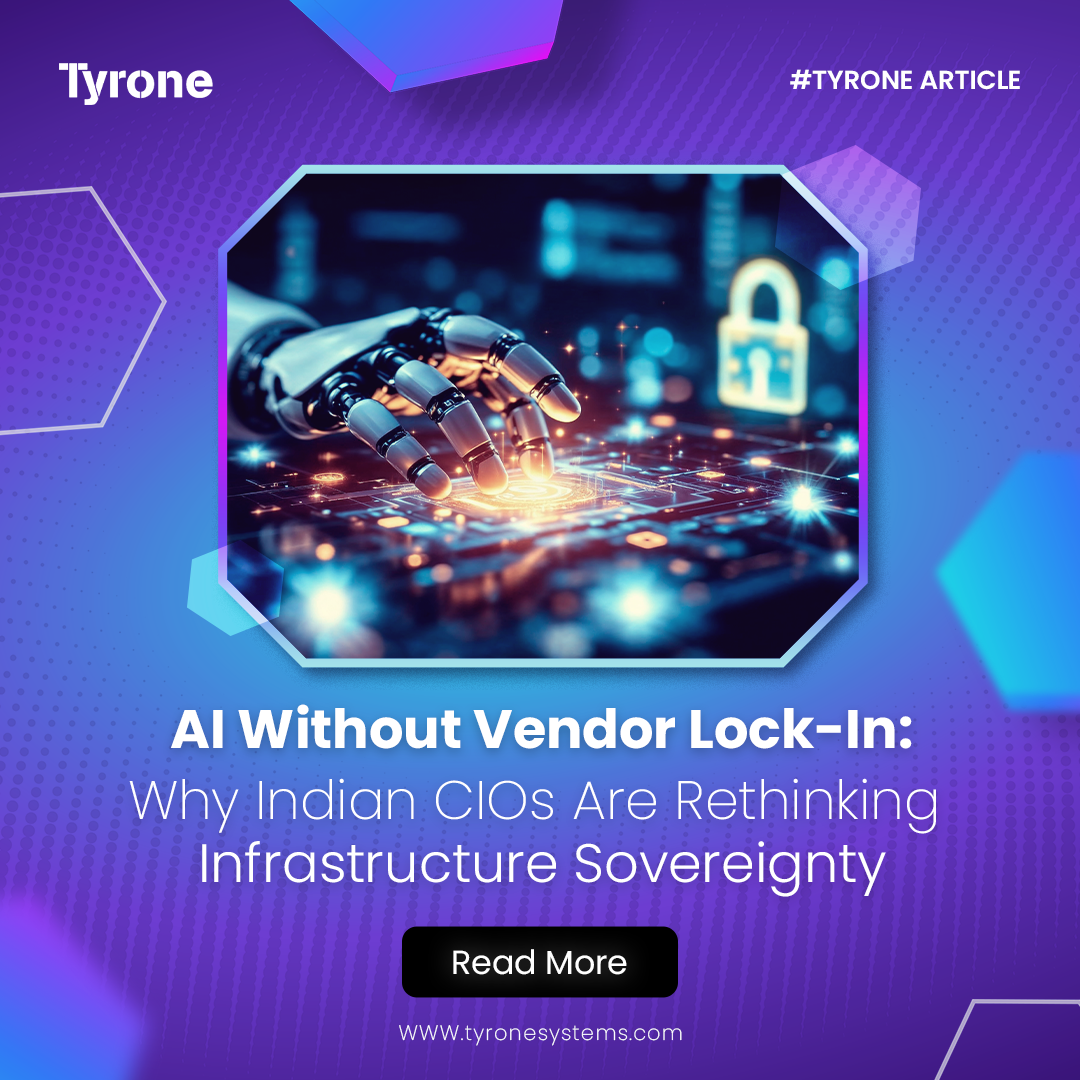
Yet, this rapid adoption has exposed a structural weakness: dependence on external vendors across the AI stack. For CIOs, the conversation is shifting from capability to control, specifically, how to avoid vendor lock-in while building scalable, compliant, and resilient AI systems.
Vendor Lock-In: The Hidden Cost of AI Acceleration
Vendor lock-in in AI is not merely a procurement issue, it is a strategic risk embedded in infrastructure decisions. Most enterprise AI deployments today rely on tightly integrated ecosystems offered by hyperscalers or platform providers. These ecosystems span compute, storage, data pipelines, and model access.
The result is a constrained operating environment where switching costs escalate over time. Data gravity, proprietary APIs, and platform-specific optimizations make migration complex and expensive. More critically, organizations lose visibility and control over how their data is processed, stored, and governed.
This becomes particularly problematic in India’s context, where regulatory frameworks such as the Digital Personal Data Protection Act (DPDP) are pushing enterprises toward stricter data accountability. CIOs are increasingly recognizing that vendor dependency undermines long-term compliance agility and operational autonomy.

Infrastructure Sovereignty Becomes a Boardroom Priority
Infrastructure sovereignty, once viewed as a policy-driven or compliance-centric concern, is now a board-level strategic imperative. Indian enterprises are reframing sovereignty not as isolation, but as control over data, workloads, and infrastructure decisions.
According to recent industry insights, only 32% of Indian organizations currently have predictive, automated, and cost-efficient infrastructure scaling in place (Source: ETCIO / Hitachi Vantara report) . This gap highlights a broader issue: while AI adoption is high, infrastructure maturity remains uneven.
As AI workloads scale, so do concerns around jurisdictional risks, service availability, and geopolitical dependencies. Enterprises are asking critical questions:
- Who owns and controls our AI pipelines?
- What happens if access to a cloud provider is disrupted?
- Can we enforce governance across multi-vendor environments?
These questions are driving a fundamental rethink of infrastructure strategy.
The Rise of Multi-Provider and Open Architectures
To mitigate lock-in risks, CIOs are increasingly adopting multi-provider and open infrastructure models. This approach is not about eliminating vendors but about avoiding dependency on any single one.
Key characteristics of this shift include:
- Hybrid and multi-cloud architectures to distribute workloads across environments
- Open standards and containerization to ensure portability of AI applications
- Decoupled data and compute layers to maintain control over critical assets
Industry developments are reinforcing this trend. New AI platforms are explicitly positioning themselves as “open” alternatives designed to eliminate lock-in and give enterprises control over their data and operations .
For Indian CIOs, this translates into a more modular AI stack, one that allows them to swap components without disrupting the entire system.
Sovereign AI and the “Make in India” Imperative
India’s push toward sovereign AI is further accelerating this transition. National initiatives are emphasizing the development of domestic infrastructure, local data processing capabilities, and indigenous AI models.
This is not just about national security, it is about economic competitiveness. Global AI capabilities remain concentrated among a small number of technology providers, creating systemic dependencies across the AI value chain .
In response, India is investing in building a national AI stack that spans hardware, compute, data, and application layers. The objective is clear: reduce reliance on external ecosystems while enabling innovation tailored to India’s unique scale and diversity .
For enterprises, this opens up new opportunities to align infrastructure strategy with national priorities, leveraging “Make in India” server ecosystems to achieve both performance and sovereignty.
Data Gravity and the Case for Localized Infrastructure
AI systems are fundamentally data-driven. As data volumes grow, the cost and complexity of moving data across jurisdictions increase significantly. This phenomenon, known as data gravity, is a key driver behind the shift toward localized infrastructure.
Indian enterprises are dealing with massive datasets generated from digital public infrastructure such as Aadhaar and UPI, which operate at population scale. Managing such data within foreign-controlled environments introduces latency, compliance, and security risks.
Localized, sovereign infrastructure enables:
- Reduced latency for AI inference and real-time applications
- Improved data governance and compliance alignment
- Enhanced security through jurisdictional control
This is why infrastructure sovereignty is no longer optional, it is foundational to scaling AI responsibly.
From Cost Optimization to Strategic Resilience
Historically, infrastructure decisions were driven by cost efficiency. Today, CIOs are optimizing for resilience, flexibility, and strategic independence.
The Indian cloud market itself reflects this shift. Sovereignty is no longer a regulatory checkbox but a core business strategy, with enterprises prioritizing control over cost arbitrage .
This evolution marks a departure from the hyperscaler-first mindset. Instead, CIOs are evaluating infrastructure through a broader lens:
- Can this architecture scale without locking us in?
- Does it support interoperability across vendors?
- Does it align with long-term data sovereignty goals?

The Road Ahead: Sovereignty as Competitive Advantage
AI infrastructure is no longer just an enabler, it is a differentiator. Organizations that control their AI stack will be better positioned to innovate, comply, and scale.
For Indian CIOs, the path forward lies in building sovereign, flexible, and vendor-agnostic infrastructure ecosystems. This does not mean rejecting global providers but integrating them into a broader, controlled architecture.
As AI continues to evolve, the winners will not be those who adopt fastest, but those who retain control.In that context, “Make in India” server ecosystems are emerging as a critical foundation, offering enterprises the ability to anchor their AI strategies in infrastructure that is not only performant, but also sovereign by design.