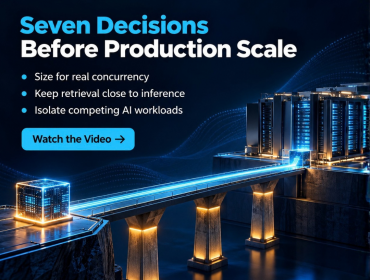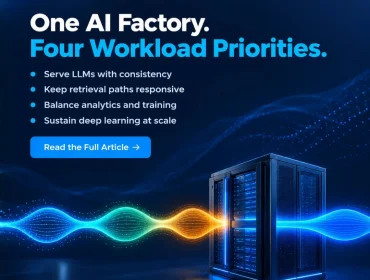
Enterprise AI becomes an infrastructure problem the moment several workloads have to run reliably together. An LLM endpoint may need low latency for business users. A RAG application may need fast access to enterprise knowledge. Analytics pipelines may process large datasets. Deep learning teams may be training models on the same accelerated compute estate. The server stack has to support all of them without turning each use case into a separate infrastructure silo.
How LLMs, RAG, Analytics and Deep Learning Share the AI Factory
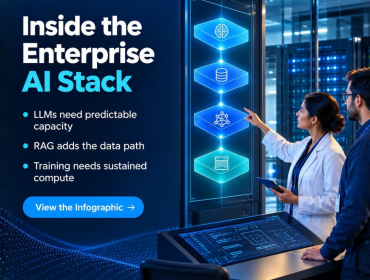
LLM inference begins with accelerator capacity. The model has to fit, requests have to be processed quickly and the platform has to absorb concurrent users. This is why production inference is different from a proof of concept: consistency matters as much as peak performance.
RAG adds a second path. Before the model generates an answer, the application retrieves relevant enterprise information. That means vector search, databases, storage and networking become part of the response time. Faster GPUs cannot compensate for a retrieval layer that is slow or poorly connected to the inference system.
Analytics broadens the resource mix further. Some analytics workloads benefit from GPU acceleration, while others rely heavily on CPU cores, system memory and storage throughput. The AI server therefore needs to be balanced enough to support the data processing that surrounds model execution.
Deep learning training places sustained demand on the platform. Multi-GPU jobs can run for long periods and consume significant accelerator capacity. In a shared AI factory, workload scheduling and resource isolation become operational requirements so training does not interrupt production inference or other priority services.
This is why enterprise AI infrastructure should be designed as a system. GPU density determines accelerator capacity. Host memory and CPUs support preprocessing and pipeline logic. NVMe and shared storage keep models and datasets accessible. Networking connects retrieval systems, distributed nodes and external data. Orchestration decides where workloads run and how resources are allocated.
Once these layers are planned together, an AI factory becomes more than a collection of servers. It becomes a repeatable foundation for adding new models and services without redesigning the infrastructure for each project. The server layer remains critical, but its value comes from how effectively it works with the rest of the stack.
| See Tyrone Camarero AI server configurations for enterprise AI factory workloads: https://tyronesystems.com/servers/RDA200A2G-424.php |
Get in touch info@tyronesystems.com