Data Lakes fail because of Format Fragmentation
Enterprises do not suffer from a lack of data. They suffer from data trapped across incompatible formats, access models, and storage silos. AI teams want S3-compatible access for large-scale model workflows. Analytics platforms depend on Hadoop-style frameworks. Business applications continue to run on NFS or SMB. Engineering and technical workloads often require POSIX access. Each environment pulls data in a different direction. The result is not a modern data strategy. It is fragmentation.
This is exactly why so many data lakes fail to deliver on their promise. Instead of becoming a unified foundation for AI, analytics, and enterprise applications, they break into isolated pools of duplicated data. Every new format, every new protocol, and every new workload often creates another copy, another repository, and another operational burden.
India’s Parallel Data Platform for AI & Enterprise Scale
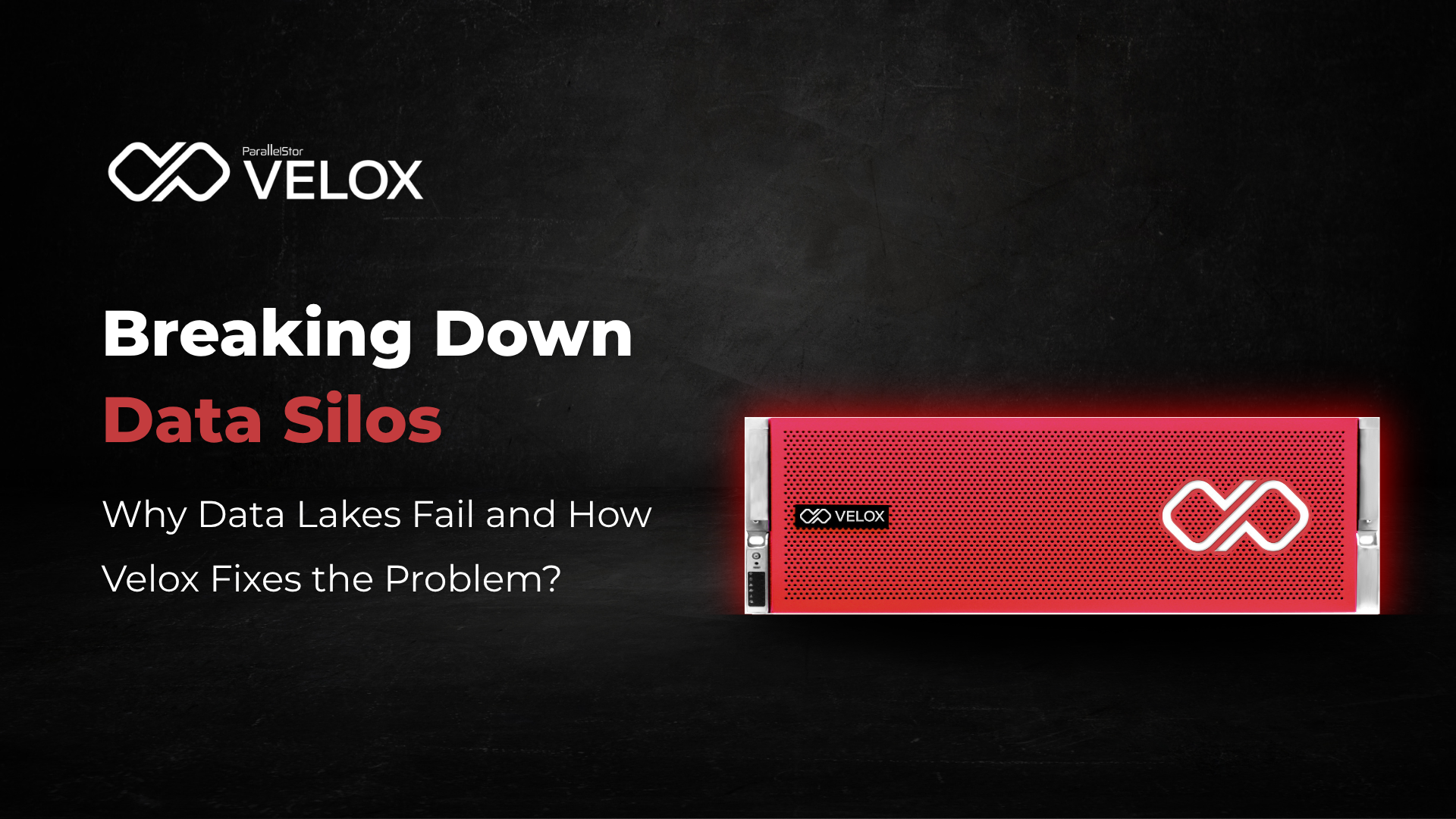
Tyrone ParallelStor Velox is India’s Parallel Data Platform for AI & Enterprise Scale. It is built to replace traditional storage silos with a unified data fabric that enables parallel access, high performance, and enterprise-wide scalability.
One Data Platform. No Silos. Infinite Scale.
From fragmented storage to one unified data fabric.
This is not just storage consolidation. It is a strategic shift from siloed infrastructure to a parallel data platform designed for AI pipelines, analytics, enterprise applications, and high-performance workloads.
Why Fragmentation Keeps Getting Worse?
Format fragmentation is one of the most underappreciated reasons enterprise infrastructure becomes complex, expensive, and slow. When different workloads cannot access the same data through a common platform, IT teams are forced to maintain multiple copies in multiple environments.
That creates a chain reaction:
- More storage sprawl
- More governance inconsistency
- More version confusion
- More ETL overhead
- More idle compute waiting for the right data
- More infrastructure cost for less business value
And the problem gets worse at scale. What begins as a workaround for one application becomes a permanent architecture problem across data centres, clouds, departments, and teams.
Why Cannot Legacy Architectures Solve it?
Legacy NAS and traditional storage systems were never designed for the demands of AI and enterprise-scale data movement. Many still depend on centralized controller models that introduce bottlenecks as concurrency and performance requirements rise.
That is the core problem with legacy architecture:
- Single-controller dependence creates performance limits
- Namespace fragmentation creates data silos
- Protocol separation creates duplicate data copies
- Scaling often increases complexity instead of reducing it
Modern enterprises do not need another storage box. They need a data platform.
How Velox solves the Problem?
Velox eliminates format fragmentation by enabling multi-protocol access to the same underlying dataset. It supports POSIX, NFS, SMB, S3/Swift, and HDFS, allowing AI, analytics, enterprise, and technical workloads to work from a common data foundation without duplication.
This changes the operating model fundamentally. Instead of maintaining isolated silos for different applications and teams, organizations can build one unified parallel data fabric where multiple workloads coexist on shared data with speed, reliability, and control.
What this means in practice
- AI teams can access object-based data for model pipelines
- Analytics teams can run frameworks on the same data foundation
- Enterprise applications can continue using familiar file protocols
- Technical users can work through POSIX environments
- IT can reduce redundant copies and simplify operations
One Unified Data Fabric, not Isolated Storage Islands
Velox is built to help enterprises move from fragmented storage to a unified data fabric. It is not just about supporting multiple protocols. It is about breaking the storage model that forces organizations to copy, move, and reformat data just to make it usable.
With Velox, enterprises can support:
- AI pipelines
- GPU-fed workloads
- Model training datasets
- Analytics environments
- Enterprise applications
- Backup and archive environments
- Traditional and modern workloads on one platform
That translates into less duplication, lower storage waste, better utilization of compute, and far less operational friction.
The Business Outcome
A real data platform should not force enterprises to choose between accessibility, performance, and scale. Velox removes that compromise.
By unifying protocols, eliminating redundant copies, and enabling parallel access to shared data, Velox helps organizations build a data lake that is actually usable. Not a lake in name, but a platform in practice.
This is why Velox is best positioned as: India’s Parallel Data Platform for AI & Enterprise Scale
It gives organizations the ability to run AI, analytics, and enterprise workloads from one high-performance data foundation, without being trapped by legacy NAS bottlenecks or traditional storage silos.
Conclusion
Data lakes fail because of format fragmentation. When every workload needs a different access model, enterprises end up with duplicated data, disconnected environments, and rising complexity. That is not a scalability strategy. It is a barrier to scale. ParallelStor Velox is built to solve this. With multi-protocol access, unified data availability, parallel architecture, and no single controller bottleneck, Velox helps enterprises replace fragmented storage with one scalable data fabric for modern workloads.
Discover how Tyrone ParallelStor Velox – India’s Parallel Data Platform for AI & Enterprise Scale can help you eliminate fragmentation, reduce copies, and accelerate AI and enterprise workloads.