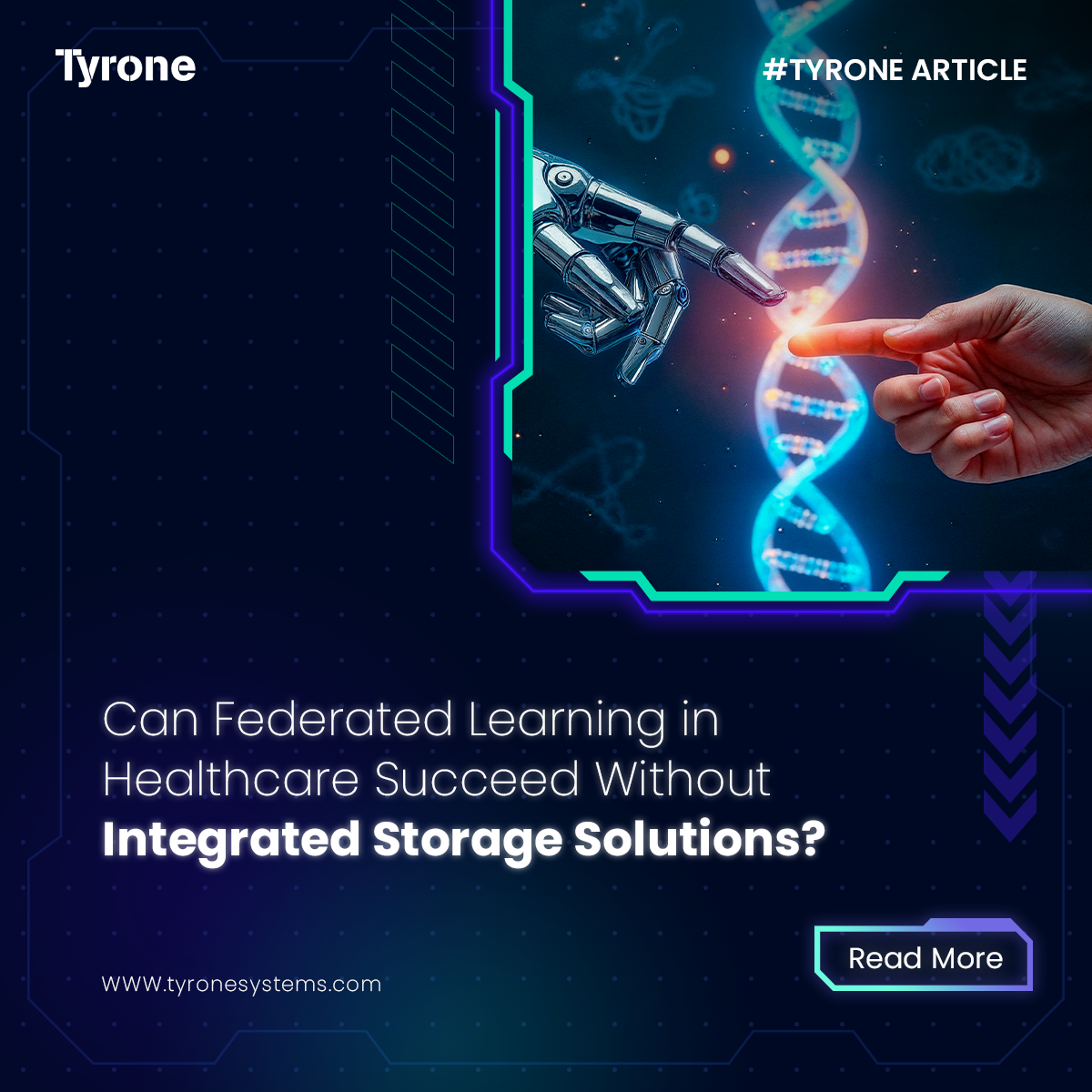
Healthcare organizations are making major strides toward leveraging artificial intelligence, particularly through federated learning (FL), to unlock insights without centralizing sensitive patient data. However, for C‑suite leaders, CIOs, and health IT investors, the pressing question isn’t whether FL could function in isolation, it’s whether it can drive real clinical value and business outcomes without integrated storage architectures. The short answer: not sustainably.
Federated Learning’s Promise, And The Underlying Reality
Federated learning enables collaborative AI model training across hospitals, labs, and clinics while keeping patient records on local servers. This design inherently supports privacy by transmitting only model updates instead of raw data, a key advantage in a highly regulated sector. FL models have, in several controlled environments, matched or even surpassed centralized models in performance metrics while preserving privacy.
Yet, progress from pilot to production, nationwide or enterprise‑wide deployments, has been slower than expected.
Underlying Barrier: Fragmented Data and Storage Silos
1. Healthcare Data Fragmentation Is Extensive
Healthcare data remains heavily siloed. Diverse electronic health record (EHR) systems, imaging repositories, and specialized departmental platforms store clinical information in incompatible formats. In markets like India, extreme decentralization, with an estimated 100,000 diagnostic labs and heterogeneous IT systems, significantly complicates standardization and data harmonization efforts that FL requires for consistent training performance. (Source: IMARC Group report)
Without unified storage or interoperability layers, FL nodes are left to reconcile incompatible and high‑variance schemas, which:
- Increases preprocessing costs
- Impairs model convergence
- Creates unmanageable governance risks
This fragmentation is not just an operational concern, it affects the very statistical integrity of federated models.

2. Interoperability Standards Adoption Is Uneven
Even where standards like FHIR (Fast Healthcare Interoperability Resources) exist, adoption varies. Most countries report active FHIR use for at least some national use cases, but this still leaves nearly one‑third of health systems operating without strong semantic consistency across sites.
Without integrated storage that normalizes data into interoperable models, federated learning faces:
- Biased or skewed input distributions
- Increased costs for integration engineering
- Greater regulatory compliance overhead
The Hidden Cost of Missing Data Integration
1. Data Quality and Model Performance Risks
FL assumes that each participating node can train using high‑quality, consistent data. Real‑world healthcare data, however, is messy, with inconsistent terminologies, missing clinical fields, and divergent coding standards. These inconsistencies lead to prediction errors and reduce overall model reliability.
Case in point: heterogeneous data environments can delay FL convergence significantly due to inconsistent feature distributions, which in real operational contexts can render insights obsolete by the time models stabilize.
2. Governance and Compliance Failures
Integrated storage solutions don’t just store data, they enforce policies such as audit trails, retention rules, and access control. Without them, federated learning projects struggle to provide:
- Clear data provenance
- Regulatory reporting evidence
- Unified audit logs across nodes
Regulators and compliance teams increasingly demand these capabilities, and failure to provide them undermines trust and slows broader adoption.
Can Federated Learning Still Work Without Integrated Storage? Yes, But With Major Trade‑offs
In constrained experiments and pilot studies, federated learning can deliver privacy‑preserving models. Regional collaborations, for example, can leverage local data without centralized archives. Projects in APAC even forecast substantial future investment, $1.6 billion toward data privacy solutions, highlighting industry acknowledgment of FL’s value. (Source: Ken Research APAC market analysis)
However, these implementations often succeed in spite of, not because of, existing infrastructure. The trade‑offs are meaningful:
- Fragmented data limits real‑world scalability
- Model validation and debugging are cumbersome
- Local compliance requirements vary, creating legal complexity
In contrast, organizations that couple FL with integrated storage layers harmonize data before training. This enables:
- Faster model convergence
- Better alignment with clinical workflows
- Improved governance
Integrated Storage: The Strategic Enabler for Federated Success
1. Facilitating Standardization Across Nodes
Integrated storage solutions bring structure to diverse data by:
- Normalizing formats using standards like FHIR
- Tagging metadata for precise clinical semantics
- Enforcing consistent taxonomies across clinical, imaging, and administrative data
This is critical in federated architectures where even small schema mismatches can mislead models.
2. Improving Trust, Compliance, and Auditability
Integrated storage systems underpin effective data governance. They enable clear:
- Patient consent trails
- Data retention policies
- Centralized oversight without moving sensitive records
This dual emphasis on governance and decentralization builds confidence among clinicians, legal teams, and executive stakeholders.
3. Enhancing Scalability and Cost‑Efficiency
A more structured storage backbone reduces one of FL’s biggest costs: communication overhead. When data is pre‑standardized, model contributions from each node align more reliably, reducing iterative communication cycles and cutting total training time, a key factor for scalability.

Conclusion: Integrated Storage Isn’t Optional, It’s Essential
Federated learning is an important innovation for privacy‑centric AI in healthcare. But without integrated storage solutions that unify data semantics, enforce governance, and streamline interoperability, FL will remain confined to pilots and boutique projects.