As Generative AI initiatives move beyond experimentation, organizations are discovering that successful production deployments depend on robust AI Infrastructure. Scaling AI is not simply about deploying larger models—it requires a coordinated approach to compute, storage, networking, and governance. Whether building an Enterprise AI Infrastructure strategy or developing a future-ready AI Factory, these five infrastructure blocks are essential.
1. Treat GenAI Scale as a Capacity-Planning Decision
Production-scale Generative AI workloads can grow rapidly in both complexity and demand. Organizations should view scaling as a long-term capacity-planning exercise rather than an extension of a pilot project. Effective planning helps create a foundation for Scalable AI Computing while preventing resource shortages, performance bottlenecks, and unexpected infrastructure costs.
2. Build GPU Infrastructure Around Workload Classes
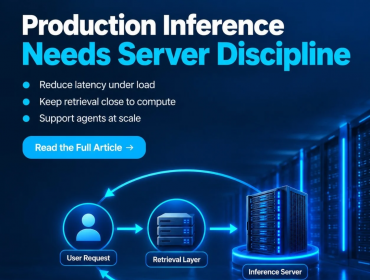
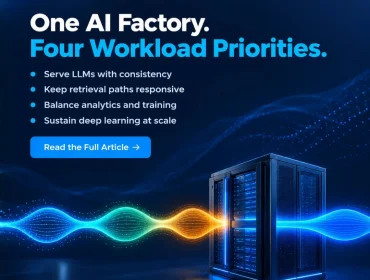
Training, fine-tuning, Retrieval-Augmented Generation (RAG), and inference all place different demands on compute resources. A well-designed GPU Infrastructure strategy allocates resources according to workload requirements, improving utilization and ensuring that critical AI applications receive consistent performance across the enterprise.
3. Prioritize AI Storage Solutions Before Expanding Compute
Adding more GPUs does not solve performance challenges if data cannot be delivered fast enough. Modern AI Storage Solutions must support high-throughput access to large datasets while minimizing latency. Optimized storage enables GPUs to operate efficiently and supports the demanding requirements of HPC for AI environments.
4. Design the AI Data Center for AI Traffic
An AI Data Center requires networking optimized for intensive east-west traffic between compute nodes, storage systems, and GPU clusters. High-bandwidth, low-latency connectivity is critical for distributed training, large-scale inference, and seamless data movement across AI environments.
5. Build Governance into Enterprise AI Infrastructure
Governance should be embedded from the beginning through identity management, access controls, logging, data lineage, and model oversight. For organizations investing in Sovereign AI Infrastructure, governance is especially important to meet security, compliance, and data residency requirements while maintaining trust in AI-driven operations.
The organizations that succeed with Generative AI will be those that treat infrastructure as a strategic asset. Building a resilient Enterprise AI Infrastructure today creates the foundation for future AI innovation, operational efficiency, and long-term competitive advantage.
Get in touch info@tyronesystems.com