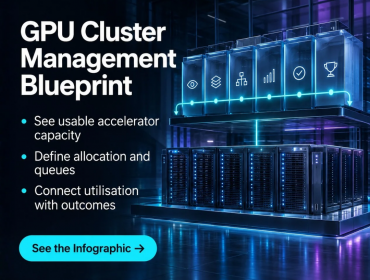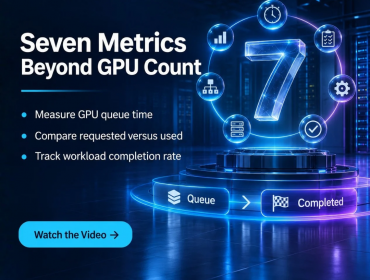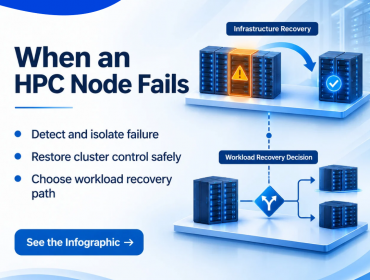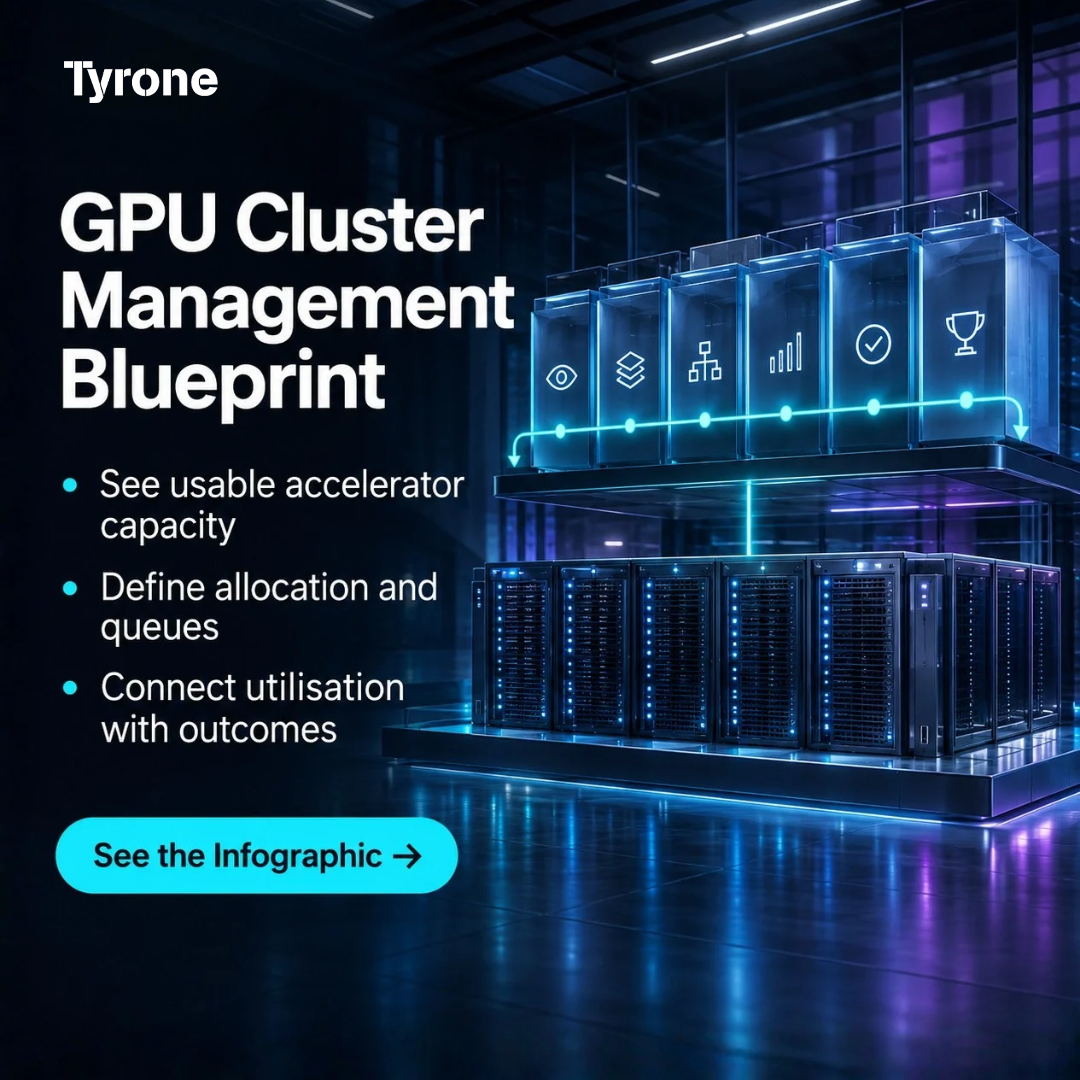
A GPU cluster becomes manageable when teams can answer five questions: what is available, who gets it, who is waiting, how well it is used and what it delivers.
Five Operating Questions for Shared AI and HPC Accelerators
Shared GPU infrastructure becomes difficult to manage when teams cannot answer a few basic questions: what capacity is available, who can use it, why jobs are waiting, how efficiently resources are being consumed and whether that consumption is producing useful outcomes.
1. Visibility — Start with the usable resource pool. Teams need to know which GPU resources and nodes are available, unhealthy or unavailable because of maintenance. That cluster-level view establishes the difference between installed capacity and capacity that workloads can actually use, giving administrators a clearer base for queue analysis and planning.
2. Allocation — Shared accelerators need explicit access rules. Users, projects and workload classes may have different priorities, service expectations and resource needs. Defining how access is granted reduces ad hoc negotiation and makes it easier to explain why one workload receives capacity before another when demand exceeds the immediately available GPU pool.
3. Queues — A queue should answer more than how many jobs are waiting. Teams need to understand why they are waiting. The cause may be a specific accelerator type, oversized requests, resource fragmentation or policy decisions. Queue visibility becomes actionable when it connects waiting workloads with the resource or rule that is preventing execution.
4. Utilisation — Reserved GPU capacity should be compared with actual use. Underused reservations can make the cluster look constrained even while accelerator cycles remain idle. Utilisation analysis also helps identify fragmented or stranded capacity that cannot satisfy current requests, giving teams evidence for workload tuning or changes to allocation policy.
5. Cost and Ownership — GPU infrastructure has a high capital and operating cost, so organisations benefit from knowing which projects, teams and budgets are creating demand. This does not require charging every GPU minute back to a department, but it does require enough ownership to connect resource consumption with capacity planning and investment decisions.
6. Outcomes — The final measure is what the accelerator pool delivers. Completed workloads, throughput and time-to-result are more meaningful than GPU activity alone. The objective is not to keep every device at maximum utilisation at all times; it is to make the right capacity available to the right workload and convert that access into productive AI or HPC output. Tyrone Cluster Manager can support the cluster-level foundation through documented provisioning, workload management, graphical monitoring and node health capabilities. GPU-specific telemetry, partitioning, scheduling or cost accounting are not listed on the published TCM page and should be evaluated separately. The strongest GPU management model combines cluster context, accelerator-level detail and outcome ownership without confusing the role of each layer.
Get in touch info@tyronesystems.com