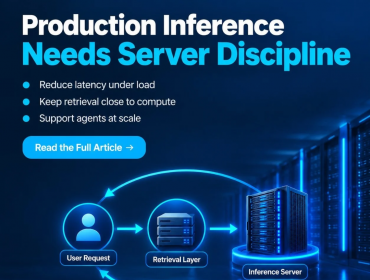
A model that performs well in testing can struggle when employees and applications begin using it simultaneously. The challenge is not simply running inference; it is maintaining an acceptable response time while requests arrive in bursts, retrieval systems are accessed and AI agents carry out multiple steps.
Seven Decisions That Connect Model Performance to User Experience
1. Define the real serving workload. Before purchasing hardware, establish how many users and applications will send requests at the same time. Include busy periods and background traffic. A test based on a single prompt may conceal queueing delays that emerge under sustained demand.
2. Size memory for the entire session. Loading model weights is only one part of inference capacity. Long prompts, model precision, active conversations and the memory used during token generation influence how many requests can run together. Benchmark representative context lengths and output sizes rather than idealised examples.
3. Measure RAG end to end. A retrieval-augmented application must find and prepare relevant information before the model answers. Query processing, vector search, optional reranking, storage and networking all contribute to the result. A faster GPU cannot compensate for a slow database or irrelevant retrieved context.
4. Account for multi-step agents. An AI agent might query an internal system, call a model, invoke a tool and validate the outcome. These steps may depend on one another. Capacity planning should reflect the number of model calls per task while latency testing should include external API and tool response times.
5. Balance the host system. CPUs and system memory support request handling, preprocessing and orchestration. Storage holds models and active data; networking connects retrieval and other services. Insufficient resources outside the GPU can limit effective model-serving capacity.
6. Prioritise production services. Training, fine-tuning and analytics can occupy GPU resources for extended periods. If those jobs share infrastructure with customer-facing inference, allocation and isolation policies are needed. Monitoring should show when latency rises and which workload is responsible.
7. Validate the path to growth. Test the complete application under realistic load, including concurrent sessions and RAG or agent steps. Track response times, queue depth, accelerator utilisation and retrieval latency. These measurements help establish when to tune software, rebalance resources or add serving capacity.
The common lesson is that an inference server is part of a connected application. The Tyrone Camarero Series provides GPU-optimised server options that can be assessed against these requirements, while the wider deployment determines how effectively the hardware is used.
| Explore Tyrone Camarero Series infrastructure for enterprise inference: https://tyronesystems.com/servers/Latest_Generation.php |
7 Infrastructure Decisions Before LLM Inference Becomes a Production Bottleneck
One fast response does not prove an LLM is ready for production. Concurrency, memory pressure, RAG retrieval and agent workflows can introduce delays long before the GPU reaches its theoretical peak. This video covers seven infrastructure decisions that help teams build dependable AI serving environments.
Get in touch info@tyronesystems.com