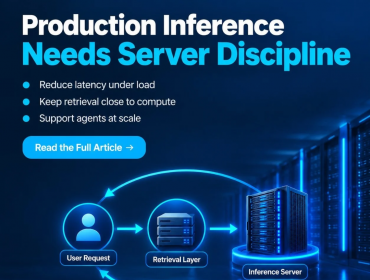
One question enters an enterprise AI application. A few moments later, an answer appears. Between those two events, several systems may have done work: a request router, a retrieval service, a vector database, an inference engine and perhaps an agent calling external tools. Understanding this sequence is essential to improving response times.
Follow the Request to Find the Real Bottleneck
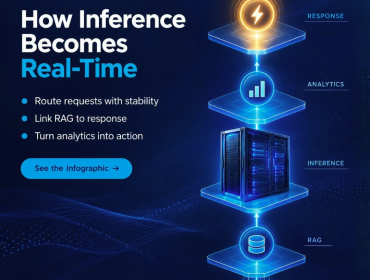
The first stage is request handling. When many users submit prompts together, the serving system needs to direct and schedule them. Waiting in a queue can be a significant part of the perceived delay. Production sizing therefore begins with concurrency, traffic peaks and acceptable response-time targets.
The second stage may be RAG retrieval. The application searches enterprise data, chooses relevant material and prepares context for the language model. Vector search and database performance matter, but relevance also matters: retrieving the wrong content quickly does not produce a trustworthy response. Optional reranking and longer retrieved passages can improve relevance while adding work to the response path.
The third stage is model inference. The server needs enough accelerator resources to hold the model and service active sessions. Model size, precision, prompt length and token generation all affect capacity. Keeping models in GPU memory where practical can reduce repeated loading, while efficient scheduling and batching help utilise available compute.
The fourth stage sits around the model. Data preparation, application logic and logging use host resources. Agents may call external tools or invoke the model more than once. Some of those operations run serially, so a short delay in each step can produce a slow overall experience. It is important to measure these calls rather than attributing every delay to the GPU.
The fifth stage is operational control. Training jobs and analytics may run on the same infrastructure estate as business-facing inference. Scheduling, resource isolation, monitoring and priorities help minimise disruption. When traffic changes, the platform also needs a plan for allocating or adding capacity.
Together, these stages provide a more practical way to troubleshoot AI performance. Rather than asking only whether a GPU is fast enough, teams can measure queues, retrieval time, inference time and tool latency separately, then target the stage responsible for the user-visible delay.
For enterprises building this foundation, the Tyrone Camarero Series offers GPU-optimised server options to evaluate as part of a wider serving architecture. Successful deployment still depends on matching those resources with application software, data services and realistic traffic patterns.
| Explore Tyrone Camarero Series AI servers: https://tyronesystems.com/servers/Latest_Generation.php |
Get in touch info@tyronesystems.com