GPU Servers for Generative AI: Text-to-Image, Text-to-Video, Training, and Inference
A text prompt may look lightweight. The infrastructure behind the response is not. The moment generative AI moves from text generation to image creation, video synthesis, fine-tuning, repeated inference and AI agents, compute demand becomes less predictable and far more infrastructure-intensive. Enterprises therefore need to think beyond whether a model can run and ask whether the underlying GPU server can sustain the workload mix, concurrency and data movement that production AI creates.
That is why GPU servers for AI are becoming a core design decision for teams building generative AI services. The same environment may need to support model development in the morning, fine-tuning in the afternoon and multiple inference endpoints or AI agents in production. Each workload stresses the system differently, so infrastructure choices need to start with the workload rather than a generic GPU count.
Why Generative AI Changes the Compute Equation
Text-to-image and text-to-video put pressure on GPU memory and throughput
Multimodal generation is computationally heavier than a simple text completion. Image diffusion and video generation repeatedly process large tensors across many steps, while higher resolution, longer clips and larger batch sizes increase memory demand. For enterprise teams, that means GPU memory, interconnect bandwidth and sustained throughput matter as much as peak accelerator specifications.
Training and fine-tuning need sustained multi-GPU performance
Model training and fine-tuning are different from interactive inference. These workloads can run for hours or days, repeatedly moving model parameters and training data across GPUs, CPUs, memory and storage. The infrastructure needs to keep accelerators fed with data, support large memory footprints and maintain predictable performance over long runs. Bottlenecks outside the GPU can quickly turn expensive compute into idle capacity.
Inference and AI agents create a concurrency problem
Inference is often discussed as a latency problem, but enterprise deployment also introduces concurrency. A single application may serve many simultaneous users, while agentic AI can create chains of model calls, retrieval steps, tool invocations and validation loops. As AI agents become more autonomous, one user request can trigger several inference operations. An AI intelligent agent architecture therefore needs enough compute headroom to handle bursts without pushing response times beyond acceptable levels.
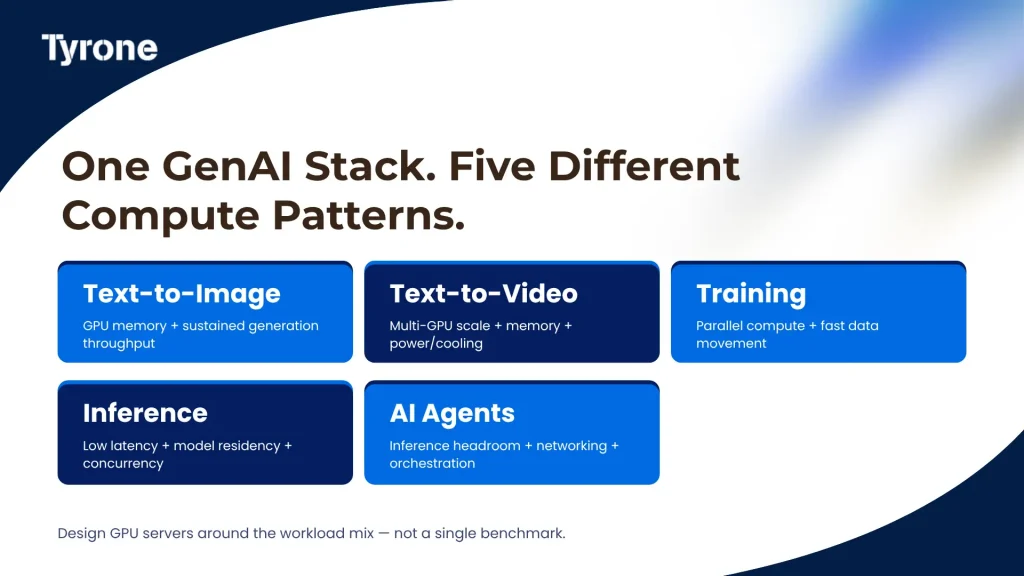
| GenAI Workload | Compute Pattern | Infrastructure Priority |
| Text-to-image | Repeated GPU-heavy generation | GPU memory, sustained throughput, fast data access |
| Text-to-video | Longer, heavier multimodal processing | Multi-GPU scale, memory capacity, cooling and power |
| Training / fine-tuning | Long-duration parallel computation | GPU density, CPU-to-GPU data flow, storage throughput |
| Interactive inference | Short, repeated requests | Low latency, concurrency, model residency |
| AI agents | Multiple linked inference/tool calls | Inference headroom, memory, networking and orchestration |
How to Build the GPU Server Layer Around the Workload
Start with GPU density, but do not stop there
GPU density determines how much accelerator capacity can sit inside a server, but the rest of the platform decides how effectively that capacity is used. CPU capability, system memory, PCIe expansion, local NVMe storage, networking and power delivery all influence whether training and inference stay balanced. A server designed only around the accelerator count can still underperform if data cannot reach those accelerators quickly enough.
Decide where an AI workstation ends and a server begins
An AI workstation can be effective for individual developers, model exploration and smaller local experiments. A GPU server becomes more relevant when teams need shared access, higher GPU density, larger memory pools, enterprise storage integration or sustained multi-user workloads. The choice should follow user count, model size, workload duration and production requirements rather than job title or team size alone.
Design for the full path from development to inference
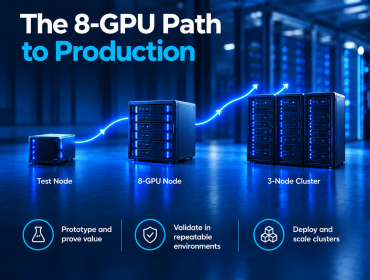
Generative AI infrastructure should make it easier to move from experimentation to deployment. Development teams need flexible environments; training requires sustained compute; inference needs reliable performance; and AI agents introduce repeated model calls and integration with data sources and tools. Planning these stages together reduces the risk of creating one infrastructure island for development and another for every production use case.
Tyrone Camarero for GPU-dense GenAI workloads
For organisations evaluating a GPU-dense server for generative AI, training and inference, Tyrone Camarero is a 4U platform supporting dual AMD EPYC 9005 series processors and up to eight NVIDIA H200 NVL or RTX PRO 6000 Blackwell Server Edition PCIe GPU cards. The platform also supports expandable DDR5 memory up to 4TB, PCIe 5.0 expansion and eight hot-swappable E1.S NVMe drives. These characteristics make it relevant to environments that need high accelerator density alongside CPU, memory and local data throughput.
| Explore the Tyrone Camarero GPU server for generative AI, AI agents, training and inference-ready GPU server deployments: https://tyronesystems.com/servers/PDA200E1MG-48.php |
Conclusion: match the server to the GenAI workload mix
Generative AI is no longer one workload. Text-to-image, text-to-video, model training, fine-tuning, inference and AI agents each create different pressure points across compute, memory, storage and networking. Enterprises that map those workload patterns before choosing infrastructure can build a GPU server layer that supports today’s use cases while leaving room for the next model, modality or agent workflow.
| Evaluating how to size GPU infrastructure for multimodal GenAI? Talk to a Tyrone AI infrastructure specialist about workload mapping, GPU density and deployment requirements. |
Frequently Asked Questions
What are GPU servers for AI?
GPU servers for AI are systems designed with one or more high-performance GPU accelerators, supported by CPUs, memory, storage and networking, to run AI training, fine-tuning and inference workloads.
Why do text-to-image and text-to-video workloads need powerful GPU servers?
Image and video generation repeatedly process large tensors and can require significant GPU memory and sustained throughput, especially as resolution, clip length or batch size increases.
Can AI agents run on the same GPU infrastructure as generative AI models?
Yes. AI agents commonly use the same inference infrastructure, but agentic workflows may generate multiple model calls, retrieval steps and tool interactions, so concurrency and capacity planning become important.
When should an organisation use an AI workstation instead of a GPU server?
An AI workstation can suit individual development and smaller local experiments. A GPU server is more appropriate when teams need shared access, higher GPU density, larger memory capacity or sustained production workloads.