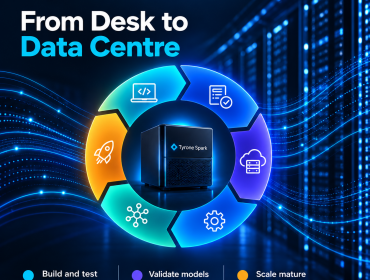
Building an AI data center is not like building a traditional enterprise data center. The workloads are different, the hardware is different, and the failure modes are different. Where conventional infrastructure prioritizes balanced utilization and general-purpose efficiency, an AI data center is engineered for one thing: sustaining maximum throughput from thousands of accelerators, hour after hour, training cycle after training cycle. This demands a holistic blueprint where five interdependent layers—compute, storage, network, cooling, and security—are designed together, not assembled from components optimized for separate purposes. At the core is GPU Infrastructure: dense clusters of accelerators with high memory bandwidth and fast interconnects, scaled to hundreds or thousands of nodes. Surrounding these accelerators is AI Storage Solutions—a parallel file system capable of delivering terabytes per second to every GPU simultaneously, with metadata performance that handles billions of training samples and checkpoint writes that complete before the next training epoch begins. The network fabric must be equally deliberate: RDMA-enabled topologies that eliminate congestion points and provide the low-latency, high-bandwidth east-west communication that distributed training demands. Then comes the often-underestimated layer: cooling. A rack of dense accelerators can consume 10kW or more; scaling to hundreds of racks requires liquid cooling, rear-door heat exchangers, or immersion techniques that traditional HVAC cannot handle. Finally, security must be architected from day one—not bolted on after deployment. This includes hardware-rooted trust, encrypted memory paths, and for regulated industries, Sovereign AI Infrastructure that ensures data never leaves jurisdictional boundaries. Together, these five layers form what industry leaders call an AI Factory—a purpose-built environment for Generative AI and large-scale model training. Whether you are designing a new facility or retrofitting existing space, this blueprint for Enterprise AI Infrastructure provides the framework for Scalable AI Computing that delivers on the promise of production AI. In this infographic, we examine each layer in detail, from GPU-to-storage ratios to cooling power requirements and security architectures, giving infrastructure architects and IT leaders a practical reference for their next AI Data Center project.
Get in touch info@tyronesystems.com