Introduction
As India accelerates its AI ambitions, the lines between AI and high-performance computing (HPC) are rapidly disappearing. The IndiaAI Mission is creating demand for affordable compute, local model development, research acceleration and enterprise AI adoption. To support this shift, organisations need scalable computing infrastructure that can handle training, inference, simulation and scientific workloads together. This blog explains how AI and HPC convergence can support India’s next phase of AI impact.
Why AI and HPC are converging
AI and HPC were once treated as separate infrastructure categories. HPC supported simulation, modelling and scientific computing. AI infrastructure supported model training, inference and data science. Today, the boundary is fading. Large AI workloads need accelerated computing, parallel processing, high-speed storage and advanced networking. HPC environments increasingly need AI-assisted simulation, optimization and analytics. The result is a shared infrastructure agenda.
IndiaAI Mission and compute demand
India’s national AI strategy is increasing the importance of scalable local compute. The IndiaAI Compute Capacity portal states that 18,000+ affordable AI compute units have been made available and that eligible users can access compute at up to 40% reduced cost under the IndiaAI Mission (Source: IndiaAI Mission). Public reporting has also noted expansion of IndiaAI compute capacity beyond 34,000 GPUs (Source: DD News). For enterprises, this confirms a larger market shift: compute access is becoming central to AI competitiveness.
Scalable computing as a strategic layer
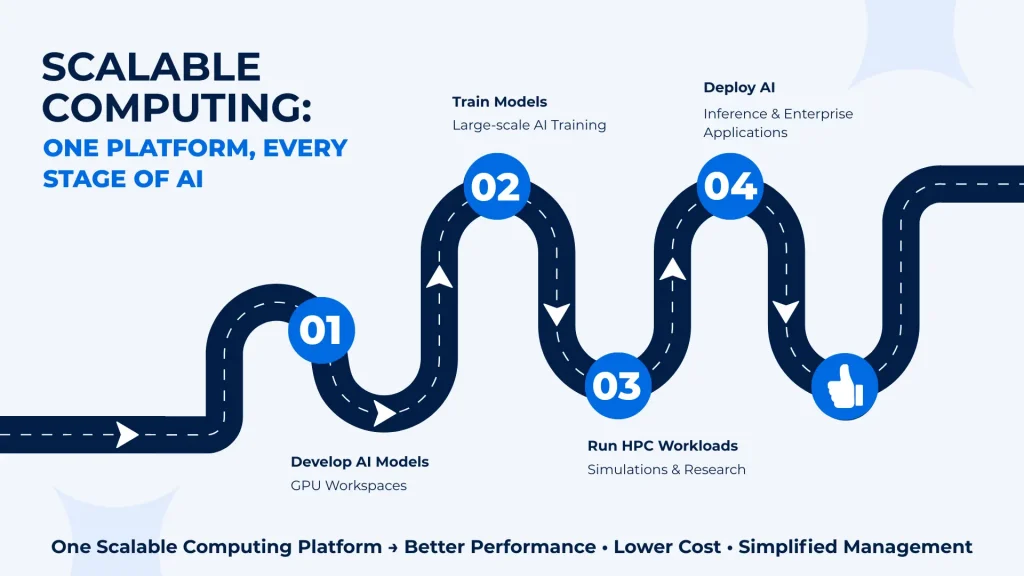
Scalable computing is not only about adding more nodes. It is about designing infrastructure that can grow across workload types. An enterprise may begin with a small AI lab, expand into GPU computing for GenAI, add HPC infrastructure for simulation, then require AI inference infrastructure for production applications. A scalable architecture allows this journey without forcing a complete rebuild at every stage.
How enterprises should plan AI + HPC infrastructure
Stakeholders should plan around workload maturity. Early-stage AI projects need flexible GPU Workspaces and cost visibility. Mature AI programs need reliable training infrastructure, inference infrastructure and governance. Scientific and industrial workloads need HPC clusters, fast storage and robust networking. A combined AI + HPC roadmap helps enterprises avoid fragmented investments and creates a common foundation for research, operations and innovation.
The business case for convergence
The business case is stronger utilization, faster innovation and improved control. When AI and HPC are planned together, organisations can share infrastructure across multiple workload classes. Research teams can accelerate scientific computing. Data science teams can train models faster. Engineering teams can run simulations with better throughput. Leadership gets one scalable computing strategy instead of multiple disconnected infrastructure projects.
Why convergence reduces fragmentation
When AI and HPC are planned separately, organisations often end up with duplicated infrastructure, disconnected data flows and uneven utilization. A converged roadmap helps reduce this fragmentation. It allows leadership to think in terms of shared compute capacity, common governance, compatible storage architectures and workload orchestration across AI and scientific computing.
The stakeholder case for scalable computing
Scalable computing gives enterprises the ability to grow without rebuilding their infrastructure strategy at every stage. A company may start with a GPU workspace, move into model training, add HPC simulations and later deploy production inference. If these stages are planned under one architecture, the organisation can manage cost, performance and governance more effectively.
Aligning with India’s AI future
The IndiaAI Mission is increasing awareness around local compute access, AI model development and sovereign capability. Enterprises that build AI + HPC readiness now can align with this national direction while also serving immediate business needs. This makes HPC solutions an important foundation for India’s scalable AI future.
From cluster to platform thinking
A computational cluster is the starting point, but enterprise AI success requires platform thinking. Leaders need to understand how users access resources, how workloads are scheduled, how data is stored, how results are monitored and how infrastructure scales. This platform view is what transforms AI and HPC from separate technology investments into one scalable computing foundation.
Quick Comparison Table
| Roadmap Stage | Infrastructure Need | Expected Outcome |
| AI Exploration | GPU Workspaces and shared AI lab resources | Faster experimentation and lower setup friction |
| Model Training | AI training infrastructure with accelerated computing | Shorter training cycles and stronger model iteration |
| Scientific Computing | HPC clusters and parallel processing | Faster simulations and research workloads |
| Production AI | AI inference infrastructure and monitoring | Reliable enterprise deployment |
| National Scale Alignment | Sovereign and scalable computing controls | Supports IndiaAI Mission-aligned growth |
The IndiaAI-aligned enterprise roadmap
An IndiaAI-aligned roadmap should begin with local compute readiness, then expand into governed GPU access, HPC-class workloads and production AI infrastructure. This approach helps enterprises participate in India’s AI growth while building internal capability. It also supports a stronger positioning for Indian OEMs and infrastructure providers that can deliver scalable, sovereign and enterprise-ready compute environments.
Tyrone HPC and Skylus AI for scalable AI and HPC infrastructure
Tyrone High Performance Computing (HPC) can support organisations planning AI and HPC convergence by providing scalable infrastructure for simulation, scientific workloads, modelling, AI training and demanding enterprise workloads. Skylus AI GPU Workspaces can serve the AI lab and experimentation layer by improving controlled GPU access, while the Skylus AI Lab Appliance can support governed AI/ML environments. Together, these solutions help enterprises build a phased roadmap across exploration, training, inference, HPC and Sovereign AI readiness.
Scalability should be planned before demand peaks
By the time AI demand becomes urgent, infrastructure gaps are already expensive to fix. Enterprises should plan scalable computing before workloads multiply, so new projects can be absorbed without constant redesign. This also helps finance teams forecast investments in phases rather than approving reactive upgrades under pressure. More importantly, it keeps the infrastructure roadmap connected to business priorities instead of allowing compute decisions to become isolated technical choices.
Conclusion
The IndiaAI Mission is accelerating the conversation around compute access, AI infrastructure, and sovereign capability. For Indian enterprises and institutions, the opportunity is to build scalable computing environments that support both AI and HPC. The future will belong to organisations that can connect GPU computing, HPC infrastructure, data governance, and enterprise AI execution into one practical roadmap for measurable impact. Explore Tyrone HPC’s high-performance AI and HPC solutions with Skylus AI, and build a future-ready infrastructure that delivers the compute power, scalability, and reliability needed to accelerate enterprise innovation.
Frequently Asked Questions
What is AI and HPC convergence?
AI and HPC convergence is the integration of AI infrastructure and High Performance Computing capabilities to support training, inference, simulation and scientific workloads.
Why does the IndiaAI Mission need scalable computing?
The IndiaAI Mission depends on affordable, accessible and high-performance compute capacity for startups, researchers, institutions and enterprises.
How does Tyrone HPC support AI and HPC convergence?
Tyrone HPC supports AI and HPC convergence by providing scalable infrastructure for simulation, scientific computing, modelling, AI training and demanding enterprise workloads.
What should enterprises build first?
Enterprises should start with workload mapping, then design GPU, storage, networking and governance layers that can scale over time.