Introduction
Sovereign AI is becoming a boardroom topic because enterprise AI depends on data, and data sovereignty helps build trust. Indian organisations working with customer records, financial information, public datasets, research IP or regulated workloads cannot treat AI deployment as a generic cloud decision. They need local AI infrastructure that supports Data Sovereignty, governance and performance together. This blog explains why Sovereign AI matters for Indian enterprises moving from AI pilots to production.
Why Sovereign AI matters now
Sovereign AI refers to the ability to develop, deploy and operate AI capabilities within a framework that protects local data, regulatory expectations and national digital priorities. For enterprises, the issue is not only where the model runs. It is where sensitive data is stored, who can access it, how workloads are audited and whether critical AI systems can operate within approved environments. As AI becomes part of customer engagement, operations, analytics and decision-making, these controls become essential.
Data Sovereignty as an enterprise requirement
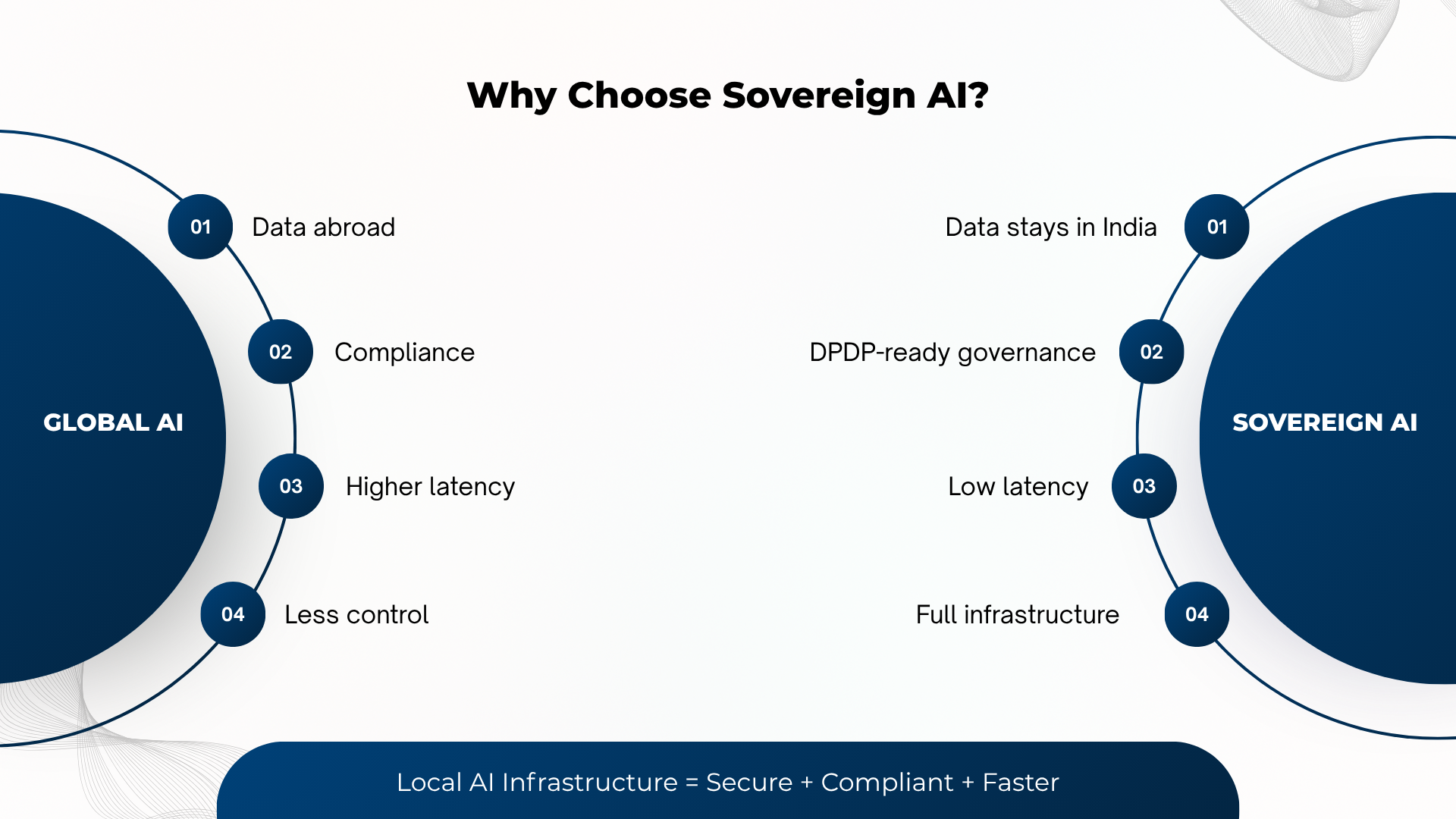
Data sovereignty means that data is subject to the laws and regulations of the jurisdiction in which it is stored, processed, or otherwise handled. For Indian enterprises, this is increasingly relevant in sectors such as BFSI, healthcare, manufacturing, education, public services and research. When data leaves controlled environments without clear governance, AI risk increases. When data stays within well-designed local AI infrastructure, organisations gain stronger control over privacy, compliance and operational continuity.
Local AI infrastructure and control
Local AI infrastructure does not mean avoiding the cloud completely. It means designing a deployment model that gives organisations the right balance of compute access, data control and scalability. Some workloads may run in a private AI lab. Some may require sovereign cloud or on-prem infrastructure. Some may use hybrid environments with strict policies. The strategic point is that AI deployment architecture should follow data sensitivity, business criticality and regulatory exposure.
Why this matters for India
The IndiaAI Mission has a five-year budget outlay of Rs 10,371.92 crore and is focused on making AI in India and making AI work for India (Source: Press Information Bureau). This national direction reinforces why local AI capability matters. As enterprises align with India’s AI ecosystem, Sovereign AI will become a practical requirement for trust, scale and long-term competitiveness.
How to evaluate sovereign AI readiness
Stakeholders should assess whether their AI infrastructure supports workload isolation, role-based access, auditability, secure storage, local deployment options and predictable performance. They should also evaluate whether AI training infrastructure and AI inference infrastructure are treated separately. Training may require large GPU pools and massive datasets, while inference may require latency, uptime and governance. Sovereign AI readiness depends on both.
The business risk of ignoring sovereignty
When AI workloads are deployed without a sovereignty lens, enterprises can expose themselves to data leakage, unclear accountability, vendor lock-in and compliance uncertainty. These risks become more serious when AI systems influence customer decisions, regulatory reporting, intellectual property or operational processes. A Sovereign AI approach allows leaders to innovate while maintaining clearer control over infrastructure, data and policy.
Sovereign AI as a trust advantage
For Indian enterprises, Data Sovereignty can also become a market differentiator. Customers, partners and regulators increasingly expect organisations to explain how sensitive data is used in AI systems. Enterprises that can demonstrate local infrastructure controls, clear access policies and auditable AI workflows will be better placed to build trust around AI-led services.
How local AI infrastructure supports scale
Local AI infrastructure can improve latency, reduce dependency on unsuitable external environments and make governance easier to enforce. It also gives enterprises more flexibility to design dedicated training and inference environments. This does not remove the need for cloud, but it makes architecture choices more deliberate. The strongest approach is often hybrid, with sovereign controls applied where data sensitivity and business criticality demand it.
Building the right governance layer
Sovereign AI requires more than local servers. It needs identity management, role-based access, workload segmentation, encryption, policy enforcement and clear accountability. These controls should be embedded into the AI infrastructure from the start, not added after deployment. When governance is designed into the platform, AI teams can move faster because the operating boundaries are already clear.
Why training and inference need different controls
AI training often uses large historical datasets and experimental pipelines, while inference usually supports live applications and business decisions. Both must be protected, but the risk profile is different. Training infrastructure needs data control and experiment governance; inference infrastructure needs uptime, latency and monitoring. Sovereign AI planning should treat both layers as separate but connected priorities.
Local control supports long-term AI confidence
As more AI systems influence customer journeys, public services and strategic decisions, enterprises will need confidence that infrastructure choices can stand up to scrutiny. Local AI infrastructure gives stakeholders a stronger foundation for accountability, continuity and responsible AI growth.
Skylus AI Lab Appliance for Sovereign AI readiness
A Sovereign AI strategy needs infrastructure that supports local control, governed access and clear workload boundaries. Skylus AI Lab Appliance can support teams that need a GPU-powered AI/ML environment with infrastructure visibility and role-based access. Skylus AI GPU Workspaces can help organisations manage project-level access to shared GPU resources while keeping sensitive AI workloads inside defined governance boundaries. For sovereign scientific computing, training and simulation requirements, Tyrone High Performance Computing (HPC) can provide the scalable compute foundation needed for regulated and high-value workloads.

Conclusion
Sovereign AI is not a policy slogan; it is an enterprise infrastructure strategy. Indian organisations that manage sensitive data need AI environments that balance innovation with control. The enterprises that win will not be the ones that simply adopt AI faster. They will be the ones that build AI infrastructure that protects data, supports scale and creates trusted business impact.
Quick Comparison Table
| Enterprise Question | Why It Matters | Infrastructure Response |
| Where does our AI data reside? | Determines regulatory and security exposure | Local or sovereign storage with clear access controls |
| Who can access GPU workspaces? | Prevents uncontrolled usage of sensitive data | Role-based access and workload isolation |
| Can AI workloads be audited? | Supports governance and compliance | Logging, monitoring and policy enforcement |
| Do training and inference need different controls? | Different workloads carry different risks | Separate architecture for training and production inference |
| Can the infrastructure scale locally? | Avoids dependence on unsuitable external environments | Scalable local AI infrastructure and hybrid design |
Frequently Asked Questions
What is Sovereign AI?
Sovereign AI is the ability to build and operate AI within trusted local, regulatory and governance frameworks.
What is Data Sovereignty?
Data Sovereignty means data is governed according to the rules and expectations of the jurisdiction where it is collected or used.
Why do Indian enterprises need local AI infrastructure?
Local AI infrastructure helps organisations control sensitive data, improve trust and support regulated AI workloads.
Which Tyrone or Skylus solution supports Sovereign AI readiness?
Skylus AI Lab Appliance and Skylus AI GPU Workspaces support Sovereign AI readiness by helping organisations manage local AI/ML environments, role-based access and controlled GPU usage.