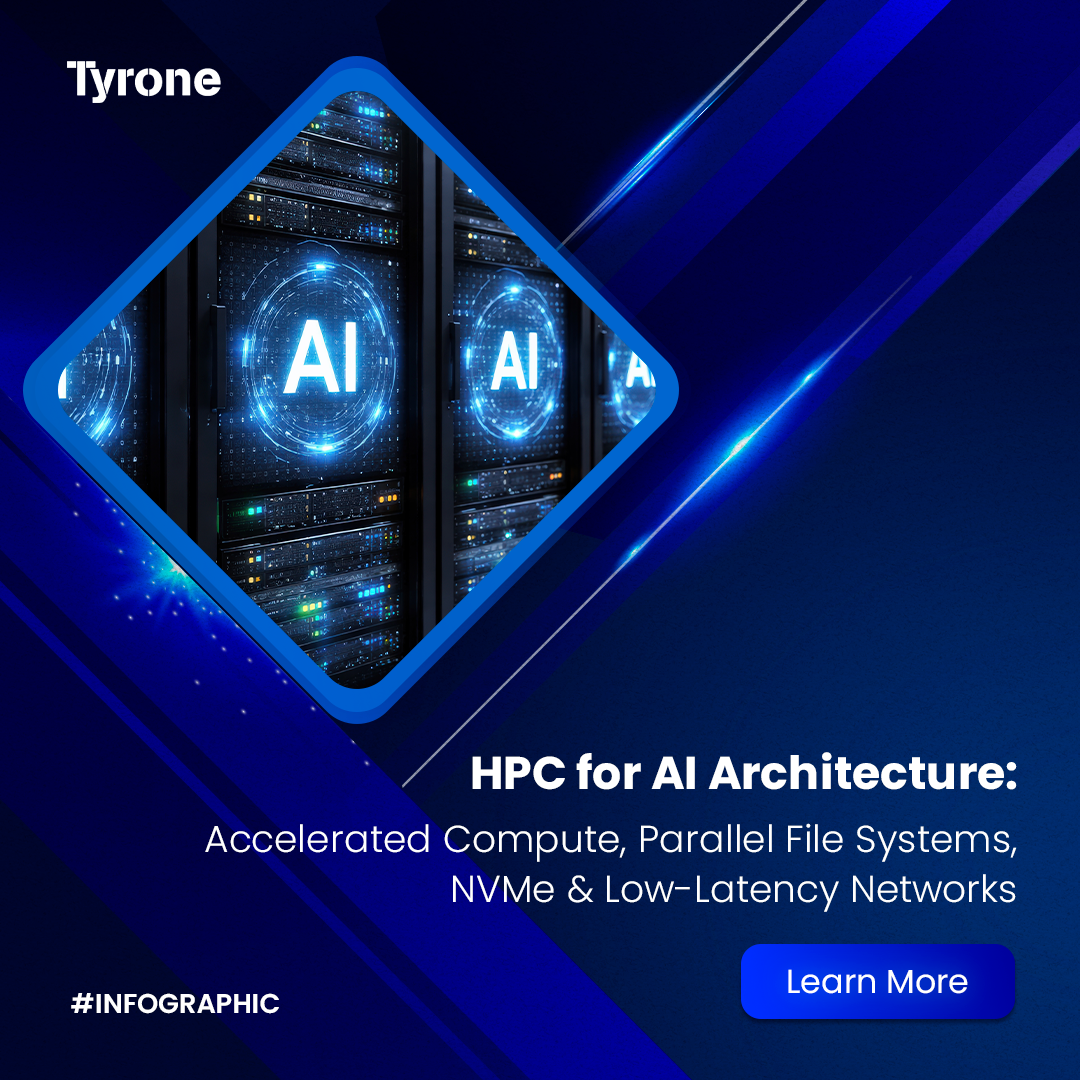
The most sophisticated AI model in the world is useless if the infrastructure beneath it cannot deliver data fast enough, synchronize gradients quickly enough, or scale widely enough. This is where High-Performance Computing (HPC) principles meet artificial intelligence—a convergence that has given rise to a specialized architecture known as HPC for AI. Unlike general-purpose enterprise infrastructure, which prioritizes flexibility and consolidation, HPC for AI is engineered for one mission: sustained, maximum-throughput execution of parallel workloads across thousands of accelerators. The four pillars of this architecture—accelerated compute, parallel file systems, NVMe storage tiers, and low-latency networks—work in concert to eliminate the bottlenecks that starve GPUs and stall training. This post examines each pillar in detail, explaining how they integrate to form the backbone of modern AI Infrastructure for Generative AI and large-scale model development.
1. Accelerated Compute: The Engine of AI Training
- What It Is: Compute nodes equipped with specialized accelerators—predominantly GPUs—designed for the parallel matrix operations that underlie deep learning. Unlike CPUs optimized for sequential, branch-heavy logic, GPUs contain thousands of cores optimized for the simple, parallel arithmetic that neural networks require.
- Why It Matters: Training a large language model on CPUs would take millennia. Accelerated compute collapses training times from years to weeks or days. For Generative AI, where model size doubles approximately every 18 months, the performance gap between CPU-only and GPU-accelerated infrastructure is widening, not narrowing.
- Architectural Considerations: Modern GPU Infrastructure must balance three factors: floating-point throughput (measured in TFLOPS or PFLOPS), memory bandwidth (how fast data moves between GPU memory and compute units), and memory capacity (how large a model or batch fits on a single accelerator). For training, high-bandwidth memory (HBM) is often more critical than peak FLOPs. For inference, memory capacity and latency matter most.
- Scaling Patterns: Single-GPU training gives way to multi-GPU within a node (using NVLink-style interconnects), then to multi-node clusters (using network fabrics). Each scaling tier introduces new challenges in synchronization and communication that the other architecture pillars must address.
2. Parallel File Systems: The Data Delivery Fabric
- What It Is: A storage architecture that distributes file data across multiple servers and storage devices, allowing hundreds or thousands of clients to access the same files in parallel. Unlike traditional network-attached storage (NAS), which presents a single point of service, parallel file systems stripe data across many nodes.
- Why It Matters: AI training workloads read datasets sequentially at high bandwidth. A single training epoch might read tens of terabytes. A parallel file system can deliver 100GB/s or more to a GPU cluster; a standard NAS appliance tops out at a few GB/s. Without parallel file systems, GPUs spend most of their time waiting for I/O.
- Key Features: Look for AI Storage Solutions that offer global namespace (a single view of all data across storage tiers), high metadata performance (handling billions of small files common in image and text datasets), and POSIX compliance (enabling existing AI frameworks to run without modification). Parallel file systems also support tiering—hot data on NVMe, warm data on SSDs, cold data on spinning disk or object storage.
- Deployment Models: Parallel file systems can be deployed on-premise within an AI Data Center, in a sovereign private cloud, or as a hybrid fabric spanning both. The key is consistency: training jobs should see the same data layout regardless of where compute runs.
3. NVMe Storage Tiers: Performance Where It Matters
- What It Is: Non-Volatile Memory Express (NVMe) is a protocol designed for flash storage that bypasses the legacy SAS/SATA bottlenecks. NVMe drives connect directly to the PCIe bus, delivering orders-of-magnitude lower latency and higher parallelism than traditional SSDs.
- Why It Matters: Even the best parallel file system cannot overcome slow underlying media. NVMe provides the raw performance needed for metadata operations (billions of small file lookups), checkpoint writes (completing in seconds rather than minutes), and data preprocessing stages that demand random access.
- Tiering Strategy: In an HPC for AI architecture, NVMe serves as the performance tier. Active training datasets reside on NVMe. Intermediate results and recent checkpoints also use NVMe. Older data, raw inputs, and archived models move to lower-cost flash or spinning media. Intelligent tiering moves data between tiers automatically based on access patterns.
- Capacity Planning: A common mistake is over-provisioning NVMe capacity while under-provisioning throughput. For AI workloads, sustained read bandwidth often matters more than total terabytes. The goal is to keep the GPU cluster data-saturated, not to maximize storage dollars per gigabyte.
4. Low-Latency Networks: The Nervous System of Distributed Training
- What It Is: Network fabrics optimized for the east-west traffic patterns of distributed AI training. This includes RDMA (Remote Direct Memory Access) for bypassing the CPU on data transfers, congestion-controlled topologies that avoid packet loss, and switch architectures designed for all-to-all communication.
- Why It Matters: In distributed training, GPUs synchronize gradients after every batch. For a thousand-GPU cluster, this means millions of synchronization events per second. If the network adds microseconds of latency or loses packets (triggering retransmission), training throughput collapses.
- Fabric Options: Two dominant approaches exist for HPC networks. The first uses InfiniBand, a purpose-built HPC fabric with hardware-level congestion control. The second uses RDMA over Converged Ethernet (RoCE), which runs on standard Ethernet switches with specific configuration for lossless operation. Both can deliver the microsecond-scale latency and 100-400Gbps bandwidth that large-scale AI requires.
- Topology Design: The physical layout of the network matters as much as the technology. Fat-tree and dragonfly topologies are common for AI clusters, providing equal bandwidth between any two nodes (non-blocking). Over-subscription—where total endpoint bandwidth exceeds core switch bandwidth—creates bottlenecks that appear only under full-cluster training loads.
5. Integration: Making the Four Pillars Work Together
- What It Takes: Accelerated compute, parallel file systems, NVMe tiers, and low-latency networks are not independent components. They must be co-designed. A GPU cluster with insufficient storage bandwidth will be I/O-bound. A parallel file system without RDMA support will waste CPU cycles on data movement. A low-latency network connected to slow storage still delivers slow I/O.
- Performance Balance: HPC for AI architects speak of “balanced design”—ensuring no single component is the persistent bottleneck. A common heuristic: 1GB/s of storage throughput per GPU for training workloads. For a 256-GPU cluster, this implies 256GB/s of parallel file system bandwidth. Network bandwidth should match or exceed storage bandwidth. NVMe capacity should be sized to hold active datasets and checkpoints.
- Monitoring and Iteration: No architecture is perfectly balanced at first. Instrumentation is critical: measure GPU utilization, storage throughput, network congestion, and NVMe latency simultaneously. When utilization drops, identify which pillar is the limiting factor and adjust.
6. The Sovereign and Enterprise Context
- For Sovereign AI Infrastructure: HPC for AI principles apply regardless of jurisdiction. The difference is where the infrastructure sits. Sovereign deployments require that all four pillars—compute, storage, networking, and their management—operate within national boundaries. This often means building dedicated AI Data Centers rather than relying on cross-border cloud resources.
- For Enterprise AI Infrastructure: Not every organization needs a thousand-GPU cluster. The principles scale down. A four-GPU server with local NVMe and a fast Ethernet switch embodies the same HPC for AI architecture at smaller scale. The key is avoiding the trap of treating AI workloads as just another application on general-purpose infrastructure.
Conclusion: Architecture Determines Outcome
HPC for AI is not a product—it is a set of architectural principles. Accelerated compute provides the raw power. Parallel file systems deliver the data. NVMe tiers provide the speed where it matters most. Low-latency networks enable coordination across thousands of accelerators. Together, these four pillars form the foundation of an AI Factory capable of sustained, high-throughput training for the largest Generative AI models. Organizations that master this architecture will train faster, scale further, and innovate quicker than those that treat AI infrastructure as a collection of commodity components. This inforgraphic has outlined the pillars; future posts will dive deeper into each, with implementation patterns and performance benchmarks for Scalable AI Computing.
Get in touch info@tyronesystems.com