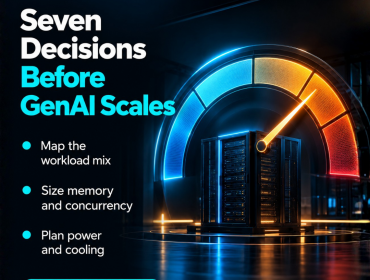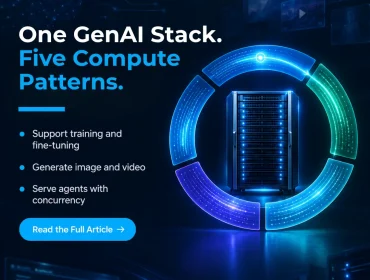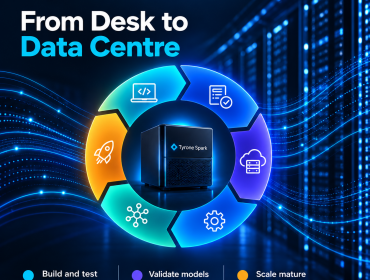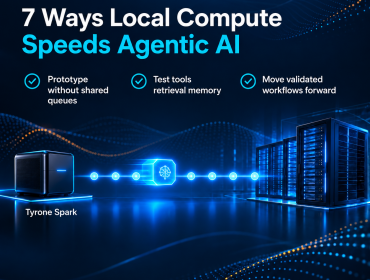
The rise of generative AI and large-scale model training has given birth to a new infrastructure paradigm: the AI Factory. Unlike traditional data centers designed for general-purpose enterprise workloads—virtual machines, databases, and web servers—an AI Factory is engineered from the ground up for the unique demands of AI Infrastructure. The differences span every layer: compute density, storage architecture, network topology, cooling methodology, and security posture. For enterprises building national AI capabilities or scaling enterprise-wide generative AI, understanding these distinctions is not academic—it is the difference between a successful deployment and a stalled initiative.
1. Compute Architecture: Throughput-Optimized vs. General-Purpose
- Traditional Data Center: Compute resources are balanced across CPU cores, memory, and local storage. Virtualization is the norm, with oversubscription acceptable. Workloads are I/O-bound or latency-sensitive, but not typically compute-saturated for sustained periods.
- AI Factory: Dominated by GPU Infrastructure with thousands of accelerators operating in parallel. Training runs can last days or weeks at 100% utilization. The architecture assumes continuous, peak compute demand rather than bursty, average utilization. Scalable AI Computing means scaling from dozens to thousands of GPUs without redesigning the underlying fabric.
2. Storage: Parallel Throughput vs. General-Purpose IOPS
- Traditional Data Center: Storage performance is measured in IOPS (input/output operations per second) and low-latency random access. Workloads like databases and email servers require fast access to small, random blocks of data.
- AI Factory: Requires AI Storage Solutions measured in GB/s or TB/s of sustained sequential throughput. A single training epoch may read terabytes of data sequentially. Checkpoint writes must complete within seconds to avoid stalling hundreds of GPUs. Parallel file systems replace traditional network-attached storage or SAN architectures to deliver the concurrency that Generative AI demands.
3. Network Fabric: East-West Heavy vs. North-South Heavy
- Traditional Data Center: Network traffic is predominantly north-south (client to server) with moderate east-west (server to server). Standard Ethernet with TCP/IP suffices for most workloads.
- AI Factory: Traffic is overwhelmingly east-west, with GPUs synchronizing gradients and sharing model states thousands of times per second. This requires RDMA-capable fabrics with microsecond latency and zero packet loss. The network is not a peripheral—it is a core component of HPC for AI architecture.
4. Cooling and Power: High-Density Engineering vs. Standard Racks
- Traditional Data Center: Rack densities typically range from 5kW to 15kW per rack. Air cooling with hot-aisle/cold-aisle containment is standard. Power redundancy is planned for peak but not continuous maximum draw.
- AI Factory: Rack densities often exceed 40kW to 100kW per rack when populated with dense accelerators. Air cooling becomes insufficient; liquid cooling, direct-to-chip cooling, or immersion cooling is required. Power infrastructure must assume continuous maximum draw for weeks-long training runs. Thermal management is a primary design constraint, not an afterthought.
5. Security: Data-in-Use Protection
- Traditional Data Center: Security focuses on data-at-rest encryption and data-in-transit protection. Access controls are identity-based. Threats are primarily external.
- AI Factory: Model weights and training datasets are intellectual property of the highest value. Sovereign AI Infrastructure adds requirements for data residency, hardware-rooted trust, and encrypted memory paths (confidential computing). Threats include model extraction, inversion attacks, and insider risks. Security must protect data not only at rest and in transit but also during active computation.
6. Operational Model: Job Scheduling vs. Virtual Machine Orchestration
- Traditional Data Center: Managed via hypervisors and virtual machine orchestration. Workloads are long-running services such as web servers and databases with high availability requirements.
- AI Factory: Managed via job schedulers designed for HPC for AI. Training jobs have start and end times, consume all available resources during execution, and require checkpointing for resilience. The operational model treats compute as a batch resource, not an always-on service.
7. Data Lifecycle: Training Pipeline vs. Transactional Processing
- Traditional Data Center: Data follows a relatively simple path: ingest, store, query, archive. Data remains in structured formats for databases.
- AI Factory: Data moves through a complex pipeline: raw ingestion, preprocessing, augmentation, feature extraction, training, checkpointing, validation, inference, and continuous retraining. Each stage has different I/O patterns and performance requirements. The storage architecture must support this entire lifecycle without data copying or staging delays.
Conclusion: Why the Distinction Matters
For organizations building national AI capabilities or enterprise-wide generative AI programs, treating an AI workload as just another application on traditional Enterprise AI Infrastructure is a recipe for failure. The AI Data Center or AI Factory is a specialized environment requiring intentional design across compute, storage, network, cooling, and security. As Generative AI moves from pilot to production, infrastructure leaders must decide: evolve existing facilities or build new ones purpose-engineered for the AI era. This video has outlined the key differences; future posts will dive deeper into each layer with practical implementation guidance.
Get in touch info@tyronesystems.com