Sovereign AI is becoming a boardroom requirement because the next phase of enterprise AI will not be judged only by model performance. It will be judged by whether organisations can prove where data lives, who can access it, how AI decisions are governed and whether infrastructure choices reduce compliance exposure. For Indian enterprises, this makes data sovereignty and enterprise AI security business-critical infrastructure priorities, not just technical preferences.
The pressure to deploy AI is rising quickly, Avalara research released in July 2026 found that 27% of Indian finance leaders said accountability for significant AI agent errors was unclear or sat with no one. That is exactly the kind of gap Sovereign AI needs to close. When AI moves into finance, healthcare, public services, research or customer decisioning, unclear accountability becomes a business risk.
Why Sovereign AI is becoming a business Opportunity
Sovereign AI gives organisations a structured way to build and operate AI within trusted local frameworks. It connects infrastructure location, data governance, role-based access, workload isolation, audit logs and operational control. The business case is simple: enterprises need AI systems that can scale without weakening compliance, privacy or trust.
A model may be powerful, but if the data pipeline is uncontrolled, the access model is unclear or the deployment location creates regulatory exposure, the business value becomes fragile. Sovereign AI helps leadership move from a speed-first AI approach to a controlled growth model where innovation and accountability can move together.
How compliance and AI security connect
Compliance AI is not only about satisfying auditors after the fact. It is about designing systems where controls are built into the operating model before sensitive workloads go live. Enterprise AI security depends on the same foundation: identity, access, monitoring, isolation and clear ownership. When these controls are embedded into AI infrastructure, teams can move faster because the guardrails are already defined.
This is especially important for AI agents and automated decision systems. If an AI system recommends actions, processes sensitive records or influences operational decisions, leadership must be able to explain how the system is governed. Sovereign AI turns that requirement into an infrastructure strategy.
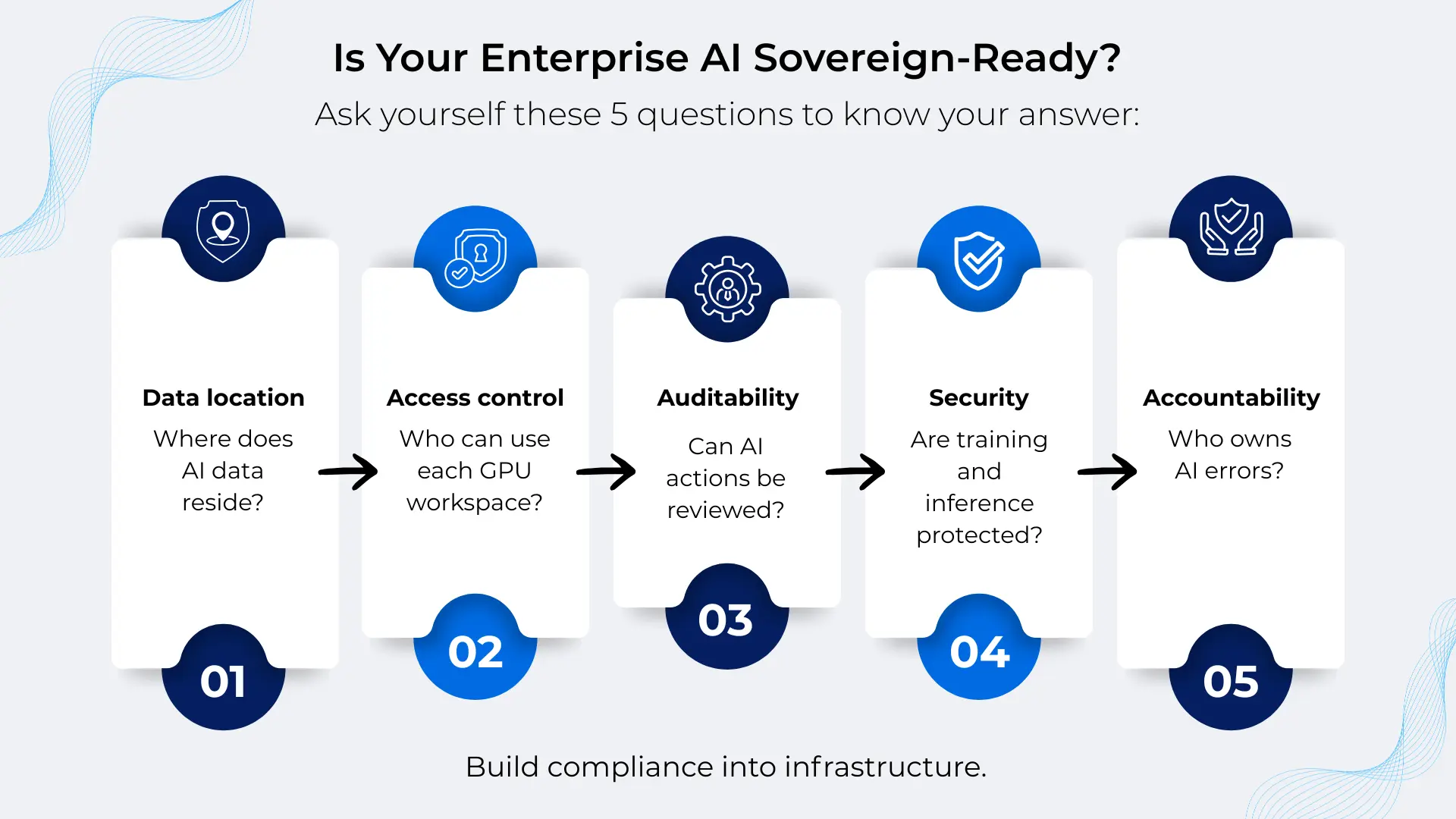
Compliance-first AI vs uncontrolled AI
| Area | Uncontrolled AI Growth | Sovereign AI Approach |
| Data location | Data may move across unclear environments | Data residency and approved deployment zones are defined |
| Access | Users and teams share resources informally | Role-based access aligns users, projects and workloads |
| Auditability | Limited visibility into model or agent actions | Logs, monitoring and ownership support review |
| Security | Controls are added after deployment | Security is designed into the infrastructure layer |
| Business value | Fast pilots but higher compliance uncertainty | Scalable AI with stronger trust and accountability |
Build your AI lab with Skylus AI. Explore GPU Workspaces, RBAC, GPU slicing, resource composability and real-time monitoring for controlled AI environments: https://tyronesystems.com/skylus.ai/index.php
Building a sovereign AI operating model
A practical Sovereign AI operating model begins with workload classification. Teams should separate low-risk experimentation from sensitive training, production inference and regulated decision workflows. Each category needs a different level of control. Some workloads may need shared GPU workspaces, while others may need stricter isolation, auditability and deployment governance.
The operating model should also clarify ownership. Who approves access? Who reviews sensitive datasets? Who monitors usage? Who signs off when AI moves from lab to production? These questions matter because infrastructure alone cannot create trust unless governance responsibilities are visible.
Solution fit: Skylus AI for controlled AI labs
Towards the implementation layer, Skylus AI fits the build-your-AI-lab intent by helping enterprises move from policy discussion to governed AI lab execution. Its GPU Workspaces, GPU slicing, RBAC, resource composability and real-time monitoring help teams structure how users access and manage shared GPU resources.
Placed near the end of a Sovereign AI roadmap, Skylus AI becomes the practical bridge between compliance planning and day-to-day AI development. It gives infrastructure teams a clearer way to support controlled experimentation, sensitive workload governance and scalable AI lab operations.
Conclusion
Sovereign AI is not a slower version of enterprise AI. It is the foundation that allows sensitive AI workloads to scale with stronger trust, governance and security. If your enterprise is evaluating Sovereign AI infrastructure, this is the right time to assess AI lab design, GPU access, workload isolation and compliance readiness. Speak with Tyrone/Netweb for a demo or consultation on building a Sovereign AI infrastructure roadmap: https://tyronesystems.com/skylus.ai/index.php
Frequently Asked Questions
What is Sovereign AI?
Sovereign AI is the ability to build, deploy and operate AI within trusted local, regulatory and governance frameworks.
Why does Sovereign AI matter for Indian enterprises?
It helps organisations manage sensitive data, comply with local expectations, protect workloads and build trust in AI-led decisions.
How does data sovereignty connect with enterprise AI security?
Data sovereignty defines where data lives and how it is controlled, while enterprise AI security protects access, workloads, models and operational workflows.
Where does Skylus AI fit in a Sovereign AI strategy?
Skylus AI supports GPU workspaces, role-based access, resource composability and monitoring, making it relevant for governed AI labs and controlled infrastructure environments.